TL;DR:
- Combination aesthetic treatments use multiple procedures simultaneously to target different skin layers and aging mechanisms, resulting in superior, natural results. Proper sequencing and spacing, such as waiting four to six weeks after laser resurfacing before injections, ensure safety and effectiveness. Not all patients are suitable, but well-planned multi-modal protocols enhance satisfaction, durability, and skin health.
A combination aesthetic treatment is the simultaneous or sequential use of two or more complementary cosmetic procedures to achieve skin rejuvenation and anti-ageing results that no single modality can match alone. The principle is synergy: each treatment targets a different layer of skin or a different mechanism of ageing, so the combined effect is greater than the sum of its parts. A 2025 systematic review of 29 studies confirmed that combining biostimulators, neuromodulators, fillers, and energy-based devices produces superior improvements in skin texture, elasticity, and contour compared to single treatments. That finding reflects what experienced practitioners at Cosmolaser observe every day: patients with multi-dimensional ageing concerns achieve more natural, harmonious outcomes when their plan addresses muscle activity, volume loss, and skin quality at the same time.
What is a combination aesthetic treatment and how does it work?
Combination therapy in aesthetics is built on the idea that facial ageing is never a single problem. Volume depletes, collagen breaks down, muscles create dynamic lines, and skin texture deteriorates, often all at once. Targeting only one of these pathways leaves the others untreated, which is why single treatments frequently produce results that look incomplete.
The most widely used combination pairs neuromodulators and dermal fillers. Botulinum toxin relaxes the muscles responsible for dynamic wrinkles such as frown lines and crow’s feet, while hyaluronic acid fillers restore lost volume in the mid and lower face. Because they act on entirely different structures, they do not interfere with each other and can safely be administered in the same appointment.

Beyond injectables, energy-based devices add a third dimension. Radiofrequency microneedling, for example, creates microscopic columns of controlled thermal injury in the dermis to stimulate collagen remodelling. Paired with a chemical peel that resurfaces the epidermis, the two procedures address both deep structural laxity and surface texture in a single treatment plan. Similarly, microneedling combined with platelet-rich plasma (PRP) uses the growth factors in the patient’s own blood to accelerate the healing and collagen response triggered by the needling.
Skin boosters and collagen biostimulators occupy a distinct category. They do not add structural volume; instead, they improve the baseline quality of the tissue itself, making it more receptive to subsequent treatments. This is the foundation of the regenerative-first approach discussed in the next section.
Pro Tip: When considering combination aesthetic procedures, ask your practitioner to explain which layer of skin each treatment targets. If two treatments address the same layer, they may be redundant rather than synergistic.
What are the proven benefits of combining aesthetic treatments?
The benefits of combination treatments extend well beyond aesthetics. Patients who receive multi-modal plans report measurably higher satisfaction. A 2023 study found a 40% higher satisfaction rate among patients receiving combination therapy compared to those receiving single treatments. That gap exists because combination plans address the full picture of a patient’s concerns rather than one isolated issue.
The clinical advantages include:
- More natural results. Addressing dynamic wrinkles, static volume loss, and skin quality together produces a balanced appearance rather than the “treated in one area only” look.
- Longer-lasting outcomes. Regenerative treatments such as biostimulators prime the tissue for better filler integration, extending the durability of the result.
- Fewer total sessions. A well-sequenced plan can consolidate what would otherwise require multiple separate courses of treatment.
- Improved skin resilience. Combining collagen-stimulating modalities with surface treatments builds healthier skin over time, not just a cosmetic correction.
- Simultaneous correction. Patients with both laxity and pigmentation concerns, for example, can address both within one planned programme rather than waiting months between separate courses.
A regenerative-first approach, which uses biostimulators or skin boosters before structural volume replacement, optimises the tissue environment. The result is more natural integration of fillers and a longer-lasting overall outcome. This is not simply a preference; it reflects the biological reality that healthier tissue responds better to every subsequent treatment.
The caution here is equally important. Combining treatments amplifies both benefits and risks. Poorly chosen combinations, or combinations performed without adequate recovery intervals, can produce prolonged downtime, inflammatory complications, or results that are difficult to attribute to a specific cause.
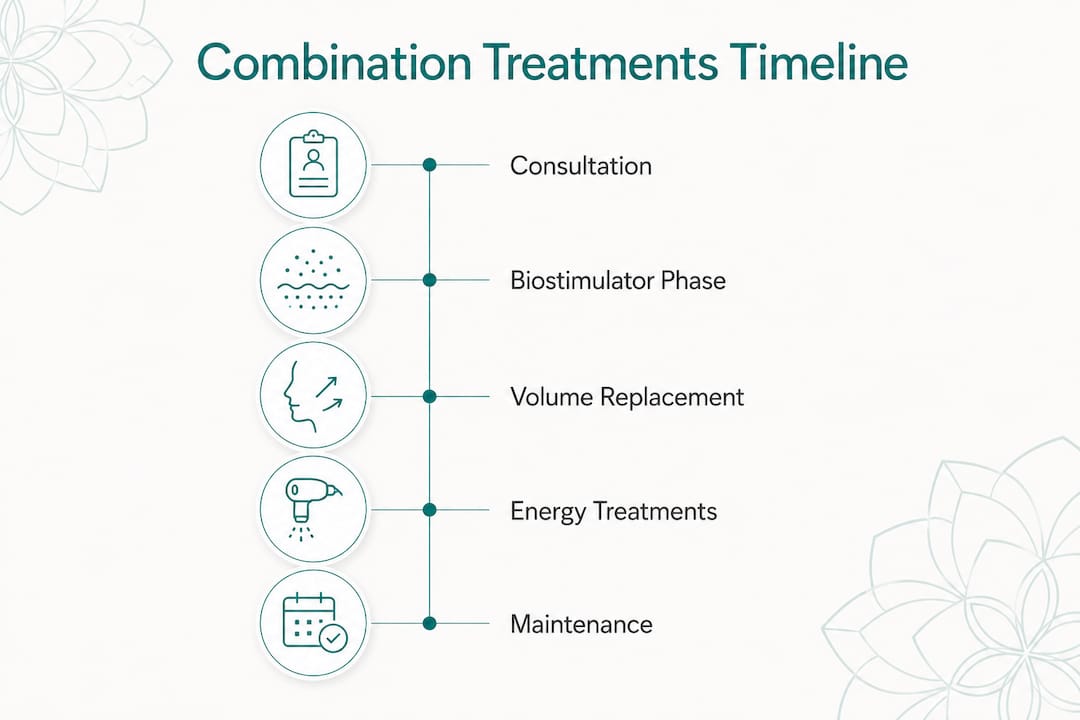
How should combination treatments be scheduled and sequenced?
Sequencing is the most technically demanding aspect of combination aesthetic procedures. The order and timing of treatments directly affect both safety and efficacy. Getting this wrong does not just reduce results; it can cause complications that are difficult to reverse.
The table below summarises the standard recommended intervals for common treatment pairs.
| Treatment combination | Recommended interval | Rationale |
|---|---|---|
| Neuromodulator + dermal filler | Same day (different areas) | No interaction; targets distinct facial layers |
| Ablative laser + dermal filler | 4–6 weeks post-laser | Filler injected before laser can degrade or cause inflammation |
| Chemical peel + neuromodulator | 2 weeks apart | Allows skin barrier to recover before injection |
| Microneedling + PRP | Same session | PRP applied immediately post-needling for maximum absorption |
| Energy device + biostimulator | 2–4 weeks apart | Reduces cumulative inflammatory burden |
Clinical guidelines recommend spacing non-overlapping procedures 2–4 weeks apart. Ablative laser resurfacing requires a 4–6 week recovery window before any injectable treatment. This interval matters because filler placed into skin that is still healing from thermal injury risks degradation and localised inflammation.
The rule on same-day combinations is equally clear. Experienced practitioners limit same-day treatments to two modalities to avoid overwhelming the skin’s inflammatory response. Limiting to two also means that if an adverse reaction occurs, the cause is far easier to identify and manage.
Energy-based treatments should generally precede injectables when both are planned in the same programme. Laser or radiofrequency energy applied over an area containing filler carries a risk of filler degradation and unpredictable tissue response. Performing the energy treatment first, then allowing full recovery, removes that risk entirely.
Pro Tip: Ask your practitioner for a written treatment timeline before your first appointment. A clear sequence with dates and recovery windows is a sign of a well-planned protocol, not unnecessary complexity.
Who is best suited for combination aesthetic treatments?
Not every patient is a candidate for multi-modal protocols, and recognising that distinction is as important as understanding the benefits. The right candidate has specific, multi-dimensional concerns that genuinely require more than one modality to address.
Factors that support suitability include:
- Multi-dimensional ageing. Patients with simultaneous volume loss, dynamic lines, and skin texture changes benefit most from combination planning.
- Good baseline healing capacity. Patients with well-controlled health and no active inflammatory skin conditions tolerate combination protocols more safely.
- Realistic expectations. Combination treatments improve appearance progressively. Results from collagen biostimulators, for example, develop over several months, not days.
- Commitment to maintenance. Multi-modal results require ongoing care. A single course of treatment is rarely the endpoint.
Patients with sensitive skin, active inflammatory disorders such as rosacea in a flare, or compromised healing capacity require careful assessment before any combination plan is designed. The same applies to patients on anticoagulant medication, where the risk of bruising from multiple injection sites is compounded.
The principle that combination treatments follow facial subunits rather than isolated problem areas is central to good candidacy assessment. A practitioner who evaluates the face as a whole, rather than responding to individual complaints in isolation, is far more likely to design a plan that produces genuine harmony. Cosmolaser’s consultation process is built on exactly this approach, assessing anatomy, skin type, lifestyle, and goals before recommending any combination protocol.
The phrase “more is not always better” is not a cliché in this context. It is a clinical principle. Quality of selection and sequencing consistently outperforms quantity of treatments.
What are the common myths and pitfalls in combination aesthetic procedures?
Several misconceptions lead patients and, occasionally, practitioners into unsafe territory. Addressing them directly protects both outcomes and safety.
- Myth: Combining all available treatments at once maximises results. Stacking multiple resurfacing methods, such as ablative laser, chemical peel, and microneedling, in rapid succession does not accelerate improvement. It overwhelms the skin’s repair capacity and prolongs downtime significantly.
- Pitfall: Ignoring recovery intervals. Skipping the recommended 2–4 week spacing between non-overlapping treatments is the most common sequencing error. The skin needs time to complete its inflammatory and repair cycle before the next stimulus is applied.
- Pitfall: Treating incompatible modalities as interchangeable. Filler placed before laser resurfacing is a well-documented risk. The thermal energy from the laser can degrade the filler material and trigger a localised inflammatory response.
- Myth: Any qualified injector can design a combination plan. Combination treatments require molecular-level knowledge of interactions between modalities. A practitioner who understands only individual treatments is not equipped to manage the compounded risks of combining them.
Combination treatments are not about doing more. They are about doing what is right. Layering treatments without a clear scientific rationale risks suboptimal results and complications that are far harder to resolve than the original concern.
Patient education is not optional in this context. Patients who understand why their plan is sequenced as it is are more likely to follow recovery instructions, attend follow-up appointments, and report adverse reactions promptly. Communication between patient and practitioner is a clinical tool, not an administrative formality.
Key takeaways
Combination aesthetic treatments deliver superior results only when each modality is chosen for a specific biological purpose and sequenced with proper recovery intervals.
| Point | Details |
|---|---|
| Definition and principle | Combination treatments use two or more complementary procedures to target different skin layers and ageing mechanisms simultaneously. |
| Satisfaction advantage | A 2023 study found a 40% higher satisfaction rate in patients receiving combination therapy versus single treatments. |
| Sequencing is critical | Ablative laser requires 4–6 weeks before injectables; same-day combinations should be limited to two modalities. |
| Regenerative-first approach | Starting with biostimulators or skin boosters before fillers improves tissue quality and extends result longevity. |
| Quality over quantity | More treatments in one session does not mean better results; scientific rationale and proper spacing determine outcomes. |
A practitioner’s perspective on getting combination treatments right
I have seen the full spectrum of outcomes from combination aesthetic treatments, from genuinely transformative results to complications that took months to resolve. The difference almost always comes down to one thing: whether the plan was driven by biology or by enthusiasm.
The facial subunit approach is the framework I return to consistently. The face is not a collection of isolated problems. It is a system of interrelated structures, and treating one area without considering its relationship to the others produces results that look corrected rather than natural. When I design a combination plan, I am thinking about how the upper, mid, and lower face interact, not just where the patient has pointed to a concern.
The regenerative-first principle has changed how I sequence treatments for most patients. Beginning with collagen biostimulators or skin boosters before introducing structural fillers consistently produces better tissue integration and longer-lasting volume. The biology supports it: healthier tissue holds filler more effectively and responds more predictably to energy-based treatments.
The hardest conversation I have with patients is the one about restraint. The instinct, understandably, is to address everything at once. My role is to explain why a staged, well-spaced plan produces a better result than an aggressive single session. Patients who understand the science behind the sequencing are far more satisfied with their outcomes, because they know what to expect and why.
If you are considering combination aesthetic procedures, the single most important question to ask your provider is: “What is the scientific rationale for combining these specific treatments in this specific order?” A confident, detailed answer is the clearest indicator of a practitioner who will keep you safe.
— Dr Anoop Suresh Babu
Combination aesthetic treatments at Cosmolaser
Cosmolaser’s team of licensed doctors and aesthetic specialists in Sharjah designs every combination treatment plan around a thorough clinical assessment. No two patients receive the same protocol, because no two patients present with identical anatomy, skin type, or goals.
The clinic offers botulinum toxin, hyaluronic acid fillers, radiofrequency microneedling, CO2 fractional laser, chemical peels, skin boosters, and collagen biostimulators, all delivered by practitioners with the molecular-level understanding that safe combination therapy requires. For patients who want to understand the full range of options available, the skin rejuvenation guide covers multi-modal strategies in detail. To explore what a personalised combination plan might look like for your specific concerns, consult the licensed aesthetician guide or book a consultation directly with the Cosmolaser team.
FAQ
What is a combination aesthetic treatment in simple terms?
A combination aesthetic treatment uses two or more cosmetic procedures together to address different causes of skin ageing simultaneously. The goal is to achieve more natural and longer-lasting results than any single treatment can produce.
Can neuromodulators and fillers be done on the same day?
Yes. Neuromodulators and dermal fillers are the most widely practised same-day combination because they target different facial layers and areas without interacting. Botulinum toxin addresses dynamic wrinkles in the upper face, while fillers restore volume in the mid and lower face.
How long should I wait between combination treatments?
Non-overlapping procedures should be spaced 2–4 weeks apart to allow the skin’s inflammatory response to settle. After ablative laser resurfacing, a minimum of 4–6 weeks is required before any injectable treatment.
Are combination treatments suitable for all skin types?
Most skin types can benefit from combination protocols when the plan is designed by a qualified practitioner who accounts for Fitzpatrick skin type, healing capacity, and any active skin conditions. Patients with inflammatory disorders or compromised healing require individual assessment before proceeding.
Is it safe to combine more than two treatments in one session?
Combining more than two invasive treatments in a single session increases recovery time and makes it significantly harder to identify the cause of any adverse reaction. Experienced practitioners typically limit same-day combinations to two modalities for both safety and diagnostic clarity.