
TCA CROSS (Chemical Reconstruction of Skin Scars) is the focal application of high-concentration trichloroacetic acid directly into atrophic acne pits to trigger local collagen remodeling. It is most effective for ice-pick scars and selected narrow boxcar scars, and it should only be performed by a trained dermatologist. A 2026 comprehensive review covering 937 patients across 34 publications reported improvement rates commonly in the 50–80% range, with transient pigmentary changes as the most frequently observed adverse effect.
Best candidates for TCA CROSS:
- Ice-pick scars (narrow, deep pits): highest response rate
- Narrow boxcar scars: moderate response
- Rolling scars: generally low response; subcision is usually the better primary tool
Safety caveat: TCA CROSS uses concentrations of 70–100% acid. Attempting this at home is dangerous and can permanently worsen scars. Always consult a qualified dermatologist for scar mapping and treatment planning before proceeding.
Key Takeaways
TCA CROSS is an evidence-supported focal chemical technique that produces meaningful improvement in ice-pick and narrow boxcar acne scars when performed by a trained clinician, assessed at 3–6 months, and combined with adjunct treatments for mixed-scar presentations.
| Point | Details |
|---|---|
| Best scar type for TCA CROSS | Ice-pick scars respond most reliably; narrow boxcar scars moderately; rolling scars need subcision instead. |
| Realistic improvement range | Published studies report improvement commonly in the 50–80% range across multiple sessions. |
| Assessment timeline | Judge durable results at 3–6 months after the final session, not during early edema. |
| Pigmentation risk | Fitzpatrick IV–VI patients need pre-treatment brightening agents and strict post-procedure sun protection. |
| Combination therapy | Mixed-scar faces almost always benefit from subcision, CROSS, and a resurfacing modality in sequence. |
| Cosmolaser Medical Centre | Offers dermatologist-led scar mapping and combination treatment plans in Sharjah for UAE patients. |
This article is general information, not a substitute for advice from a qualified doctor. Consult a qualified healthcare professional about your own circumstances before acting on anything here.
Table of Contents
- How do TCA CROSS scars actually heal?
- Which scar types respond best to TCA CROSS?
- How TCA CROSS is performed in clinic
- What results look like and when to judge them
- What the clinical evidence shows
- How TCA CROSS fits into a multimodality plan
- Complications and how clinicians manage them
- Day-by-day recovery after TCA CROSS
- Who should not have TCA CROSS?
- Clinician tips drawn from the evidence
- What to ask before booking a TCA CROSS appointment
- A perspective on TCA CROSS and what patients often miss
- Cosmolaser Medical Centre: scar assessment and TCA CROSS in Sharjah
- Sources
- FAQ
How do TCA CROSS scars actually heal?
TCA CROSS works through a precise, controlled injury. When high-concentration trichloroacetic acid touches the base and walls of an atrophic pit, it causes immediate protein coagulation, which appears clinically as “frosting” — a white discoloration at the treated site. That focal injury sets off an inflammatory cascade: the body recruits fibroblasts to the damaged dermis, and those fibroblasts produce new collagen. Over weeks to months, that neocollagenesis gradually raises the floor of the scar pit toward the surrounding skin surface.
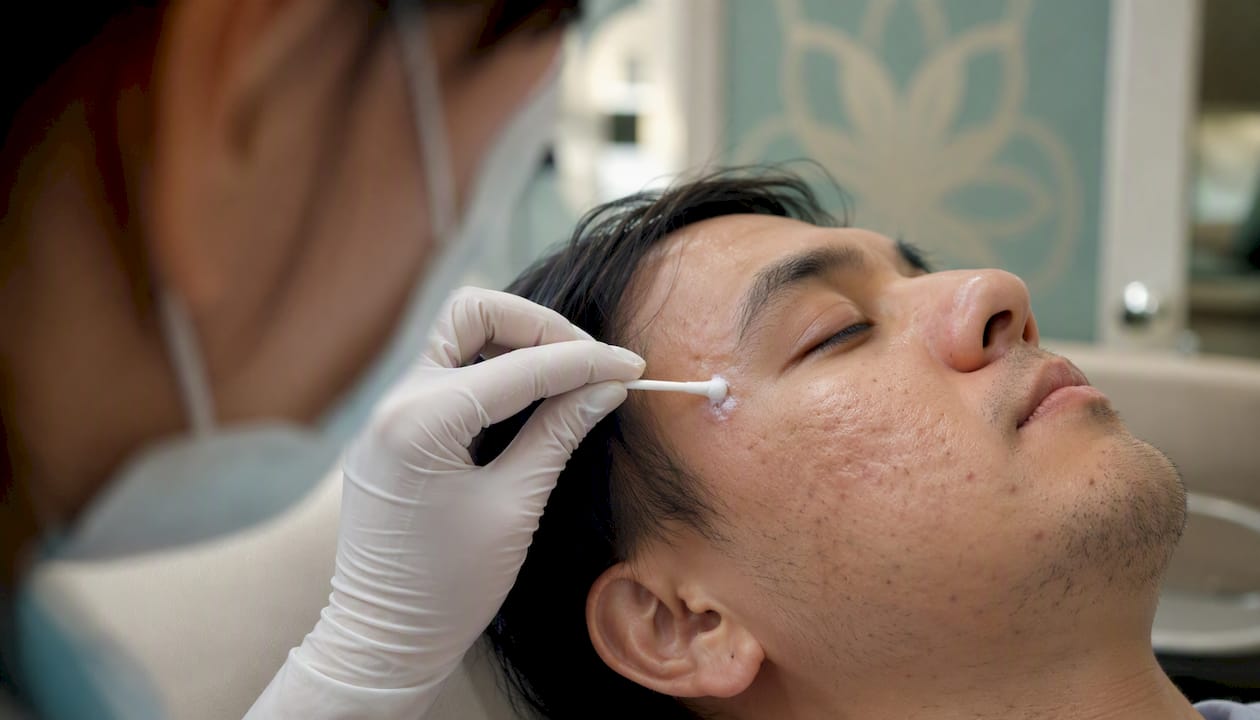
The frosting endpoint is not cosmetic. It signals that the acid has reached sufficient dermal depth to provoke remodeling. A faint frost indicates superficial penetration; a dense, firm white frost suggests deeper dermal contact. Clinicians monitor frosting in real time and stop application once the target endpoint is reached, because over-frosting risks deeper injury and a higher complication rate.
Concentration matters significantly. Higher concentrations produce deeper injury and faster visible response, but the risk of complications scales with concentration as well. A clinician choosing between 70% and 100% is balancing depth of remodeling against pigmentary risk, particularly in patients with darker skin tones. The chemical peel protocols at Cosmolaser Medical Centre follow the same concentration-and-depth logic applied to individual patient assessment.
Which scar types respond best to TCA CROSS?
Not all acne scars are the same, and choosing the wrong tool is the most common reason patients see disappointing results.
Ice-pick scars are narrow, deep, V-shaped pits that extend into the mid-to-deep dermis. They are the strongest indication for TCA CROSS because the applicator can deposit acid precisely at the base without significant spread. Response rates in published trials are consistently the highest of any scar subtype.
Boxcar scars are wider, U-shaped depressions with defined vertical walls. Narrow boxcar scars respond moderately well; wider ones may need CO2 fractional laser or punch techniques in addition to CROSS because the pit floor is too broad for focal acid alone to remodel effectively.
Rolling scars are caused by fibrous tethering bands that pull the skin surface downward. Stretching the skin flat with two fingers is a simple in-clinic test: if the depression disappears with stretch, it is almost certainly a rolling scar. TCA CROSS does very little for rolling scars because the problem is structural tethering, not a pit. Subcision — a technique that releases those bands with a needle — is the appropriate primary tool.
Fitzpatrick skin type considerations
Patients with Fitzpatrick types IV–VI carry a meaningfully higher risk of post-inflammatory hyperpigmentation (PIH) after TCA CROSS. This does not make the procedure contraindicated, but it does require a modified approach: a pre-treatment course of topical agents (typically hydroquinone, azelaic acid, or a retinoid), conservative frosting endpoints, and a structured post-procedure photoprotection plan. Clinicians should discuss this risk explicitly before the first session, not after. For patients concerned about skin tone correction alongside scar treatment, an integrated plan is the safer path.
How TCA CROSS is performed in clinic
A well-run TCA CROSS session follows a consistent sequence. Skipping any step increases the risk of complications.
- Consent and photography. The clinician documents baseline scar depth and distribution with standardized photos under angled lighting. Written consent covers expected effects, pigmentary risks, and the number of sessions likely needed.
- Skin preparation. The face is cleansed and degreased with acetone or alcohol to remove sebum, which would otherwise slow acid penetration and produce uneven frosting.
- Pre-treatment topical regimen. Some protocols include a 4–6 week course of tretinoin or a brightening agent before the first session, particularly for Fitzpatrick IV–VI patients, to prime the skin and reduce PIH risk.
- Scar mapping. The clinician uses angled light and the skin-stretch test to categorize each scar and mark the targets for CROSS versus any adjunct technique.
- Acid application. A fine applicator — a sharpened toothpick, a 26-gauge needle tip, or a fine-tipped brush — is dipped in TCA and touched to the base of each pit. The skin around the scar is stretched taut to open the pit and prevent acid from pooling on the surrounding surface. The clinician watches for frosting and stops at the target endpoint.
- Neutralization and monitoring. After frosting is achieved, the site is left to neutralize naturally (TCA self-neutralizes) or gently blotted. The clinician checks for any acid spread beyond the scar margin.
- Session scheduling. The pilot study using 100% TCA treated patients every two weeks for four sessions. Most published series use intervals of 3–6 weeks between sessions, with a typical course of 3–6 sessions total. Sessions are spaced to allow full healing before re-treatment.
Do not attempt TCA CROSS at home. The concentrations used are caustic enough to cause permanent scarring, chemical burns, and irreversible pigment loss if applied without clinical training and real-time frosting monitoring.
What results look like and when to judge them
The first thing patients notice after a session is not improvement. It is swelling. Dermal edema fills the treated pits within hours, and for the first few days, scars can look shallower than they actually are. That early apparent improvement is temporary. As the edema resolves over 1–2 weeks, the pits may look similar to their pre-treatment state, which can feel discouraging. This is normal and expected.
True collagen remodeling takes time. Fibroblast activity and new collagen deposition continue for weeks after each session, and the cumulative effect of multiple sessions builds over months. The practical timeline looks like this:
- Days 0–3: Frosting, erythema, and edema at treated sites.
- Days 3–10: Crusting forms and sheds; treated pits may look temporarily deeper once swelling resolves.
- Weeks 2–8: Gradual, subtle filling of pits as new collagen matures.
- 3–6 months after the final session: The point at which clinicians assess durable outcomes. Judging results before this window closes is premature.
Published trials categorize outcomes using qualitative ranges such as excellent, good, fair, or poor improvement levels. The 2026 systematic review of six randomized controlled trials confirmed that 100% TCA CROSS appears effective for atrophic acne scars, though study heterogeneity prevented pooled estimates. Realistic expectation-setting before the first session is one of the most important things a clinician can do.
What the clinical evidence shows
The evidence base for TCA CROSS is substantial but not without limitations. Here is what the key studies actually found.
| Study | Population | Concentration | Sessions | Key Outcome |
|---|---|---|---|---|
| Pilot RCT (PMC2956965) | 12 patients, ice-pick scars | 100% TCA | 4 sessions, every 2 weeks | most completers showed substantial improvement; transient PIH in isolated patients |
| 2026 Comprehensive Review (JCAD) | 34 publications, 937 patients, Fitzpatrick I–V | 70–100% TCA | Varied | Improvement commonly 50–80%; PIH most frequent adverse event |
Key safety signals across the literature:
- Post-inflammatory hyperpigmentation: the most commonly reported adverse event, typically transient
- Hypopigmentation: less common but potentially longer-lasting, particularly at higher concentrations
- Crusting: expected and self-resolving within 7–10 days
- Scar widening: rare, almost always linked to acid spread beyond the scar margin
- Infection: uncommon when standard wound care is followed
The evidence quality is moderate. Most trials are small, and outcome grading systems differ between studies, which makes direct comparison difficult. The 2026 comprehensive review recommended multimodality approaches and careful technique as the two most reliable levers for optimizing outcomes and minimizing pigmentary complications.
How TCA CROSS fits into a multimodality plan
TCA CROSS rarely works in isolation for patients with mixed scar types, which describes most real-world presentations. The combination of subcision and CROSS is well-supported because the two techniques address different anatomic problems: subcision releases the fibrous bands causing rolling scars, while CROSS remodels the pit walls and floor of ice-pick scars. Running both on the same face, in the right sequence, produces better outcomes than either alone for mixed presentations.
| Adjunct | Primary mechanism | Best scar target | Typical sequencing relative to CROSS |
|---|---|---|---|
| Subcision | Releases dermal tethering bands | Rolling scars | Before or concurrent with CROSS series |
| Microneedling | Collagen induction across broader surface | Shallow boxcar, texture | After CROSS series is complete |
| CO2 fractional laser | Ablative resurfacing, collagen remodeling | Boxcar, surface texture | After CROSS series; allow full healing |
| PRP (platelet-rich plasma) | Growth factor delivery, may enhance healing | Adjunct to any modality | Often combined with microneedling sessions |
| Dermal fillers | Volume replacement | Deep rolling, broad atrophy | After structural release; temporary correction |
Sequencing matters. Structural release with subcision should come before surface remodeling with CROSS or lasers. Attempting resurfacing over tethered skin produces surface improvement without addressing the underlying cause. For patients with significant rolling scars, subcision is the first step; CROSS addresses the residual pits once tethering is released. Combining cosmetic treatments safely requires a clinician who can map each scar type and assign the right tool to each.
A split-face study found subcision produced a greater mean decrease in rolling scar depth than 100% TCA CROSS and that CROSS carried more pigmentary alterations in that cohort, reinforcing the principle that tool selection must follow scar type, not convenience.
Complications and how clinicians manage them
Most adverse events from TCA CROSS are predictable and manageable when the procedure is performed correctly. The short-term effects — burning during application, erythema, frosting, and crusting — are expected and resolve within days to a week.
Common adverse events and management:
- Post-inflammatory hyperpigmentation (PIH): The most frequent complication, especially in Fitzpatrick IV–VI. Managed with pre-treatment brightening agents, conservative frosting, strict sun avoidance, and post-procedure topical hydroquinone or azelaic acid if PIH develops.
- Hypopigmentation: Less common but harder to reverse. Higher concentrations and repeated sessions in the same site increase risk. Clinicians use the lowest effective concentration and allow full healing between sessions.
- Crusting: Expected. Patients should not pick or forcibly remove crusts, as doing so increases scarring and PIH risk.
- Acid creep (scar widening): Occurs when TCA spreads beyond the scar margin onto surrounding normal skin. Prevented by stretching the skin taut, using fine applicators, and blotting excess acid immediately. This is the most preventable serious complication.
- Mucosal injury: Rare but possible if TCA is applied near the lip margin or nasal ala without careful technique. Immediate blotting and irrigation are the first response.
- Infection: Uncommon. Standard wound care and avoiding occlusive products in the first 48 hours reduce risk.
Pro Tip: Clinicians who use a fine 26-gauge needle tip rather than a blunt toothpick report better control over acid volume and placement, which directly reduces the risk of acid creep and scar widening.
Sun protection is not optional after TCA CROSS. UV exposure on healing skin is the single most reliable way to convert transient erythema into persistent PIH, particularly in patients with darker skin tones. Broad-spectrum SPF 50+ applied daily from day one of recovery is standard protocol.
Day-by-day recovery after TCA CROSS
Recovery from TCA CROSS is manageable for most patients, but it requires consistent wound care and strict sun avoidance.

Days 0–2: Expect immediate frosting at treated sites, followed by erythema and mild swelling. The treated pits may look temporarily improved due to edema. Apply a gentle, fragrance-free moisturizer and avoid touching the treated areas. No makeup on treated sites for at least 48 hours.
Days 3–7: Crusts form over each treated pit. These are part of the healing process. Gently cleanse with a mild cleanser twice daily, pat dry, and apply a thin layer of petrolatum or a prescribed healing ointment. Do not pick crusts. If crusts have not shed by day 10, contact the clinic for review. Mineral-based makeup may be used cautiously after day 5 if crusts are intact and not weeping.
Weeks 2 onward: Once crusts shed, the skin underneath may appear pink or slightly darker than surrounding skin. This is normal. Continue daily SPF 50+ application without exception. If PIH develops, the clinician may prescribe a topical brightening agent. Avoid resurfacing procedures, exfoliants, and retinoids until the clinician confirms full healing, typically at the 4–6 week follow-up. For patients with Fitzpatrick IV–VI, a skin tone correction plan may run concurrently with the CROSS series to keep PIH controlled between sessions.
Who should not have TCA CROSS?
Patient selection is where outcomes are won or lost before the first drop of acid is applied.
Absolute contraindications:
- Active skin infection at the treatment site (bacterial, viral, or fungal)
- Active herpes simplex virus (HSV) outbreak; prophylactic antivirals are required for patients with a history of facial HSV
- Pregnancy and breastfeeding
- Known keloid or hypertrophic scar tendency (risk of worsening)
- Uncontrolled systemic disease affecting wound healing (e.g., uncontrolled diabetes)
Relative contraindications and timing constraints:
- Recent isotretinoin use: Most dermatologists recommend waiting 6–12 months after completing isotretinoin before any ablative or chemical procedure, due to impaired wound healing and altered sebaceous gland function. The exact interval should be discussed with the treating clinician based on dose and duration.
- Fitzpatrick V–VI: Not a contraindication, but requires a modified protocol with pre-treatment brightening, conservative frosting endpoints, and extended follow-up for pigment monitoring.
- Unrealistic expectations: Patients expecting complete scar elimination in one session are not good candidates for any scar treatment. TCA CROSS produces gradual, cumulative improvement over multiple sessions and months of remodeling.
- Active inflammatory acne: Treating active acne before addressing scars is standard practice. Performing CROSS on skin with active pustules increases infection risk and may worsen scarring.
For a full overview of acne scar treatment types and how TCA CROSS fits within a broader plan, a structured consultation is the right starting point.
Clinician tips drawn from the evidence
The gap between a good TCA CROSS outcome and a poor one often comes down to technique discipline and expectation management, not the acid itself.
Before the first session: Counsel patients that the 3–6 month assessment window is non-negotiable. Edema creates early apparent improvement that reverses as swelling resolves. Patients who understand this are far less likely to abandon treatment prematurely or request premature re-treatment. Also discuss the realistic possibility that combination therapy will be needed for mixed-scar presentations.
During application: Use the finest applicator available. A 26-gauge needle tip or a fine wooden toothpick sharpened to a point gives the clinician the most control over acid volume. Stretch the skin taut before touching the applicator to the pit. Watch the frosting develop in real time and stop at a faint-to-moderate white frost. Intermittent blotting between scar applications prevents pooling and acid creep. DermNet NZ’s TCA CROSS guidance identifies acid creep as the most common preventable cause of scar widening.
For a mixed-scar face: A practical sequencing plan might look like this: scar mapping at consultation → subcision for rolling scars (session 1) → TCA CROSS series for ice-pick pits (sessions 2–5, every 3–4 weeks) → CO2 fractional laser or microneedling for residual texture and boxcar scars (after CROSS series is complete and healing confirmed). Patients with Fitzpatrick IV–V should have a brightening topical agent running throughout and extended follow-up intervals between sessions.
Pro Tip: Scar mapping under angled lighting before every session, not just the first, catches new scars that have become visible as surrounding skin improves and prevents over-treating sites that have already responded.
The DrPlus clinical education resource notes that the skin-stretch test is the single most commonly skipped step in failed cases: if the depression flattens with stretch, it is a rolling scar and CROSS is the wrong tool.
What to ask before booking a TCA CROSS appointment
Choosing a qualified provider is as important as choosing the right treatment. A clinic that performs TCA CROSS without proper scar mapping, risk discussion, or follow-up protocol is a clinic that is more likely to produce complications than results.
Questions to ask at consultation:
- What are your qualifications and training in chemical scar reconstruction?
- Can you show me before-and-after photos with documented follow-up at 3–6 months?
- How do you map scars before treatment, and which types do you see in my case?
- What concentration of TCA do you use, and how do you decide?
- How do you prevent acid spread beyond the scar margin?
- What is your protocol if I develop PIH after a session?
- How many sessions do you anticipate, and what are the intervals?
- What follow-up is included, and how do I reach you if I have a concern between sessions?
Red flags to watch for:
- No scar mapping or categorization before treatment
- A blanket “full-face CROSS” plan without distinguishing scar types
- Unwillingness to discuss risks, alternative tools, or realistic timelines
- No written aftercare instructions or emergency contact provided
- Pressure to book multiple sessions upfront before assessing response
What reputable clinics provide:
- Written aftercare protocol with specific day-by-day guidance
- A scheduled follow-up at 4–6 weeks post-session
- Clear documentation of the treatment plan, concentrations used, and scar map
- A named clinician responsible for the procedure and follow-up
Consulting a qualified dermatologist before any chemical scar procedure is the baseline standard, not an optional step.
A perspective on TCA CROSS and what patients often miss
TCA CROSS is one of the most underused tools in acne scar management, and the reason is usually misunderstanding, not evidence. Patients come in having read that lasers are the gold standard, and they are surprised when a dermatologist recommends a chemical technique for their ice-pick scars. The reality is that no laser reaches the base of a narrow ice-pick pit as precisely as a fine-tipped applicator loaded with 100% TCA. Lasers excel at surface texture and broad atrophy; TCA CROSS excels at the pit itself.
What patients consistently underestimate is the timeline. The 3–6 month assessment window is not a disclaimer. It is the biology. Collagen remodeling does not compress into weeks because a patient wants faster results. Clinicians who set this expectation clearly before the first session produce patients who complete their full course of treatment. Those who soften the timeline to avoid difficult conversations produce patients who quit after two sessions and conclude the treatment “didn’t work.”
The other underappreciated point is that TCA CROSS almost always works best as part of a plan, not as a standalone procedure. A face with ice-pick scars, rolling scars, and boxcar scars needs at least two tools, and often three. Subcision for the rolling component, CROSS for the pits, and a resurfacing modality for the broader texture. Treating only the pits while leaving rolling scars tethered produces partial improvement that frustrates both the patient and the clinician. The evidence for combination approaches is consistent on this point.
At Cosmolaser Medical Centre, the approach to acne scar treatment starts with a structured scar mapping consultation, not a treatment booking. That distinction matters for outcomes.
Cosmolaser Medical Centre: scar assessment and TCA CROSS in Sharjah
Patients in the UAE dealing with persistent ice-pick or atrophic acne scars have access to structured, physician-led scar treatment at Cosmolaser Medical Centre in Sharjah. The clinic offers dermatologist-led scar mapping consultations that categorize each scar type before any treatment is planned, which is the step that most determines whether a patient gets the right tool or the wrong one.

For patients who need more than one approach, Cosmolaser Medical Centre offers combination aesthetic treatment plans that bring subcision, TCA CROSS, and resurfacing options under one roof, with a single clinician overseeing the full sequence. The first visit includes a clinical assessment, standardized photography, and a proposed treatment plan with realistic timelines and session estimates. Patients leave knowing what to expect, not guessing. To book a scar assessment consultation at Cosmolaser Medical Centre in Sharjah, visit the acne treatment page or contact the clinic directly.
Sources
- The Use of Chemical Reconstruction of Skin Scars (CROSS) Method With Trichloroacetic Acid (TCA) for Atrophic Scars: A Comprehensive Review on Application Techniques, Adjunct Therapies, and Complications
- Efficacy and safety of 100% TCA CROSS for atrophic acne scar: A systematic review | JKKI : Jurnal Kedokteran dan Kesehatan Indonesia
- Subcision, CROSS and combination approaches in acne scar treatment (review)
- Study comparing 100% TCA CROSS versus subcision for rolling scars
FAQ
How long do TCA CROSS results last?
Results from TCA CROSS reflect permanent structural changes in the dermis through new collagen deposition, so improvement in treated pits tends to be durable. However, new acne breakouts can create new scars, and ongoing sun damage can affect skin quality over time.
Is it normal for skin to look worse after TCA CROSS?
Yes, temporarily. Dermal edema in the first few days can make pits look shallower, and once swelling resolves, scars may appear similar to their pre-treatment state. This is a normal part of the healing process; durable results are assessed at 3–6 months after the final session.
Are there risks with TCA CROSS?
The most common risk is post-inflammatory hyperpigmentation, particularly in patients with Fitzpatrick IV–VI skin types. Less common risks include hypopigmentation, scar widening from acid spread, and infection. A trained dermatologist using precise application technique and a structured aftercare protocol significantly reduces these risks.
Can I perform TCA CROSS at home?
No. TCA CROSS uses 70–100% trichloroacetic acid concentrations that cause immediate protein coagulation. Without real-time frosting monitoring and clinical training, home application carries a high risk of chemical burns, permanent scar widening, and irreversible pigment loss. This procedure must be performed by a qualified dermatologist in a clinical setting.
How many sessions does TCA CROSS typically require?
Most published protocols use 3–6 sessions spaced 3–6 weeks apart, depending on scar depth, skin type, and response to treatment. A dermatologist will assess response after each session before scheduling the next.