The long-pulsed Nd:YAG laser operating at 1064 nm is the preferred choice for safe, effective hair removal on darker skin tones, specifically Fitzpatrick types IV through VI. Its longer wavelength penetrates approximately 5–7 mm into the dermis, bypassing the melanin-rich epidermis and targeting the hair follicle directly. That physical advantage means significantly lower risk of burns, blistering, and post-inflammatory hyperpigmentation (PIH) compared with shorter-wavelength devices.
Two practical points follow from this:
- Safety requires protocol discipline. A test patch is non-negotiable for darker phototypes, and clinics must use conservative fluences, aggressive cooling (contact cooling or cryogen spray), and documented consent before treating.
- Results are real but gradual. Most patients achieve greater than 50% hair reduction after a typical course of 6–10 sessions spaced 4–8 weeks apart, with darker skin types often requiring the higher number of sessions.
One caveat worth stating plainly: if a clinic skips the test patch, uses settings calibrated for lighter skin, or lacks cooling technology, the risk of temporary pigment changes rises sharply. Choosing the right practitioner matters as much as choosing the right wavelength.
Table of Contents
- How does Nd:YAG laser hair removal actually work?
- Who is a good candidate, and what are the contraindications?
- How many sessions do you need, and what results should you expect?
- What happens during a consultation and a treatment session?
- What are the side effects, and how do clinics reduce risk?
- Aftercare: what to do after each session
- What does Nd:YAG laser hair removal cost in the UK?
- How do you choose a safe, experienced clinic in the UK?
- How does Nd:YAG compare with diode and alexandrite lasers?
- What does the clinical evidence say about Nd:YAG for skin of colour?
- Key takeaways
- A clinician’s perspective on Nd:YAG safety
- Useful sources and further reading
- Nd:YAG treatments at Cosmolaser Medical Centre
- FAQ
How does Nd:YAG laser hair removal actually work?
The 1064 nm wavelength sits at the longer end of the near-infrared spectrum. That length matters because melanin, the pigment responsible for skin and hair colour, absorbs light most aggressively at shorter wavelengths. By operating at 1064 nm, the Nd:YAG laser passes through the epidermis with comparatively little absorption there, depositing most of its thermal energy at follicle depth.

The underlying principle is selective photothermolysis: the laser pulse is calibrated so that heat builds in the melanin-containing hair shaft faster than it can dissipate into surrounding tissue. The follicle is damaged; the epidermis is largely spared. Shorter wavelengths, such as the 755 nm alexandrite, are absorbed more readily by epidermal melanin, which is why they carry a higher PIH risk on brown or dark skin.
Key physics points at a glance:
- Wavelength: 1064 nm (near-infrared)
- Dermal penetration: deep enough to reach the bulb and bulge of the follicle
- Epidermal melanin absorption: substantially lower than at 755 nm or 810 nm
- Pulse duration: typically milliseconds-range, matched to the thermal relaxation time of the follicle
“Long-pulsed Nd:YAG allows energy to pass through the epidermis to reach the follicle with less epidermal absorption compared with shorter wavelengths, making it the preferred modality for patients with skin of colour.” — AestheticMedGuide clinical review
Pro Tip: Ask your clinician specifically about pulse duration settings. Longer pulse durations spread the heat delivery over more time, reducing peak epidermal temperature. Combined with pre- and post-pulse cooling, this is the primary mechanism for protecting darker skin during treatment.
Who is a good candidate, and what are the contraindications?
The Nd:YAG laser is suitable for a broad range of patients, but it delivers its clearest safety advantage for those with Fitzpatrick skin types IV, V, and VI — medium-brown to very dark skin tones where shorter-wavelength devices carry a substantially higher complication risk. Patients with Fitzpatrick types I through III can also be treated safely, though other wavelengths may offer slightly faster results on very fair skin.
Hair type matters too. The laser targets melanin in the hair shaft, so dark, coarse, terminal hair responds best. Very fine, blonde, grey, or white hair contains insufficient melanin to absorb the energy effectively, and results will be limited regardless of skin type.
Contraindications to discuss at consultation
- Active skin infection, open wounds, or inflammatory skin conditions in the treatment area
- Recent or current isotretinoin use (most clinics require a minimum six-month gap post-course)
- Active tan or recent significant sun exposure in the treatment zone
- Pregnancy (most clinics defer treatment as a precaution)
- Certain photosensitising medications
- History of keloid scarring in the treatment area
“Patients with skin of colour have higher baseline risks for PIH and other complications from energy-based devices; careful device selection and protocol tailoring reduces those risks substantially.” — International Journal of Research in Dermatology, 2025
A test patch is not an optional extra for darker phototypes. It is a clinical safety step that allows the practitioner to observe the skin’s response to a specific fluence and pulse duration before committing to a full treatment. The observation period is typically 48–72 hours, during which the clinician checks for excessive erythema, blistering, or early pigment change.
| Criterion | Nd:YAG (1064 nm) suitability |
|---|---|
| Fitzpatrick I–III | Suitable; other wavelengths may also be considered |
| Fitzpatrick IV–VI | Preferred option; lower PIH risk than shorter wavelengths |
| Dark, coarse hair | Excellent response |
| Fine, light, grey, or white hair | Poor response; laser not recommended |
| Active tan | Defer treatment until tan fades |
| Recent isotretinoin | Minimum six-month gap typically required |
How many sessions do you need, and what results should you expect?
Hair grows in cycles, and the laser only destroys follicles in the active (anagen) growth phase. Because not all follicles are in anagen simultaneously, multiple sessions are required to catch each follicle at the right stage.
A typical Nd:YAG course involves 2–6 sessions spaced 4–6 weeks apart, though protocols for darker phototypes often extend to 6–10 sessions to achieve comparable reduction. The additional sessions reflect both the conservative fluences used to protect the epidermis and the tendency for darker skin to respond more gradually.
- Sessions are usually spaced 4–8 weeks apart, varying by body area and hair growth cycle
- Greater than 50% hair reduction is commonly observed after a completed course
- One prospective study reported clinically significant reduction persisting at one year after 4–5 sessions with the long-pulsed Nd:YAG
- Maintenance sessions (typically once or twice a year) are often needed for long-term results, as the laser does not permanently eliminate every follicle in a single course
Statistic to note: Studies report significant hair reduction after repeated Nd:YAG treatments, with clinically significant reduction persisting at 12 months in patients completing multiple sessions.
Anatomical site also influences response. Axillary skin tends to respond faster than the chin or legs, partly because the skin is thinner and follicles are more accessible. Sun-exposed areas such as the face carry a higher risk of temporary dyspigmentation and need stricter pre- and post-treatment sun protocols.
What happens during a consultation and a treatment session?
The consultation
A thorough consultation precedes any treatment. The clinician will review your medical history, assess your Fitzpatrick skin type, discuss the device to be used and its settings, and obtain written consent. This is also the moment to ask about the test patch, the number of sessions recommended for your skin and hair type, and who will operate the device on the day.
The test patch
The test patch is performed on a small area of the treatment zone, usually 48–72 hours before the first full session. The clinician applies a conservative fluence and documents the skin’s response. If the patch site shows only mild, transient redness that resolves within a few hours, the protocol is confirmed for the full treatment.
A typical session, step by step
- The treatment area is shaved (usually by the patient at home the day before, or by the clinic on the day).
- A topical anaesthetic cream may be applied 30–45 minutes before the session if the area is sensitive.
- The clinician applies a cooling gel or activates the device’s integrated contact-cooling system.
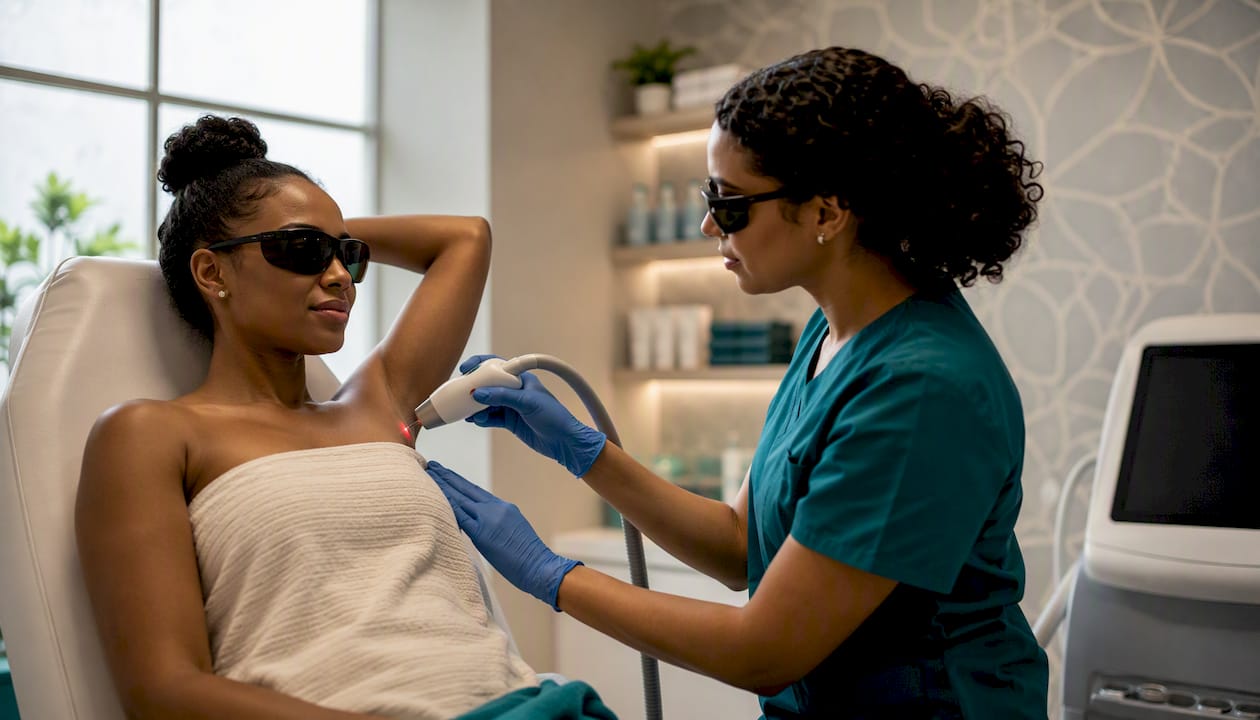
- The handpiece is placed against the skin and pulses are delivered systematically across the treatment zone.
- The clinician checks for appropriate endpoints (mild erythema around the follicle, no blistering).
- Post-session cooling is applied, and aftercare instructions are given.
Sessions typically last 15–45 minutes depending on the area treated.
Pro Tip: If you find the treatment uncomfortable, ask whether an ‘in-motion’ delivery technique is available. A prospective comparison found that in-motion Nd:YAG delivery produced similar hair reduction to traditional long-pulse delivery but with reduced pain and erythema, making it a practical option for sensitive patients.
What are the side effects, and how do clinics reduce risk?
Immediate effects
Mild redness and swelling around the treated follicles are expected and typically resolve within a few hours. Some patients experience a sensation similar to a mild sunburn for the remainder of the day. These are normal treatment responses, not complications.
Less common but important risks
Post-inflammatory hyperpigmentation (darkening of the skin) and hypopigmentation (lightening) can occur, particularly if sun exposure happens before or after treatment, or if fluences are set too aggressively for the patient’s phototype. Blistering and scarring are rare when protocols are followed correctly, but they are possible if the device is miscalibrated or the operator lacks experience with darker skin. Temporary pigment changes are more likely when sun exposure is not avoided in the weeks surrounding treatment.
Key statistic: Immediate side effects such as mild redness and swelling typically subside within a few hours; temporary pigment changes are the most clinically significant risk and are substantially reduced by strict sun avoidance and conservative fluence protocols.
Safety protocols clinics must follow
- Perform a documented test patch and review results before the first full session.
- Use conservative fluences for Fitzpatrick IV–VI, incrementally increasing only with documented tolerance.
- Apply aggressive cooling throughout, using contact cooling or cryogen spray.
- Calibrate the device regularly and verify settings before each session.
- Ensure the treating clinician has documented experience with diverse phototypes.
Red flags: when to contact the clinic urgently
- Blistering or open skin that does not begin to resolve within 24–48 hours
- Spreading redness, warmth, or signs of infection
- Significant pigment change appearing within days of treatment
- Any reaction that seems disproportionate to what was described at consultation
Aftercare: what to do after each session
Proper aftercare is where many patients inadvertently increase their risk of complications. The steps are straightforward but must be followed consistently.
- Apply a cool compress or cooling gel immediately after the session to reduce erythema and discomfort
- Cleanse the area gently with a mild, fragrance-free cleanser for the first 48 hours
- Use a non-comedogenic, fragrance-free moisturiser to support the skin barrier
- Avoid sun exposure to the treated area for a minimum of two weeks post-session; in the UK, this is achievable for much of the year but requires particular vigilance during summer months
- Apply SPF 30 or higher daily to any treated area that may be exposed to daylight, even incidentally
- Do not wax, thread, or use depilatory creams between sessions; shaving is the only acceptable hair removal method between treatments
- Avoid abrasive scrubs, chemical exfoliants, and heat treatments (saunas, steam rooms) for at least one week post-session
“Sun-exposed areas carry a higher risk of temporary dyspigmentation and need stricter pre- and post-treatment sun protocols — this applies both before and after each session in the course.” — JAMA Dermatology site-specific outcomes review
Pro Tip: For patients managing post-treatment pigment changes, a broad-spectrum SPF applied every morning, including on overcast UK days, is the single most effective preventive measure. UVA penetrates cloud cover and can trigger PIH even without direct sun.
Contact the clinic promptly if you notice blistering, spreading redness, or any pigment change that appears within days of treatment rather than weeks.
What does Nd:YAG laser hair removal cost in the UK?
UK pricing varies considerably based on the treatment area, the grade of the treating clinician, the device model, and whether integrated cooling technology is included. The table below gives approximate ranges; always request an itemised quote.
Ranges are indicative. Prices in London and major cities typically sit at the upper end.
What affects the price?
- Area size: larger areas require more time and energy delivery
- Clinician grade: a GMC-registered doctor or HCPC-registered practitioner typically commands a higher fee than a beauty therapist operating without medical oversight
- Device technology: newer devices with integrated dynamic cooling cost more to operate and maintain
- Clinic setting: a regulated medical clinic with a named prescriber will generally price higher than a non-medical salon, reflecting the additional governance and safety infrastructure
Pro Tip: A significantly lower price than the ranges above is a red flag, not a bargain. It often indicates a lower-specification device, less experienced operators, or the absence of a test patch and medical oversight. For darker skin tones especially, the cost of treating a complication far exceeds any saving on the initial course.
When reviewing a quote, confirm that it includes the test patch, specifies the device model and cooling method, names the clinician grade who will perform the treatment, and outlines what post-care support is provided if a complication arises.
How do you choose a safe, experienced clinic in the UK?
The UK does not yet have a single mandatory national licence for laser hair removal practitioners, which means the quality gap between providers is wide. The burden of due diligence falls on the patient.
Trust signals to look for
- The treating clinician holds a recognised registration: GMC (doctor), HCPC (nurse, physiotherapist, or allied health professional), or NMC (nurse/midwife)
- A named prescriber or doctor provides medical oversight for the clinic
- The device carries MHRA or UKCA marking, confirming it meets UK medical device safety standards
- The clinic has documented treatment protocols and performs a test patch before every first course
- The practitioner can demonstrate experience treating Fitzpatrick IV–VI phototypes specifically
For a broader understanding of what clinical safety standards in aesthetic practice require, reviewing the regulatory framework before your consultation is worthwhile.
Questions to ask at consultation
- Which device will be used, and what is its model name?
- What cooling system does the device use?
- Who will perform the treatment, and what are their qualifications?
- Do you routinely perform a test patch for my skin type?
- How many sessions do you recommend for my phototype and hair type, and why?
- What is your protocol if I develop a pigment change or other complication?
“Clinical guidelines repeatedly emphasise operator experience as a primary determinant of safety and outcomes for Nd:YAG on darker skin — clinics should have documented experience treating diverse phototypes and run test-patch protocols with documented consent.” — Laser therapy in skin of colour, PubMed
Red flags: no test patch offered, vague or evasive answers about the device model or operator qualifications, pricing substantially below market rate, no mention of medical oversight or prescriber involvement.
How does Nd:YAG compare with diode and alexandrite lasers?
| Laser type | Wavelength | Safety for darker skin | Penetration depth | PIH risk | Typical sessions needed | Comfort |
|---|---|---|---|---|---|---|
| Short-wavelength (alexandrite) | 755 nm | Lower; higher epidermal melanin absorption | Moderate | Higher for Fitzpatrick IV–VI | 6–8 | Moderate to high discomfort |
| Mid-wavelength diode | 810 nm | Moderate; acceptable for Fitzpatrick III–IV with care | Moderate to deep | Moderate | 6–8 | Moderate |
| Long-pulsed Nd:YAG | 1064 nm | Highest for darker skin | Deep (5–7 mm) | Lowest of the three | 6–10 | Manageable with cooling |
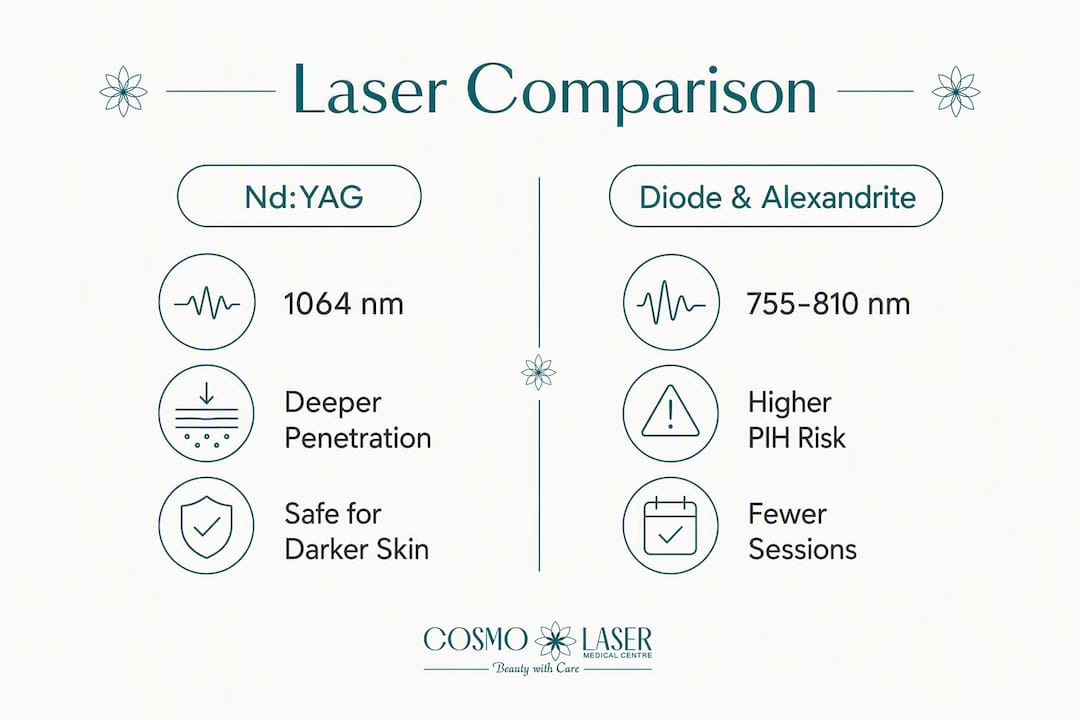
The alexandrite laser at 755 nm produces excellent results on fair skin with dark hair, but its shorter wavelength is absorbed more aggressively by epidermal melanin, raising the PIH risk for brown and dark skin tones. Diode lasers at 810 nm occupy a middle ground: safer than alexandrite for Fitzpatrick III–IV, but still less suitable than Nd:YAG for Fitzpatrick V–VI. For a broader comparison of laser wavelengths and their clinical indications, the differences in tissue interaction are worth understanding before committing to a course.
The practical trade-off with Nd:YAG is that more sessions may be needed to achieve the same percentage reduction as a diode on lighter skin, and the treatment can be more uncomfortable at higher fluences. Aggressive cooling and, where available, in-motion delivery address both issues without compromising efficacy.
What does the clinical evidence say about Nd:YAG for skin of colour?
The evidence base for long-pulsed Nd:YAG in darker phototypes is well established. A 2025 review in the International Journal of Research in Dermatology confirmed Nd:YAG (1064 nm) as the recommended modality for Fitzpatrick IV–VI, citing its lower epidermal melanin absorption and the importance of test patches and conservative fluences. A prospective study by Lorenz published in Lasers in Surgery and Medicine reported clinically significant hair reduction persisting at 12 months after 4–5 sessions, supporting the multi-session model used in clinical practice.
A more recent prospective comparison published in Medicina found that in-motion Nd:YAG delivery produced similar hair reduction to traditional long-pulse delivery but with reduced pain and erythema, a finding with practical relevance for patients who find standard treatment uncomfortable.
“A conservative, documented incremental-fluence approach plus photographic follow-up after the patch test is the best way to balance efficacy and safety in Fitzpatrick IV–VI patients.” — Long-pulse Nd:YAG follow-up study, Lorenz, Lasers Surg Med
Key expert-level protocols the evidence supports:
- Incremental fluence titration starting conservatively, with documented photographic follow-up after the patch test
- Aggressive cooling at every session, not only at higher fluences
- Extended session intervals (up to 8 weeks) for darker phototypes to allow full recovery between treatments
- Combination approaches, such as laser plus topical eflornithine for pseudofolliculitis barbae, have shown additive benefit in some trials for patients with inflammatory ingrown hairs
In the UK context, these protocols align with the expectation that treating clinicians hold recognised registrations and that devices carry MHRA or UKCA certification. The clinical rationale for laser selection in a regulated medical setting reinforces why device choice and operator experience are inseparable.
Key takeaways
The long-pulsed Nd:YAG (1064 nm) is the safest, most evidence-backed laser for hair removal on darker skin tones, requiring a test patch, conservative fluences, aggressive cooling, and a qualified practitioner to achieve greater than 50% reduction over 6–10 sessions.
| Point | Details |
|---|---|
| Preferred wavelength for darker skin | 1064 nm Nd:YAG penetrates 5–7 mm, bypassing epidermal melanin to reduce PIH risk. |
| Sessions and spacing | Most patients need 6–10 sessions spaced 4–8 weeks apart; greater than 50% reduction is the typical outcome. |
| Test patch is mandatory | For Fitzpatrick IV–VI, a test patch 48–72 hours before the first session is a clinical safety requirement, not optional. |
| Cooling and fluence discipline | Aggressive cooling and conservative, incrementally increased fluences are the primary safeguards against burns and pigment change. |
| Cosmolaser Medical Centre | Offers clinician-led Nd:YAG treatments with documented protocols and test-patch procedures for darker skin tones. |
Pro Tip: Before booking any course, confirm the clinic will perform a test patch, name the exact device model, and tell you the qualifications of the person operating it. Those three questions alone will filter out the majority of unsuitable providers.
A clinician’s perspective on Nd:YAG safety
The conversation around Nd:YAG laser hair removal for darker skin has shifted considerably over the past decade, and not always in the right direction. The technology is genuinely well-suited to Fitzpatrick IV–VI phototypes. The physics are sound, the evidence is solid, and the outcomes, when protocols are followed, are clinically meaningful. What concerns me is the gap between what the evidence recommends and what patients sometimes receive in practice.
The test patch is the single most important safety step for any patient with darker skin, yet it is still routinely skipped by providers who are either under-equipped or under-trained. A test patch is not a formality. It is the mechanism by which the clinician calibrates the device to the individual patient’s skin response, and it is the only reliable way to identify those patients who need a more conservative approach before committing to a full treatment area.
Cooling is equally non-negotiable. Higher fluences are needed to reach deeper follicles with the 1064 nm wavelength, and without integrated contact cooling or cryogen spray, the epidermal temperature rises to a point where pigmentary complications become likely rather than rare. The best devices combine both; the best clinicians use them consistently, not selectively.
The UK regulatory environment is improving, but patients with brown and dark skin tones remain disproportionately exposed to risk from under-regulated providers. Choosing a clinic with a named, registered clinician and a documented protocol is not overcautious. It is the standard of care the evidence demands.
Useful sources and further reading
The following primary sources and clinical reviews underpin the claims made in this article. For UK patients, the MHRA and professional registration bodies (GMC and HCPC) are the primary regulatory references for device safety and clinician qualifications.
- Laser therapy in skin of colour — PubMed (PMC): foundational review of wavelength selection and safety protocols for Fitzpatrick IV–VI
- Laser-assisted hair removal for darker skin types — PubMed: clinical evidence for long-pulsed diode and Nd:YAG in darker phototypes
- Hair removal with the long-pulsed Nd:YAG laser — Lorenz, Lasers Surg Med: prospective 12-month outcome data
- Comparing traditional and in-motion Nd:YAG — MDPI Medicina: pain and efficacy comparison of delivery techniques
- Laser hair removal — Mayo Clinic: accessible overview of side effects and aftercare
- MHRA — UK medical device regulation: device certification and safety standards
- GMC — General Medical Council register: verify doctor registration in the UK
- HCPC — Health and Care Professions Council register: verify allied health professional registration
“Before the advent of longer wavelengths, longer pulse durations and more efficient cooling devices, laser-assisted hair removal was best suited for phototypes I–III. Now, it can be performed safely and efficaciously on darker skin types.” — PubMed, laser-assisted hair removal for darker skin types
This article provides general information about Nd:YAG laser hair removal and is not a substitute for professional medical advice. Consult a GMC-registered doctor or HCPC-registered practitioner to confirm whether this treatment is appropriate for your skin type and medical history.
Nd:YAG treatments at Cosmolaser Medical Centre
For patients with darker skin tones who want Nd:YAG laser hair removal delivered under genuine medical oversight, Cosmolaser Medical Centre offers clinician-led treatments with documented test-patch protocols and individualised fluence planning. The difference between a medical clinic and a beauty salon is not just the device on the shelf. It is the clinical governance around how that device is used: who assesses your skin, how settings are calibrated to your phototype, and what happens if your skin responds unexpectedly.
Cosmolaser Medical Centre’s team includes qualified doctors and dermatology specialists with direct experience treating diverse skin tones, including Fitzpatrick IV–VI. Every treatment course begins with a thorough consultation and a mandatory test patch. Cooling is integrated into the protocol, not an afterthought.
To understand the full range of clinician-led aesthetic options available, the types of body aesthetic treatments guide is a useful starting point. For patients who want to understand the clinical reasoning behind laser selection before booking, why aesthetic clinics use lasers sets out the evidence clearly.
Book a consultation with Cosmolaser Medical Centre to receive a personalised skin assessment, a documented test patch, and a treatment plan built around your skin type.
FAQ
Is Nd:YAG laser good for hair removal?
Yes. The long-pulsed Nd:YAG at 1064 nm is one of the most clinically validated options for hair removal, particularly for darker skin tones (Fitzpatrick IV–VI), where it offers a lower risk of burns and pigment changes than shorter-wavelength devices.
What is the main disadvantage of the Nd:YAG laser?
The primary limitation is that more sessions are typically needed compared with alexandrite or diode lasers on lighter skin, and the treatment can be more uncomfortable at the higher fluences required to reach deeper follicles. Integrated cooling substantially reduces discomfort.
How often can you have Nd:YAG laser treatment?
Sessions are typically spaced 4–8 weeks apart, allowing the skin to recover fully and targeting follicles in successive growth cycles. Darker phototypes often benefit from the longer end of that interval.
Which is better, diode or Nd:YAG laser hair removal?
For Fitzpatrick I–III, a diode laser at 810 nm can be equally effective and slightly more comfortable. For Fitzpatrick IV–VI, the long-pulsed Nd:YAG at 1064 nm is the safer choice because its longer wavelength reduces epidermal melanin absorption and the associated risk of PIH.