
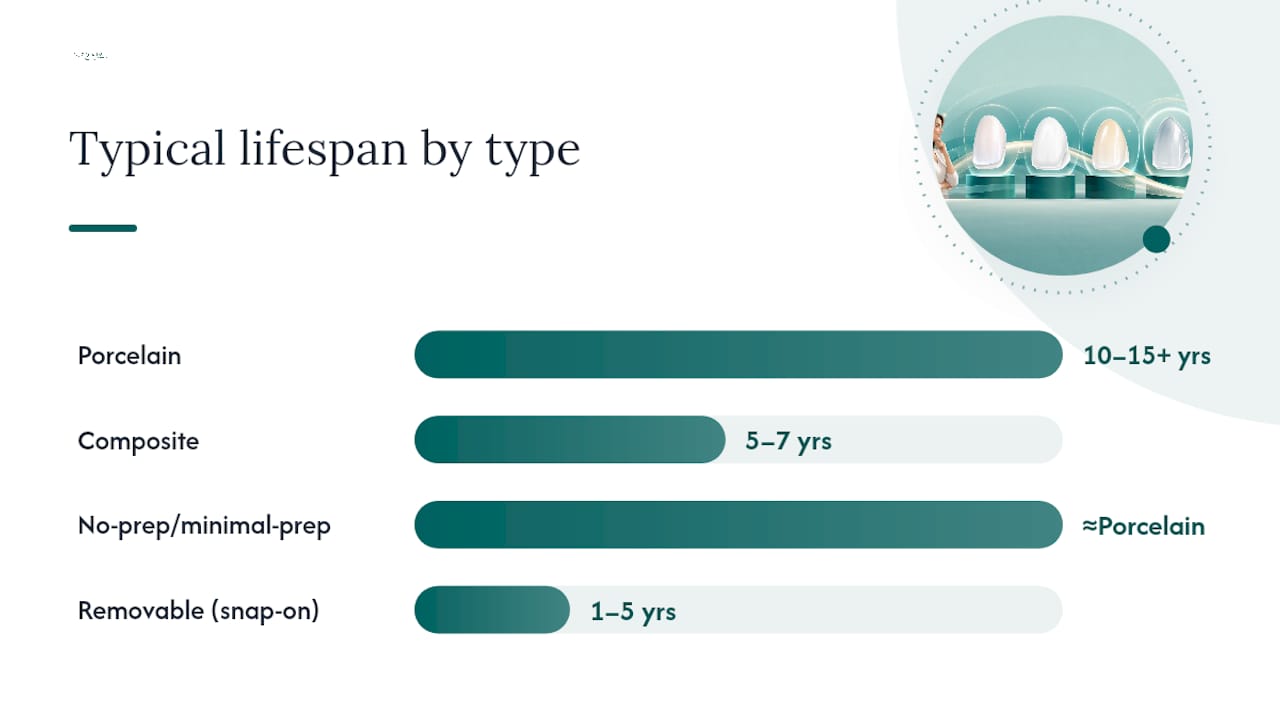
Dental veneers are thin, custom-made shells bonded to the front surfaces of your teeth to change their color, shape, or spacing — and they suit adults with healthy teeth and gums who want a lasting cosmetic improvement. Porcelain veneers typically last 10–15 years or longer, while composite veneers average 5–7 years. In the U.S., costs range from the lower hundreds per tooth for composite to roughly $1,000 or more per tooth for porcelain, depending on material, clinician expertise, and location. For patients in the UAE and Sharjah, Cosmolaser Medical Centre offers in-person veneer consultations with technology-driven planning and locally managed follow-up care.
Key Takeaways
Porcelain veneers are the most durable cosmetic dental restoration for adults with healthy teeth and gums, lasting 10–15 years or longer when placed by a licensed clinician and maintained with consistent oral hygiene and a nightguard for grinders.
| Point | Details |
|---|---|
| Lifespan by material | Porcelain lasts 10–15+ years; composite averages 5–7 years with proper care. |
| Irreversibility | Enamel removal of 0.3–0.7 mm makes veneers a permanent commitment requiring lifelong replacement. |
| Candidacy first | Healthy gums, no active decay, and sufficient enamel are required before any veneer is placed. |
| Cost and financing | Insurance rarely covers veneers; payment plans over 12–24 months are widely available. |
| Cosmolaser Medical Centre | In-person veneer consultations with technology-driven planning are available in Sharjah, UAE. |
Table of Contents
- What dental veneers are and how they work
- Types of veneers: which option fits your situation?
- Who qualifies for veneers and who should wait?
- Veneers vs. crowns, bonding, and orthodontics: which treatment fits your case?
- The veneer procedure: what happens at each appointment?
- Benefits and risks: what you gain and what you accept
- How much do veneers cost, and how long do they last?
- Daily care and long-term maintenance for your veneers
- How to choose a cosmetic dentist for veneers
- What to expect immediately after placement and at follow-up visits
- Why clinician experience and planning quality change your outcome
- The case for slowing down before you commit
- Veneers at Cosmolaser Medical Centre in Sharjah
- Sources
- FAQ
What dental veneers are and how they work
Veneers are custom-made shells that fit over the front surfaces of teeth to conceal chips, stains, gaps, and other cosmetic issues. The shell bonds directly to the enamel, which means enamel condition is the single most important structural factor before placement. Two primary materials are used:
- Porcelain (ceramic): Fabricated from high-quality ceramics such as E.max lithium disilicate or feldspathic porcelain, porcelain closely mimics the light-transmitting quality of natural enamel. It resists staining and holds its color for years.
- Composite resin: Applied directly to the tooth surface or fabricated chairside. Less expensive upfront, but more prone to staining and surface wear over time.
Beyond aesthetics, veneers can restore function by rebuilding worn enamel surfaces and closing food-trapping gaps that contribute to periodontal disease risk. Cosmetic problems they routinely address include:
- Intrinsic stains that whitening cannot reach (tetracycline discoloration, fluorosis)
- Chipped or fractured tooth edges
- Gaps between front teeth (diastema)
- Slightly misshapen or uneven teeth
- Worn enamel from acid erosion or mild grinding
Types of veneers: which option fits your situation?
The four main veneer types differ along four axes: durability, appearance, how much tooth structure they require, and cost. Porcelain sits at one end of the spectrum; removable snap-on veneers sit at the other.
| Type | Appearance | Prep Required | Typical Lifespan | Repairability | Approx. U.S. Price Range |
|---|---|---|---|---|---|
| Porcelain | Highly natural, translucent | 0.3–0.7 mm enamel removal | 10–15+ years | Replacement only | Higher cost per tooth |
| Composite | Good, less translucent | Minimal to moderate | 5–7 years | Patchable chairside | Lower cost per tooth |
| No-prep / minimal-prep | Natural, thinner profile | Little to no enamel removal | Similar to porcelain | Replacement only | Comparable to porcelain |
| Removable (snap-on) | Cosmetic only | None | 1–5 years (with care) | Replaced as unit | Lowest cost |
Porcelain remains the clinical gold standard. The ceramic material transmits light in a way that composite cannot fully replicate, and its stain resistance means the color stays consistent for a decade or more when bonded correctly.
Composite veneers cost less upfront and can often be placed in a single visit. The trade-off is a shorter lifespan and a higher likelihood of surface staining from coffee, tea, and red wine. They are patchable if a small chip occurs, which is a meaningful practical advantage.
No-prep or minimal-prep options remove little to no enamel, making them appealing to patients who want a reversible or near-reversible path. The limitation is real: severe staining or significant misalignment may still require traditional preparation because the added thickness of a no-prep shell can look bulky on teeth that already have prominent contours.
Removable snap-on veneers are a temporary cosmetic device, not a clinical restoration. They sit over existing teeth without bonding and are appropriate only for short-term aesthetic situations, not as a substitute for permanent dental treatment.
Who qualifies for veneers and who should wait?
The single most important screening criterion is enamel health. Veneers bond to enamel, not dentin, so patients with significant enamel loss may not achieve a durable bond. Beyond that, a dentist will assess:
Candidacy checklist:
- No active tooth decay in the teeth being treated
- Healthy gum tissue with no active periodontal disease
- Sufficient enamel remaining for bonding
- Controlled bruxism (grinding) or willingness to wear a nightguard
- Bite that does not place excessive force on the veneer surface
Red flags that require treatment first:
- Active periodontal disease or untreated cavities
- Severe malocclusion that places shear forces on veneers
- Heavy, uncontrolled grinding without a management plan
- Teeth with more than roughly 50% structural loss (crowns are more appropriate)
Many patients need preparatory treatment before veneers are placed. Gum therapy for mild gingivitis, fillings for small cavities, or a course of orthodontic alignment with braces or aligners can all make veneers both safer and more aesthetically successful. Addressing alignment first also reduces the amount of enamel that needs to be removed during preparation.
Veneers vs. crowns, bonding, and orthodontics: which treatment fits your case?
Veneers address cosmetic changes to the front surface of a tooth. That single distinction separates them from the alternatives:
- Veneers: Best for color, shape, and minor spacing changes on structurally sound teeth
- Crowns: Cover the entire tooth and are preferred when tooth structure loss exceeds roughly 50% or when the tooth has been root-canal treated and needs full protection
- Composite bonding: A faster, lower-cost fix for a single chip or small gap; lifespan is shorter and the material is more prone to staining
- Orthodontics: The right starting point when the primary problem is alignment, crowding, or bite — clear aligners or braces correct the underlying position before any cosmetic restoration
Practical use-case guidance:
- Single chipped incisor with no other concerns: bonding is often sufficient
- Widespread discoloration that whitening cannot resolve: veneers are the more durable solution
- Structurally damaged tooth after trauma or decay: crown provides better biomechanical support
- Crooked front teeth: orthodontics first, then veneers if cosmetic refinement is still needed
- Severely damaged dentition: full-arch dental implants may be the appropriate restorative path
Mixing treatments is common. Orthodontics before veneers reduces the amount of enamel preparation needed and produces a more predictable cosmetic result. When a tooth has underlying pulp issues, root canal treatment should be completed before any veneer is placed.
The veneer procedure: what happens at each appointment?
The standard workflow runs from consultation through cementation in two to four visits over two to four weeks for lab-fabricated porcelain. Composite and CAD/CAM options can compress this into a single appointment.
Step-by-step clinical process:
- Consultation and examination: The dentist reviews oral health, takes X-rays or a CBCT scan when indicated, and discusses shade, shape, and material options with you.
- Shade selection and mock-up: Digital photographs and shade mapping guide the ceramist. A digital or putty mock-up lets you preview the result before any tooth is touched.
- Enamel preparation: Approximately 0.3–0.7 mm of enamel is removed from the front surface. Local anesthesia is used; most patients report minimal discomfort.
- Impressions or digital scan: A physical impression or intraoral scan captures the prepared tooth geometry and is sent to the dental laboratory.
- Temporary veneers: Acrylic temporaries protect the prepared teeth and give you a preview of the final shape during the lab fabrication period (typically one to two weeks).
- Try-in appointment: The finished veneers are placed without permanent cement so you and the dentist can evaluate color, fit, and bite. Adjustments are made at this stage.
- Cementation: The veneers are etched, primed, and bonded with dental cement. Excess cement is removed, and the bite is refined.
Mild sensitivity to temperature is common in the days following preparation and again after cementation. This usually resolves within one to two weeks as the tooth adjusts to the new restoration.
Benefits and risks: what you gain and what you accept
The core trade-off with veneers is straightforward: you gain a durable, natural-looking cosmetic result, and you accept a permanent change to your tooth structure.
Benefits:
- Dramatic improvement in color, shape, and symmetry
- Porcelain resists staining better than natural enamel
- Closes gaps and corrects minor misalignment without orthodontics
- Can protect worn enamel surfaces and reduce food-trapping gaps
- Long lifespan relative to composite bonding
Risks and downsides:
- Irreversible: enamel removal cannot be undone, so you will always need a veneer or crown on that tooth
- Increased sensitivity, particularly to temperature, during and after preparation
- Chips or debonding require repair or full replacement
- Replacement costs accumulate over a lifetime of renewals
- Dental insurance rarely covers veneers because they are classified as cosmetic
Pro Tip: If you grind your teeth at night, a custom nightguard is not optional — it is the single most effective way to prevent veneer fracture and extend the life of your restoration.
One clinical caution: unlicensed “veneer technicians” or pop-on veneer services can place restorations over untreated decay or periodontal disease, risking chronic infection or nerve damage. Treatment must be delivered by a licensed dentist with proper diagnostics.
How much do veneers cost, and how long do they last?
Porcelain veneers typically last 10–15 years or longer; composite veneers average 5–7 years. Cost varies by material, clinician experience, laboratory quality, number of teeth, and geographic region.
| Material | Typical U.S. Price Range | Average Lifespan |
|---|---|---|
| Porcelain (E.max, feldspathic) | Higher cost per tooth | 10–15+ years |
| Composite resin | Lower cost per tooth | 5–7 years |
Factors that move the price higher include:
- Dentist’s cosmetic training and case volume
- Premium ceramic materials (E.max lithium disilicate vs. standard ceramic)
- Independent laboratory fees vs. in-house milling
- Number of teeth treated (six to eight veneers is a common smile makeover range)
- Geographic market (major metropolitan areas typically cost more)
Insurance and financing: Most dental insurance plans classify veneers as cosmetic and provide no coverage. Some plans cover a portion if there is a documented functional need (for example, protecting severely worn enamel). Payment plan options through dental financing programs are widely available and allow patients to spread costs over 12–24 months. Ask your clinic about in-house financing or third-party dental credit options before your first appointment.
Daily care and long-term maintenance for your veneers
Good oral hygiene combined with a few behavioral protections is what keeps veneers looking their best for the full length of their lifespan.
Do:
- Brush twice daily with a soft-bristle toothbrush and a non-abrasive toothpaste (avoid whitening pastes with coarse particles, which scratch porcelain glaze)
- Floss daily, paying attention to the gum margin where cement meets tooth
- Wear a custom nightguard if you grind or clench
- Wear a sports mouthguard during contact activities
- Schedule professional cleanings every six months so your dentist can check margins, cement integrity, and gum health
Avoid:
- Chewing ice, hard candy, or pen caps
- Biting fingernails or opening packaging with your teeth
- Excessive consumption of staining beverages (coffee, red wine, dark tea) without rinsing afterward
- Abrasive toothpastes or stiff-bristle brushes
At follow-up visits, your dentist will check the veneer margins for microleakage, assess gum health around the restoration, and polish the surface. Composite veneers can often be patched chairside if a small chip occurs. Porcelain veneers, by contrast, typically require full replacement when they fail because the ceramic cannot be reliably bonded and color-matched after fracture.
How to choose a cosmetic dentist for veneers
Pick a licensed dentist with documented cosmetic experience and a portfolio of before-and-after cases. Credentials and communication quality matter as much as the material used.
Questions to ask at your consultation:
- How many veneer cases do you complete per year, and can I see before-and-after photos?
- Which materials and laboratory do you use?
- Do you offer a digital mock-up or trial veneer before preparation?
- What is your policy if a veneer chips or debones within the first year?
- Will you take X-rays or a CBCT scan before treatment?
Credentials to look for:
- DDS or DMD degree from an accredited dental school
- Postgraduate cosmetic dentistry coursework or fellowship
- Membership in recognized dental professional associations
Red flags:
- Veneer services offered by non-dentists or unlicensed technicians
- Prices that seem implausibly low with no explanation of materials or lab
- No before-and-after photo portfolio
- No clinical examination or diagnostic imaging before treatment
- Pressure to commit without a trial mock-up
Pro Tip: Request a digital smile design or putty mock-up before any enamel is removed. Seeing the proposed shape and size on your actual teeth — before the irreversible step — is the clearest signal that a clinician prioritizes your outcome over speed.
For patients in the UAE and Sharjah, Cosmolaser Medical Centre’s veneer service provides in-person consultations with technology-driven planning and locally managed follow-up, which matters when adjustments or re-bonding are needed after placement.
What to expect immediately after placement and at follow-up visits
Mild sensitivity and slight gum tenderness are the most common experiences in the 24–72 hours after veneer cementation. Major complications are uncommon when patients are properly screened and treated by a licensed clinician.
Immediate aftercare:
- Avoid very hot or very cold foods and beverages for 24–48 hours
- Stick to a soft diet if temporary veneers are in place
- Over-the-counter analgesics (ibuprofen or acetaminophen) manage any post-procedure discomfort
- Avoid biting directly into hard foods for the first week while the cement fully cures
Follow-up schedule and adjustments:
- A check-up one to two weeks after cementation lets the dentist refine the bite and polish any rough margins
- If the bite feels uneven or a veneer feels “high,” contact the clinic promptly — a brief adjustment appointment resolves this quickly
- Annual or biannual professional cleanings are the baseline maintenance schedule
- Report any sensitivity that persists beyond two weeks, any clicking sensation, or visible margin gaps
Why clinician experience and planning quality change your outcome
Clinician skill and pre-treatment planning materially affect both the longevity and the natural appearance of veneers. A technically precise preparation, accurate impressions or digital scans, and clear communication with an experienced ceramist reduce the likelihood of remakes, poor color matching, and early failure.
Pro Tip: Digital workflows — intraoral scanners, CAD/CAM milling, and 3D smile mock-ups — reduce fit errors and give you a preview of the result before any enamel is touched. Ask whether your clinic uses digital planning as a standard part of the process.
Key factors that separate high-quality veneer outcomes from average ones:
- Detailed shade mapping under natural and clinical light before preparation
- Accurate impressions or intraoral scans that capture the full preparation margin
- A skilled dental ceramist who understands translucency, surface texture, and characterization
- CBCT imaging when underlying bone or root anatomy needs assessment before treatment
- A structured follow-up protocol to catch margin issues early
For UAE and Sharjah patients, verifying that your clinic uses licensed dentists, accredited laboratory partners, and proper diagnostic imaging is the practical due diligence step before committing to treatment. Cosmolaser Medical Centre’s licensed aesthetician treatment standards reflect the same principle: licensed, qualified practitioners with proper diagnostics produce safer and more durable results than unlicensed alternatives.
The case for slowing down before you commit
There is a pattern in how adults approach veneers that consistently leads to regret: they focus almost entirely on the final appearance and almost not at all on the preparation phase. The mock-up appointment, the shade mapping session, the conversation with the ceramist — these feel like administrative steps. They are not. They are where the outcome is actually decided.
The conventional advice tells you to “choose an experienced dentist and use quality materials.” That is true but incomplete. What it misses is that the planning conversation itself is diagnostic. A clinician who spends time on shade selection under natural light, who shows you a digital preview before touching your enamel, and who explains exactly how much tooth structure will be removed is demonstrating something more important than technical skill: they are demonstrating that they understand your specific anatomy and your specific goals. A clinician who skips those steps and moves directly to preparation is optimizing for speed, not for your outcome.
The second thing the standard advice underweights is the irreversibility. Patients hear “irreversible” and process it abstractly. The concrete reality is that once 0.3–0.7 mm of enamel is removed, that tooth will need a veneer or crown for the rest of your life. That is not a reason to avoid veneers — for the right candidate, the trade-off is clearly worth it. But it is a reason to be certain before you sit in the chair, not after.
For patients in the UAE and Sharjah, the additional consideration is follow-up access. Veneers occasionally need to bite refinement, margin polishing, or re-bonding in the months after placement. Choosing a local clinic with a structured follow-up protocol is not a minor convenience — it is part of the clinical outcome.
Veneers at Cosmolaser Medical Centre in Sharjah
Adults in the UAE who want a lasting cosmetic improvement without traveling abroad have a locally managed option at Cosmolaser Medical Centre. The clinic’s dental team in Sharjah provides in-person veneer consultations with technology-driven planning — including digital shade mapping and diagnostic imaging — so patients understand exactly what their treatment involves before any enamel is prepared.
The approach at Cosmolaser Medical Centre pairs clinical rigor with patient education: you see the proposed result before the irreversible step, and follow-up visits are built into the care plan rather than treated as an afterthought. For adults weighing porcelain veneers, composite options, or a combined smile makeover, the starting point is a consultation where your oral health is assessed and your goals are mapped to the right material and technique. Book your veneer consultation at Cosmolaser Medical Centre in Sharjah to get a personalized treatment plan grounded in proper diagnostics.
This article is general information, not a substitute for advice from a qualified doctor. Consult a qualified healthcare professional about your own circumstances before acting on anything here.
Sources
- Veneers | MouthHealthy – Oral Health Information from the ADA
- Dental veneers: pros and cons | Colgate
- Dental veneers: benefits, procedure, costs, and results | Healthline
- What Are Dental Veneers? | Veneers Authority
FAQ
How much do veneers actually cost?
Composite veneers fall in the lower cost range per tooth, while porcelain veneers typically run higher per tooth, with significant variation based on clinician experience, material grade, and geographic market. Dental insurance rarely covers the cost because veneers are classified as cosmetic.
How long do dental veneers last?
Porcelain veneers commonly last 10–15 years or longer; composite veneers typically last 5–7 years. Lifespan depends on oral hygiene, grinding habits, and whether a nightguard is worn.
What is the main downside of having veneers?
Irreversibility is the primary downside. Enamel removal of approximately 0.3–0.7 mm means the tooth will always require a veneer or crown, and increased temperature sensitivity is common in the weeks following preparation.
What happens to the teeth underneath veneers?
The prepared tooth remains alive and functional beneath the veneer. Because enamel is permanently reduced, the tooth is more vulnerable to sensitivity and decay at the margins if oral hygiene lapses — which is why professional cleanings every six months and careful daily brushing at the gum line are non-negotiable for veneer patients.