
Cellulite is the dimpled, orange-peel texture that appears when subcutaneous fat pushes upward through fibrous connective tissue bands beneath the skin. The immediate, honest answer: there is no permanent cure. Clinical evidence and dermatologist consensus agree that the appearance can be meaningfully reduced, but the structural anatomy that causes it cannot be permanently altered by any currently available treatment. If you notice sudden skin changes, pain, warmth, or rapid onset of new lumps, see your GP promptly to rule out other conditions before considering any aesthetic intervention.
- Cellulite is a structural, not a pathological, skin condition
- Its appearance can be reduced temporarily through lifestyle measures and clinic procedures
- No single treatment eliminates it permanently
- Sudden or painful skin changes warrant a GP assessment before any cosmetic treatment
Table of Contents
- How cellulite forms beneath the skin
- What cellulite looks like and how common it is
- What causes cellulite and who is most at risk
- At-home measures: what the evidence actually supports
- Clinic treatments: what each option does and how long results last
- When does cellulite need a doctor’s assessment?
- How to choose a cellulite treatment and a clinic in the UK
- What dermatologists want you to understand before you book
- Key takeaways
- A clinician’s perspective on realistic cellulite care
- Cosmolaser Medical Centre: personalised cellulite assessment and treatment
- Useful sources and further reading
- FAQ
How cellulite forms beneath the skin
The dimpling you see on the surface is the visible result of a mechanical conflict happening several millimetres below it. Skin is organised in layers: the epidermis sits outermost, beneath it lies the dermis (containing collagen and elastin), and below that is the subcutaneous layer where fat is stored in lobules. Running vertically through this fat layer are fibrous connective tissue bands called septae, which anchor the skin to the underlying muscle fascia.
In women, these septae tend to run in a perpendicular, column-like arrangement. Fat lobules expand with weight gain, hormonal changes, or simply with age, and they push upward against the underside of the dermis. The septae, meanwhile, remain tethered and pull downward. The result is the characteristic puckering: fat bulging up, fibrous bands pulling down, creating the uneven surface visible from outside.
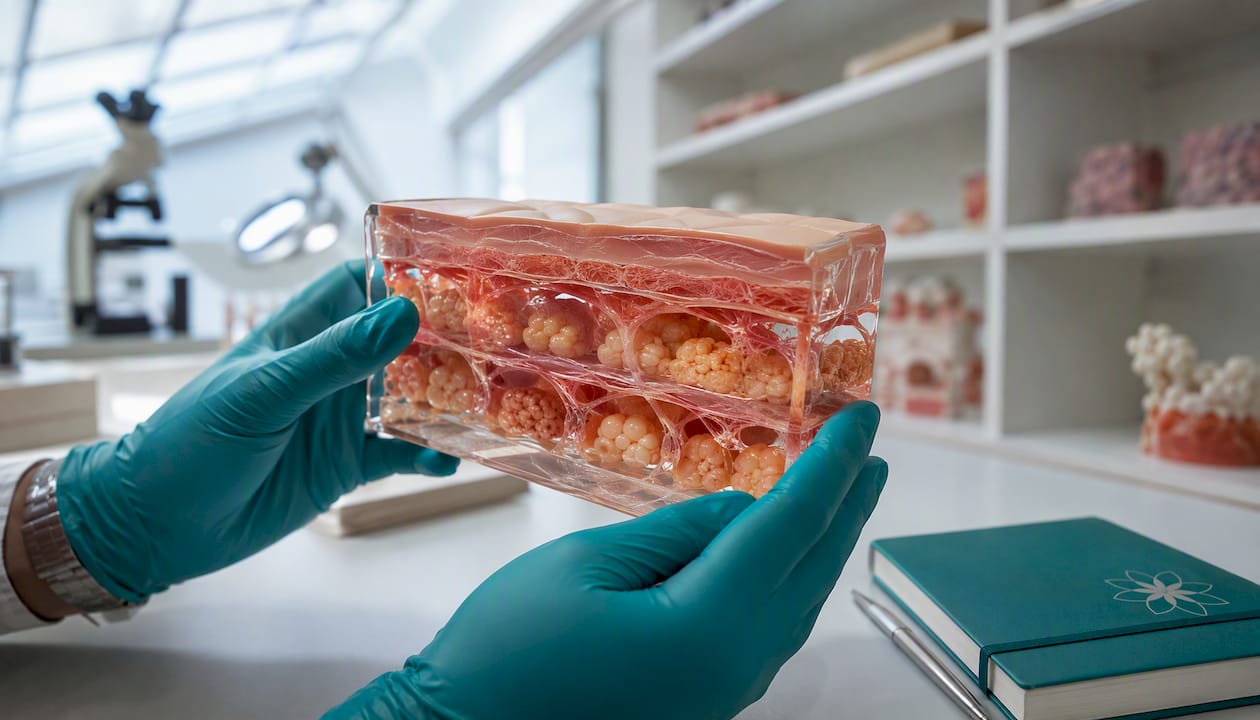
Men’s septae are typically arranged in a criss-cross pattern, which distributes pressure more evenly and explains why clinically visible cellulite is far less common in men.
Structural contributors that determine severity:
- Septae orientation and thickness: perpendicular bands in women create more pronounced tethering
- Skin thickness and elasticity: thinner, less elastic skin (which worsens with age) makes underlying irregularities more visible
- Local fat distribution: areas with higher subcutaneous fat volume, particularly the thighs and buttocks, are most affected
- Dermal collagen quality: collagen fibres that stretch, break down, or pull tight allow fat cells to bulge outward more readily
- Hormonal environment: oestrogen influences both fat distribution and collagen structure, which is why cellulite often becomes more visible around puberty, pregnancy, and menopause
Pro Tip: Pinching the skin of your outer thigh will make cellulite visible even in people who appear unaffected at rest. This is normal anatomy, not a sign of poor health.
What cellulite looks like and how common it is
The most recognisable sign is a dimpled or quilted texture, often described as resembling orange peel or cottage cheese. Visibility changes considerably with posture: lying flat may reduce the appearance, while standing, sitting, or compressing the skin makes it more pronounced. Skin tension and lighting angle both affect how obvious the dimpling looks in any given moment.
The condition appears most frequently on the outer and inner thighs, buttocks, and lower abdomen. The upper arms and the back of the knees are less commonly affected but not unusual sites. Severity is typically graded on a scale from Grade 1 (visible only when the skin is pinched) through Grade 3 (visible at rest with deep depressions and raised areas).
Prevalence: A majority of women who have gone through puberty have some degree of cellulite, while a minority of men are clinically affected. This makes it one of the most common skin presentations in adult women, not a disorder or a consequence of poor lifestyle choices.
The condition is not associated with any systemic disease. Slim women have it; women who exercise regularly have it. Its presence alone is not a clinical concern.
What causes cellulite and who is most at risk
The aetiology is multifactorial, which is precisely why no single intervention resolves it completely. Several interacting factors determine whether cellulite develops and how visible it becomes.
Hormonal influence is central. Oestrogen promotes fat storage in the thighs and buttocks, reduces collagen production over time, and affects the microcirculation in subcutaneous tissue. This explains why cellulite often worsens at hormonal transition points: puberty, pregnancy, and the perimenopause.
Genetics determine septae architecture, skin thickness, and baseline fat distribution. If your mother or grandmother had pronounced cellulite, your own structural predisposition is likely similar. This is not a modifiable factor.
Age compounds the problem through two mechanisms: skin thins and loses elasticity as collagen and elastin production decline, and subcutaneous fat distribution shifts. The same amount of fat becomes more visible through thinner, less supportive skin.
Weight and body composition matter, but not in the way many people assume. Gaining weight can worsen cellulite by increasing the volume of fat pushing against the septae. However, losing weight does not reliably eliminate it. Some patients report that cellulite becomes more visible after significant weight loss, because the overlying skin has less volume to fill it and hangs more loosely.
“Cellulite is not a sign of being overweight or unhealthy. It reflects the structural arrangement of connective tissue and fat beneath the skin, which is largely determined by genetics and hormones rather than lifestyle alone.”
— Paraphrased from AAD clinician guidance on cellulite
Key risk factors at a glance:
- Female sex (due to septae orientation and oestrogen)
- Family history of pronounced cellulite
- Age-related skin thinning and reduced collagen density
- Sedentary lifestyle (reduced muscle tone and circulation)
- Hormonal fluctuations (puberty, pregnancy, menopause, hormonal contraception)
- Rapid weight gain or loss
A clinical review published in PubMed confirms this multifactorial pathophysiology and proposes matching treatment intensity to severity: lifestyle measures for mild cases, non-invasive energy devices for moderate presentations, and minimally invasive procedures such as subcision for severe grades.
At-home measures: what the evidence actually supports
Self-care approaches can reduce the visible appearance of cellulite, but none of them alter the underlying fibrous septae. Understanding the ceiling of each approach helps you use them without disappointment.
Exercise and strength training
Resistance training that builds muscle mass in the thighs and buttocks physically fills the space beneath the skin, reducing the contrast between fat lobules and the tethered septae. Improved circulation from regular aerobic exercise also supports lymphatic drainage and skin health. Cleveland Clinic guidance confirms that exercise can reduce visibility, though it does not remove the structural cause. Evidence strength: modest. Expect gradual improvement over months of consistent training, not weeks.

Weight management
Maintaining a stable, healthy body weight prevents additional fat from increasing pressure on the septae. A balanced diet rich in protein (to support collagen synthesis), adequate hydration, and reduced ultra-processed food intake supports skin quality over time. However, weight loss alone is a weak intervention for cellulite specifically. Evidence strength: weak to modest. A cellulite diet plan built around whole foods and lean protein is sensible for general health, but it should not be marketed to you as a cellulite cure.
Topical products
- Caffeine-based creams: temporarily constrict blood vessels and dehydrate fat cells, creating a transient smoothing effect. The effect typically lasts hours, not days.
- Retinol (0.3%): applied daily, retinol may thicken the dermis over six months or longer of consistent use, producing modest visual improvement. This is the topical ingredient with the strongest evidence base, though results remain modest.
- Other ingredients (aminophylline, herbal extracts): limited or no robust clinical evidence of meaningful effect.
Evidence strength for topicals: weak to modest. The best cellulite creams produce temporary surface changes; none penetrate deeply enough to release fibrous septae.
Massage and mechanical devices
Dry brushing, foam rolling, cupping, and endermologie-style massage create temporary skin swelling and improved surface circulation. The skin may feel smoother immediately afterwards. Studies show these effects typically last hours to days rather than weeks or months. They do not alter deep fibrous septae. Evidence strength: weak.
Pro Tip: If you use a retinol product for cellulite, patch-test on a small area for 48 hours first and introduce it gradually (every other night initially) to minimise irritation. Stop use if you develop persistent redness, peeling, or burning, and consult a dermatologist before continuing.
What to expect from home measures:
- Exercise: gradual, modest reduction in visibility over 3–6 months of consistent resistance and aerobic training
- Retinol cream: modest skin thickening after 6+ months of daily use; results are subtle
- Caffeine topicals: temporary smoothing effect lasting hours; useful before an event, not as a long-term solution
- Massage/dry brushing: immediate but fleeting improvement; no structural change
Clinic treatments: what each option does and how long results last
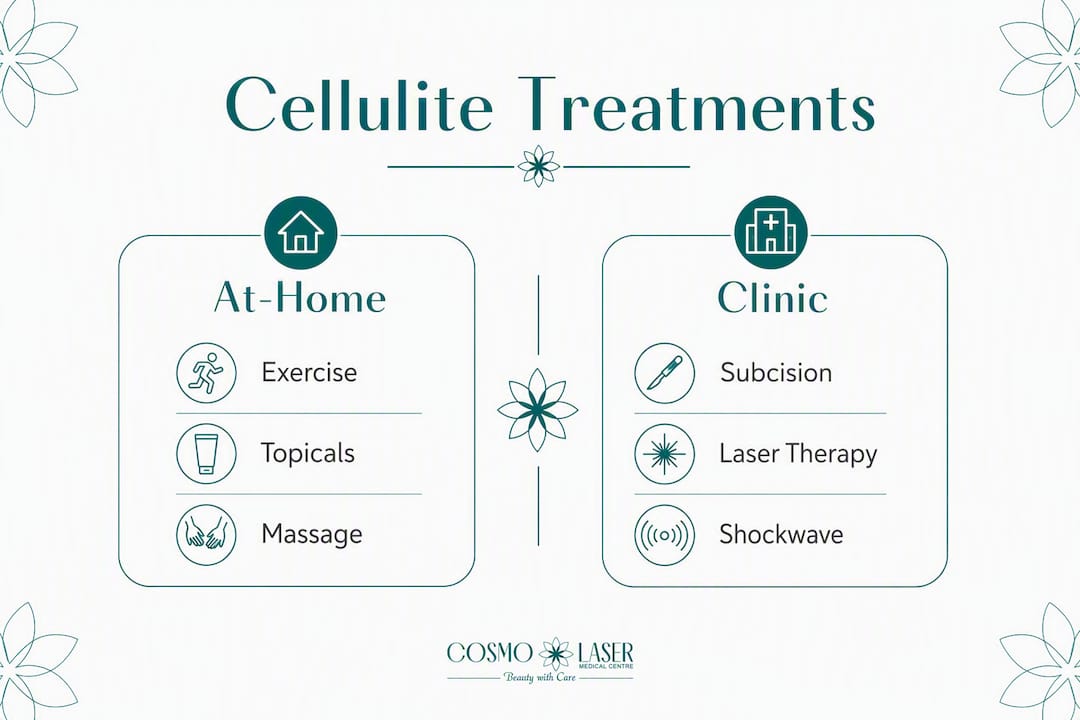
In-clinic procedures address cellulite at a deeper anatomical level than any home measure. No procedure offers a permanent cure, but several produce meaningful, multi-month improvements. The table below summarises the main options.
| Treatment type | How it works | Typical outcome and duration | Common side effects | Evidence strength |
|---|---|---|---|---|
| Subcision (needle or device-assisted) | A needle or device severs tethering septae beneath the skin | High patient satisfaction; improvements lasting 2+ years in some studies | Bruising, swelling, temporary tenderness | Strong |
| Laser-assisted (e.g., Cellulaze-type) | Laser energy releases septae, thickens dermis, and stimulates collagen | Results often lasting 1 year or longer; some patients report 2+ years | Bruising, swelling, short recovery period | Moderate to strong |
| Radiofrequency (RF) devices | Thermal energy tightens skin and stimulates collagen remodelling | Improvement lasting 6 months to 1 year; multiple sessions required | Temporary redness, mild swelling | Moderate |
| Acoustic wave therapy | Pressure waves disrupt fat lobules and stimulate circulation | Modest improvement; typically requires 6 sessions; shorter durability | Mild discomfort, temporary redness | Moderate |
| Injectable therapies (e.g., collagen biostimulators) | Stimulate collagen production in the dermis | Gradual improvement over months; duration varies | Bruising, swelling at injection site | Moderate |
| Liposuction | Removes fat volume | Not a cellulite treatment; may worsen dimpling | Significant downtime, risk of contour irregularities | Not recommended for cellulite |
Subcision
Subcision is currently the most evidence-supported minimally invasive option. A fine needle or device-assisted tool is inserted beneath the skin to physically cut the tethering fibrous bands. AAD clinical guidance reports high patient satisfaction and improvements lasting two years or more in some cohorts. Bruising and swelling are expected for one to two weeks post-procedure.
Laser and energy-based treatments
Laser-assisted procedures combine septae release with thermal energy that stimulates collagen production, effectively thickening the dermis over time. Mayo Clinic data indicates results lasting six months to a year or longer, with some minimally invasive laser approaches reporting durability beyond two years. Multiple sessions are often required, and maintenance treatments extend results. Laser skin remodelling works on similar collagen-stimulation principles used in wrinkle reduction, making it a versatile tool in combination plans.
Radiofrequency devices deliver controlled thermal energy to the dermis and subcutaneous layer. They do not release septae directly but improve skin laxity and texture. Results typically last six months to one year, and most protocols involve a course of sessions rather than a single treatment.
Acoustic wave therapy
Acoustic wave (or shockwave) therapy uses pressure pulses to disrupt fat lobule architecture and stimulate local circulation. It is non-invasive and well-tolerated, but the evidence for durable improvement is more modest than for subcision or laser. A typical course involves six to eight sessions over several weeks.
Why liposuction is not the answer
Liposuction removes fat volume but does not address the fibrous septae. Removing fat can actually worsen the appearance of dimpling by reducing the volume that previously filled the skin, leaving the tethered bands more prominent. Most medical cellulite procedures target connective tissue and skin quality rather than fat removal. Patients who approach a clinic expecting fat loss from a cellulite procedure should be redirected to a separate body-contouring conversation.
A short regulatory note for UK patients: Before booking any energy-based device treatment, check that the device holds MHRA approval for its intended use and that the clinician performing the procedure is registered with the GMC (for doctors) or holds appropriate professional registration. The Care Quality Commission (CQC) registers and inspects clinics in England; checking CQC status is a straightforward step that protects you.
Combining treatments that target different anatomical layers, such as subcision for septae release, radiofrequency for skin tightening, and collagen biostimulators for dermal quality, typically produces more satisfying results than any single modality alone. — PubMed clinical review
When does cellulite need a doctor’s assessment?
Ordinary cellulite does not require medical treatment. A clinician typically assesses it through visual inspection, a brief history, and, where necessary, palpation to rule out other dermatological or soft-tissue conditions. The most important distinction is between cellulite and cellulitis: cellulitis is a bacterial skin infection that can look superficially similar but is a medical emergency requiring antibiotics.
See your GP urgently if you notice any of the following:
- Skin that is warm, red, or tender to the touch
- Rapid onset of new skin changes over hours or days
- Fever, chills, or feeling systemically unwell alongside skin changes
- Painful nodules or lumps beneath the skin
- Skin changes following an injury, insect bite, or recent procedure
- Lymph node swelling in the groin or thigh alongside skin changes
These are red flags that warrant same-day or urgent GP assessment, not a cosmetic clinic booking.
Before a clinic consultation, prepare the following:
- Photographs of the affected area taken in consistent lighting and posture over time, to document any changes
- A list of current medications, supplements, and any hormonal contraception
- A record of any previous cosmetic or dermatological procedures
- Notes on relevant medical history (thyroid conditions, lymphoedema, prior surgeries in the area)
- A clear description of your goals and what outcome you would consider a success
How to choose a cellulite treatment and a clinic in the UK
The UK aesthetic market is largely unregulated for non-surgical procedures, which means the burden of due diligence falls on the patient. Choosing well is not complicated, but it requires asking the right questions.
Credentials to verify before booking:
- GMC registration for any doctor performing or supervising the procedure (check via the GMC online register)
- CQC registration for the clinic if it is in England (check via the CQC website)
- Specific training and experience in the procedure you are considering, not just general aesthetics
- MHRA device status for any energy-based equipment used
Questions to ask at your consultation:
- What grade of cellulite do I have, and which treatment is most appropriate for my severity?
- How many sessions will I need, and what is the realistic improvement I should expect?
- How long will results last, and what maintenance will I need?
- What are the common side effects and the rare but serious risks?
- What is the total cost, including any follow-up sessions or maintenance?
- What happens if I am unhappy with the result?
On cost: UK pricing for cellulite treatments varies considerably by modality and clinic. Radiofrequency courses typically run across multiple sessions; subcision is generally priced per treatment area. Be cautious of prices that seem significantly below the market norm, as they may reflect unqualified practitioners or unregistered devices. High-pressure sales tactics, such as being pushed to book a package on the day of consultation, are a warning sign.
Pro Tip: Always request a written treatment plan and a breakdown of costs before committing. A reputable clinic will provide this without hesitation. If a clinic refuses or pressures you to decide immediately, walk away.
A clinical review recommends matching treatment intensity to the severity of your cellulite: mild cases respond to lifestyle and topical adjuncts; moderate cases to non-invasive energy devices; severe cases to minimally invasive procedures such as subcision. A good clinician will follow this logic rather than defaulting to the most expensive option.
What dermatologists want you to understand before you book
The most consistent message from dermatology and aesthetic medicine is this: manage your expectations before you manage your cellulite. AAD expert guidance emphasises that topical creams and home devices rarely reach the anatomical root cause, which lies in the deep fibrous septae. Surface treatments produce surface results.
“The most critical part of any cellulite consultation is not the treatment plan itself, but the conversation that establishes what the patient can realistically expect. Clinicians who skip this step set their patients up for dissatisfaction, regardless of how technically successful the procedure is.”
— Paraphrased from AAD clinical guidance
Clinician consensus also supports multimodal planning. Combining subcision with targeted energy devices and skin-thickening topicals addresses the condition at multiple anatomical levels simultaneously, which is why combination aesthetic treatment approaches consistently outperform single-modality protocols in clinical practice.
Practical advice for your consultation:
- Bring photographs taken at consistent angles and lighting to document your baseline
- Ask the clinician to grade your cellulite severity and explain how that grade informs the treatment recommendation
- Request a realistic timeline: when will you see initial results, and when will they peak?
- Discuss maintenance from the outset; most effective treatments require periodic repeat sessions
- Set a specific, measurable goal (e.g., reduced visibility at rest, improved texture on pinch) rather than a vague aspiration to “get rid of it”
Lifestyle measures such as resistance training and balanced nutrition support clinic results and help maintain improvements over time, even though they do not alter the structural septae. The most realistic outcome from a well-planned multimodal approach is a meaningful, visible reduction in severity that requires periodic maintenance to sustain.
Key takeaways
Cellulite is a structural skin condition affecting the majority of adult women; its appearance can be reduced through a combination of lifestyle measures and clinic procedures, but no treatment permanently eliminates it.
| Point | Details |
|---|---|
| No permanent cure exists | Results from laser, subcision, and RF treatments last 6 months to 2+ years; maintenance is required. |
| Multimodal approaches work best | Combining septae release, energy-based skin tightening, and topical support produces better outcomes than any single treatment. |
| Home measures have a ceiling | Exercise and retinol (0.3%) offer modest, gradual improvement; dry brushing and caffeine creams produce effects lasting hours only. |
| Red flags need a GP, not a clinic | Pain, warmth, rapid onset, or systemic symptoms alongside skin changes require urgent medical assessment. |
| Cosmolaser Medical Centre | Offers personalised multimodal cellulite assessment and treatment, including skin tightening and combination procedures. |
A clinician’s perspective on realistic cellulite care
The conversation around cellulite is too often shaped by marketing rather than anatomy. Patients arrive at consultations having tried numerous creams, devices, and dietary protocols, and the most valuable thing a clinician can offer at that point is clarity, not another product.
What the evidence consistently shows is that the fibrous septae are the primary structural driver of dimpling, and that any treatment which does not address them directly will produce only surface-level, temporary changes. This is not a reason for pessimism. Subcision and laser-assisted septae release genuinely work for many patients, producing improvements that last years with appropriate maintenance. The problem is not the treatments themselves; it is the gap between what patients are led to expect and what the anatomy will allow.
The patients who achieve the most satisfying outcomes are those who arrive with a clear, graded understanding of their condition, realistic goals, and a willingness to commit to a maintenance plan. A single session of any treatment is rarely sufficient. Cellulite management is better understood as an ongoing skin health strategy than as a one-time procedure.
Cosmolaser Medical Centre approaches this with a structured assessment process: grading severity, identifying the dominant anatomical contributors, and building a plan that combines the most appropriate modalities for that individual. Safety and evidence guide every recommendation. Patients are never offered a treatment that the clinical evidence does not support for their specific grade of cellulite.
Cosmolaser Medical Centre: personalised cellulite assessment and treatment
For patients who have moved past home remedies and want a clinically grounded plan, Cosmolaser Medical Centre offers a structured pathway from assessment to treatment. The clinic’s approach begins with a thorough consultation that grades cellulite severity and identifies which anatomical factors are dominant, before recommending a treatment combination.
Relevant procedures available at Cosmolaser Medical Centre include skin tightening using energy-based devices, radiofrequency microneedling for dermal remodelling, and combination treatment packages that address multiple anatomical layers in a single plan. All procedures are performed by qualified clinicians, and every recommendation is grounded in the peer-reviewed evidence base for cellulite management.
The clinic does not promise permanent results, because the evidence does not support that claim. What it does offer is a transparent, safety-first consultation and a realistic treatment plan tailored to your specific grade and goals. To book a personalised assessment, visit the Cosmolaser Medical Centre cellulite page or contact the clinic directly.
Useful sources and further reading
The following sources were used in preparing this article. Readers planning treatment in the UK are advised to verify clinician GMC registration and clinic CQC status independently, and to check MHRA device approval for any energy-based treatment they are considering.
- Cellulite: MedlinePlus Medical Encyclopedia — foundational overview of cellulite anatomy and causes
- Cellulite: What It Is, Causes, Location and Treatment — Cleveland Clinic — prevalence data and clinical overview
- How to Get Rid of Cellulite — Cleveland Clinic — evidence review of lifestyle and clinic options
- Cellulite: Diagnosis and Treatment — Mayo Clinic — treatment durability data and clinical guidance
- Cellulite Treatments: What Really Works — American Academy of Dermatology — dermatologist consensus and expectation management
- A Clinical Guide to the Treatment of Cellulite — PubMed — peer-reviewed clinical review of aetiology, pathophysiology, and treatment algorithms
- Cosmolaser Medical Centre — Cellulite — clinic-specific treatment information and booking
This article provides general health information and is not a substitute for professional medical advice. Consult a qualified clinician or your GP before beginning any treatment.
FAQ
Can you actually get rid of cellulite permanently?
No. There is no treatment that permanently eliminates cellulite. In-clinic procedures such as subcision and laser can produce meaningful improvements lasting from six months to two years or more, but the underlying structural anatomy means maintenance is required.
What is the main cause of cellulite?
The primary cause is the mechanical interaction between subcutaneous fat lobules pushing upward and fibrous septae pulling the skin downward. Hormonal factors (particularly oestrogen), genetics, and age-related skin thinning all influence how pronounced this becomes.
How do you reduce cellulite on the legs?
A combination approach works best: resistance training to build muscle tone, a balanced diet to support skin health, and, for more significant improvement, in-clinic treatments such as radiofrequency or subcision targeting the thigh septae. No single home remedy produces lasting structural change.
Will cellulite go away if you lose weight?
Not reliably. Weight loss can reduce the volume of fat pressing against the septae, which may modestly improve appearance. However, significant weight loss sometimes makes cellulite more visible, as the overlying skin has less volume to fill it. The fibrous bands remain regardless of body weight.
How long do clinic cellulite treatments last?
Duration depends on the modality. Subcision studies report improvements lasting two years or more in some patients. Laser and radiofrequency treatments typically produce results lasting six months to one year, with repeat sessions extending durability. No treatment offers a permanent outcome.