
TL;DR:
- Early diagnosis and classification of alopecia are essential because scarring and nonscarring types require different treatments. Visiting a dermatologist for in-person evaluation, including trichoscopy and possible biopsy, enables accurate diagnosis and appropriate intervention. Prompt assessment helps preserve hair follicles, especially in scarring alopecia, and improves treatment outcomes.
Alopecia is the medical term for any clinically significant hair loss, ranging from small reversible patches to permanent follicle destruction. The single most important step you can take right now is to book an in-person dermatology consultation. Early diagnosis separates the reversible forms from the scarring ones, and that distinction changes everything about your treatment pathway.
At your appointment, a clinician will use tools such as trichoscopy (a magnified scalp examination) and, where needed, a scalp biopsy to classify your hair loss accurately. Cosmolaser Medical Centre in Sharjah offers exactly this in-person diagnostic and treatment pathway, with a clinical team experienced in both medical and procedural hair restoration.
- Bring dated photographs showing the progression of your hair loss
- List all current medications, including supplements and hormonal contraceptives
- Note any recent illnesses, surgeries, significant weight changes, or stressful events
- Record any family history of hair loss on both sides
Pro Tip: Take photos in consistent lighting every four weeks from diagnosis. This simple habit gives your clinician objective evidence of progression or response that a single clinic visit cannot provide.
Table of Contents
- What does normal hair shedding look like?
- How do dermatologists classify alopecia?
- What causes hair loss and what does each pattern look like?
- What happens at an alopecia diagnosis appointment?
- Which treatments work for which type of hair loss?
- What are realistic timelines for hair regrowth?
- When should you see a dermatologist urgently?
- Cosmetic and psychological support during treatment
- How Cosmolaser Medical Centre approaches alopecia
- Key takeaways
- What early diagnosis actually changes
- Alopecia assessment and treatment at Cosmolaser Medical Centre
- Useful sources and further reading
- FAQ
What does normal hair shedding look like?
Losing around 100 hairs per day is considered normal physiological shedding. Hair loss becomes a clinical concern when you notice sustained thinning, visible patches, or shedding that consistently outpaces regrowth.
100 hairs per day is the accepted normal shedding threshold. Anything beyond that, sustained over weeks, warrants a clinical assessment rather than a wait-and-see approach.
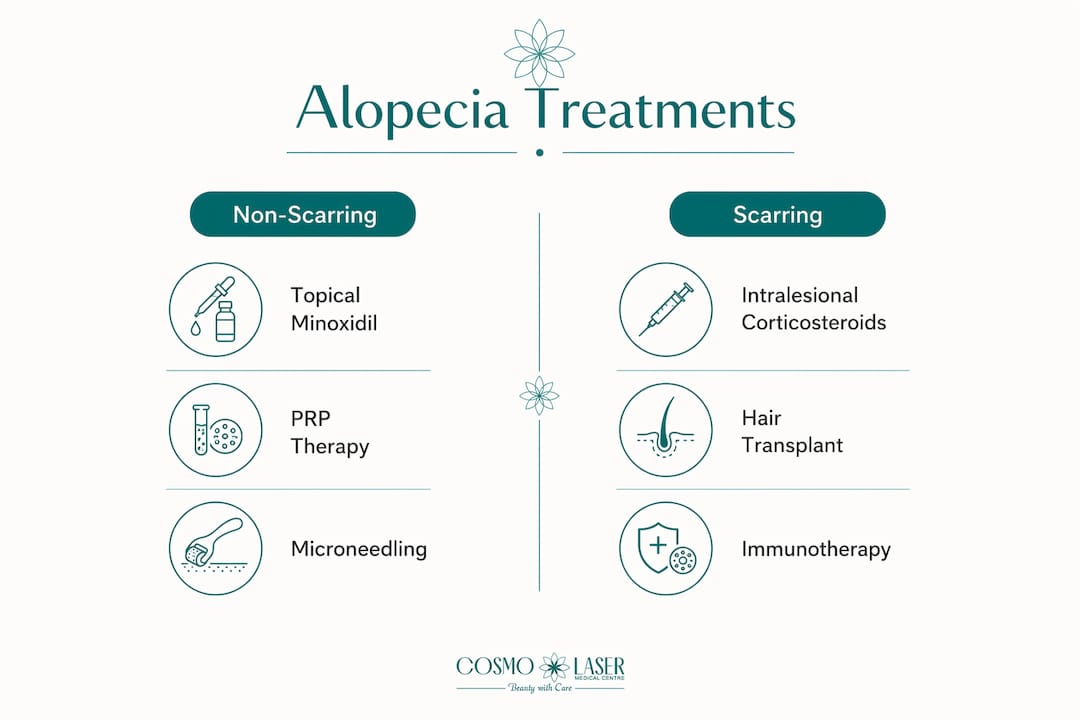
Hair loss can be focal (confined to distinct patches) or diffuse (spread across the scalp). The nonscarring versus scarring distinction is the most clinically important split: nonscarring forms preserve the follicle and retain regrowth potential, while scarring forms destroy it permanently. Androgenetic alopecia is the most prevalent type, affecting many men and women as they age, though it can begin as early as adolescence.
How do dermatologists classify alopecia?
The primary clinical division is nonscarring versus scarring alopecia, and it determines whether regrowth is biologically possible.
Nonscarring types (follicles intact, regrowth possible):
- Androgenetic alopecia (male- and female-pattern hair loss)
- Alopecia areata (autoimmune, patchy)
- Telogen effluvium (diffuse, trigger-related)
- Traction alopecia (mechanical damage from hairstyles)
Scarring types (follicles destroyed, regrowth not possible):
- Lichen planopilaris
- Discoid lupus erythematosus
- Folliculitis decalvans
Accurate classification changes the urgency of biopsy and the entire treatment approach. A scarring process caught early can be slowed; one identified late leaves only cosmetic or surgical options.
Pro Tip: Inspect the bare patches in good light. A smooth, shiny scalp surface with no visible follicular openings suggests scarring alopecia and warrants urgent referral, not watchful waiting.
What causes hair loss and what does each pattern look like?
Androgenetic alopecia follows a predictable pattern: recession at the temples and crown in men, diffuse thinning along the central parting in women. The hormone dihydrotestosterone (DHT) drives progressive follicle miniaturisation, and the process is largely hereditary.

Alopecia areata presents as sudden, coin-sized patches of smooth hair loss, often with short “exclamation point” hairs at the patch margins. The immune system attacks hair follicles, causing inflammation without scarring. It can affect any body area and, in severe cases, progresses to alopecia totalis (complete scalp loss) or alopecia universalis (total body hair loss).
Telogen effluvium produces diffuse shedding roughly three months after a triggering event, such as illness, surgery, childbirth, rapid weight loss, or certain medications. It is usually self-limiting once the trigger resolves.
Traction alopecia develops at the hairline and temples from chronic tension: tight braids, high ponytails, and hair extensions are the most common culprits.
Common medication and systemic causes to flag at your consultation:
- Chemotherapy agents (anagen effluvium)
- Blood thinners, antihypertensives, retinoids, anticonvulsants (telogen effluvium)
- Thyroid disorders, iron deficiency, polycystic ovary syndrome
- Fungal scalp infection (tinea capitis), particularly in children
Pro Tip: Biotin and collagen supplements only improve hair growth when a clinical deficiency exists. Routine supplementation without confirmed deficiency does not accelerate regrowth and can create false expectations.
What happens at an alopecia diagnosis appointment?
A structured diagnostic sequence helps the clinician narrow the cause before any treatment is prescribed.
- History — onset, rate of progression, family history, medications, recent illnesses, and hormonal changes
- Physical examination — scalp, hair shaft, and any nail changes (pitting suggests alopecia areata)
- Pull test — gentle traction on approximately 40 hairs across three scalp zones; more than 4–6 telogen hairs per pull indicates active effluvium
- Trichoscopy — dermoscopic magnification of the scalp to assess follicular density, miniaturisation, and signs of inflammation or scarring
- Blood tests — thyroid function, full blood count, serum ferritin, vitamin D, and hormonal panels where indicated
- Scalp biopsy — a 4-mm punch biopsy sectioned horizontally is the preferred method to differentiate scarring from nonscarring alopecia when the clinical picture is unclear
A scalp biopsy is not a last resort — it is often the only way to confirm a scarring diagnosis before irreversible follicle loss has progressed too far to treat effectively.
Bring to your appointment: dated photographs, a full medication list, and a written timeline of when shedding began and any preceding health events.
Which treatments work for which type of hair loss?
| Treatment | Best suited to | Typical time to effect | UK access route |
|---|---|---|---|
| Topical minoxidil | Androgenetic, telogen effluvium | 8–12 months | Over the counter |
| Oral finasteride (men) | Male-pattern | 6–8 months | GP or private prescription |
| Intralesional corticosteroids | Alopecia areata | 4–8 weeks per cycle | Clinic procedure |
| Systemic immunosuppressants / JAK inhibitors | Severe alopecia areata | Variable; specialist-led | NHS specialist or private |
| PRP (platelet-rich plasma) | Adjunct for androgenetic, areata | Monthly × 3, then maintenance | Private clinic |
| Low-level laser therapy | Pattern hair loss | Months of regular use | OTC device or clinic |
| FUE / FUT hair transplant | Stable androgenetic alopecia | 12 months post-procedure | Private surgical clinic |
Finasteride safety note: Finasteride 1 mg is licensed for male-pattern hair loss only. It carries a teratogenic risk and must not be handled or taken by anyone who is pregnant or may become pregnant. In the UK, it is available on private prescription; GPs may prescribe it but often refer to a dermatologist first.
Minoxidil shedding phase: When starting topical minoxidil, an early shedding phase lasting 2–6 weeks is common and usually indicates the treatment is working, not failing. Maintaining adherence through this phase is clinically important.
Low-level laser therapy has FDA clearance for pattern hair loss and can be used alongside other treatments, though the mechanism is not fully understood and evidence remains limited to androgenetic alopecia.
For hair transplant surgery, donor graft availability constrains outcomes in extensive hair loss. FUE leaves small circular donor scars; FUT produces a linear scar that may be visible with short hairstyles. Candidacy depends on donor density and whether the underlying loss has stabilised.
Pro Tip: Combination approaches, such as PRP alongside microneedling, are increasingly used in aesthetic dermatology clinics to address pattern loss from multiple angles simultaneously.
What are realistic timelines for hair regrowth?
- Telogen effluvium — shedding typically peaks around three months after the trigger and resolves within six months once the cause is addressed
- Topical minoxidil — visible regrowth takes 8–12 months; treatment must continue indefinitely to maintain results
- Finasteride — clinical evidence of response is assessed at 6–8 months
- Alopecia areata (patchy) — hair may regrow spontaneously within one year in many cases, so watchful waiting is a legitimate initial strategy for limited disease
Signs of improvement to report at follow-up:
- Reduced daily shedding count
- Visible regrowth (fine vellus hairs at patch margins)
- Stable hairline with no new patches
Signs of progression requiring reassessment:
- New patches appearing while existing ones persist
- Scalp becoming smooth and shiny at patch borders
- Nail pitting or other systemic symptoms developing
When should you see a dermatologist urgently?
Most hair loss is not a medical emergency, but certain presentations need prompt assessment.
Seek same-week assessment for:
- Rapid, extensive shedding over days rather than weeks
- Painful, inflamed, or tender scalp
- Smooth, shiny skin at loss sites with absent follicular openings (scarring signs)
- Sudden patchy loss progressing quickly toward alopecia totalis
Routine referral is appropriate for:
- Gradual thinning consistent with androgenetic pattern
- Diffuse shedding following a clear trigger (telogen effluvium)
- Stable patchy loss without scalp inflammation
Early recognition of scarring alopecia is critical. Once follicles are irreversibly destroyed, treatment options are limited to cosmetic and surgical approaches — there is no way to restore what has already been lost.
In the UK, you can request an NHS GP referral to a dermatologist, though waiting times vary. Private dermatology appointments are typically available within days and include trichoscopy and biopsy in a single visit.
Cosmetic and psychological support during treatment
Medical treatment timelines are long. Cosmetic and psychological support during that period is not optional — it is part of good care.
Appearance options:
- Medical-grade wigs and hairpieces (NHS prescription available for certain diagnoses)
- Scalp micropigmentation (tattooing technique that replicates follicular density)
- Camouflage fibres (keratin-based products that bind to existing hair)
Psychological support:
- Cognitive behavioural therapy (CBT) for body image distress
- Peer support groups such as Alopecia UK
- Clinic-based signposting to mental health resources
Hair loss consistently affects self-esteem and quality of life across all genders and ages. Treating the psychological dimension alongside the physical one produces better adherence to medical treatment and better patient outcomes overall.
For daily haircare during treatment, scalp care practices such as gentle cleansing, avoiding excessive heat, and minimising mechanical tension help protect remaining follicles while medical therapy takes effect.
How Cosmolaser Medical Centre approaches alopecia
The clinical team at Cosmolaser Medical Centre, led by Dr Anoop Suresh Babu, follows a structured in-clinic pathway designed to reach an accurate diagnosis before any treatment is recommended.
Typical pathway:
- Initial consultation: full history, scalp examination, pull test
- Trichoscopy: in-house dermoscopic assessment of follicular status
- Targeted blood tests: thyroid, ferritin, vitamin D, hormonal panel where indicated
- Personalised treatment plan: medical options (topical and injectable), procedural options (intralesional steroid injections, PRP, hair restoration consultation), and referral pathways where needed
Every patient’s hair loss pattern is different. A treatment plan built on an accurate diagnosis — not a generic protocol — is what produces consistent, measurable results.
The clinic’s procedural capabilities include trichoscopy, intralesional corticosteroid injections, PRP therapy, and hair restoration consultation. Follow-up appointments track objective response using comparative photography and trichoscopic reassessment.
Key takeaways
Early diagnosis and accurate classification are the foundations of effective alopecia management, because the nonscarring versus scarring distinction determines whether regrowth is biologically possible at all.
| Point | Details |
|---|---|
| See a dermatologist early | Scarring alopecia causes irreversible follicle loss; early assessment preserves your treatment options. |
| Classification drives treatment | Nonscarring types (androgenetic, areata, telogen effluvium) are potentially reversible; scarring types are not. |
| Timelines are long | Minoxidil takes 8–12 months; finasteride response is assessed at 6–8 months; alopecia areata may resolve spontaneously within a year. |
| Finasteride safety | Licensed for men only; teratogenic risk means it must not be taken or handled by anyone who may become pregnant. |
| Cosmolaser Medical Centre | Offers in-person trichoscopy, intralesional injections, PRP, and hair restoration consultation in Sharjah. |
What early diagnosis actually changes
The conventional wisdom on hair loss is that you should “wait and see.” In clinical practice, that advice costs patients follicles they cannot get back. Scarring alopecias, in particular, are frequently mistaken for androgenetic thinning in the early stages, and by the time the distinction is obvious to the naked eye, the window for anti-inflammatory treatment has often closed.
What I find most underestimated is the psychological toll of uncertainty. Patients who receive a clear diagnosis, even when the news is not ideal, consistently report less distress than those left in diagnostic limbo. A named condition with a mapped treatment pathway is something you can act on. Vague reassurance is not.
The other point worth making plainly: combination approaches work better than single-modality treatment for most patients. Medical therapy stabilises the process; procedural options such as PRP or microneedling address density; and consistent follow-up with objective photography tracks whether the plan is working. None of that happens without an in-person assessment as the starting point.
Alopecia assessment and treatment at Cosmolaser Medical Centre
Patients in Sharjah dealing with hair loss have access to a full diagnostic and treatment pathway at Cosmolaser Medical Centre, without the waiting times associated with NHS referrals. The clinic offers same-visit trichoscopy, targeted blood test referrals, intralesional corticosteroid injections, PRP therapy, and hair restoration consultations, all within a single clinical setting.
The first step is a consultation with Dr Anoop Suresh Babu or the Cosmolaser clinical team, where your history, scalp examination, and trichoscopy results are reviewed together to produce a personalised treatment plan. For patients considering procedural options, the clinic’s dermatologist-led approach ensures that every recommendation is grounded in clinical evidence rather than a one-size-fits-all protocol. Book your in-person consultation at cosmolaser.ae to begin with an accurate diagnosis.
Useful sources and further reading
The clinical information in this article draws on the following primary and authoritative sources. UK prescribing rules for finasteride and minoxidil differ from other markets; always confirm current guidance with your prescribing clinician.
- Alopecia — StatPearls / NCBI Bookshelf
- Alopecia — MSD Manual Professional Edition
- Hair Loss (Alopecia) — Penn Medicine
- Alopecia Areata — NIAMS
- Alopecia Areata — Mayo Clinic
- A dermatologist’s guide to hair loss treatments — VCU Health
- Hair transplantation practical considerations — PMC
- It’s not too late to save thinning hair — Harvard Health
This article provides general clinical information and does not constitute medical advice. Confirm diagnosis, treatment suitability, and current UK prescribing guidance with a qualified clinician for your individual situation.
FAQ
What is the difference between alopecia areata and androgenetic alopecia?
Alopecia areata is an autoimmune condition causing sudden patchy hair loss, while androgenetic alopecia is a hereditary, hormone-driven process producing gradual thinning in a predictable pattern. Both are nonscarring, but their treatments differ entirely.
Can alopecia areata resolve on its own?
Yes. Hair may regrow spontaneously within one year in many cases of patchy alopecia areata, making watchful waiting a reasonable initial strategy for limited disease.
How long does minoxidil take to work?
Visible regrowth from topical minoxidil typically takes 8–12 months, and treatment must continue indefinitely to maintain results. An early shedding phase in the first 2–6 weeks is normal.
Is finasteride safe for women?
Finasteride is licensed for male-pattern hair loss only. It carries a teratogenic risk and must not be taken or handled by anyone who is pregnant or may become pregnant.
When does hair loss need urgent medical attention?
Seek prompt assessment for rapid extensive shedding, a painful or inflamed scalp, or smooth shiny skin at loss sites with no visible follicular openings, as these signs may indicate scarring alopecia requiring urgent treatment.