The most reliable path to a smoother, tighter neck is a personalized, staged plan that combines non-surgical therapies with surgical correction reserved for cases where skin excess is too significant for devices or injectables to manage. Treatment categories generally fall into four groups: energy-based devices, injectables, fat-reduction methods, and surgery, and the right mix depends entirely on your anatomy. Rather than chasing a single trending technology, book a medical assessment first so a qualified clinician can map your specific concerns, whether that’s platysmal bands, submental fat, or crepey skin, to the treatments that actually address them.
TL;DR:
- Non-surgical treatments are effective for mild to moderate neck concerns, but significant skin excess still requires surgical excision for lasting results.
- Treatments should be carefully sequenced, prioritizing fat reduction first, then skin tightening, resurfacing, and finally injectables for refinement.
- Energy-based devices and regenerative injectables offer ongoing improvement but need repeated sessions, with surgical options providing longer-lasting outcomes.
- Specific neck anatomy, such as platysmal bands or submental fat, guides tailored treatment choices, and providers should have proven experience with neck procedures.
- A personalized, staged plan based on a thorough assessment is essential to achieve optimal, durable neck rejuvenation results.
Table of Contents
- How Clinicians Assess the Aging Neck
- Non-Surgical Treatments and What Each One Actually Targets
- Surgical Options and When They Make Sense
- The Smartest Sequence for Combining Treatments
- How to Choose the Right Treatment and Provider
- Key Takeaways
- Sources
- FAQ
How Clinicians Assess the Aging Neck
The neck ages differently than the face, and that difference drives every treatment decision. Neck skin runs roughly 0.25 millimeters thick across the epidermis and dermis combined, compared to more than a millimeter on the cheek, according to a comprehensive review of neck aging and rejuvenation. That thinness means the neck heals more slowly and tolerates far less aggressive intervention than facial skin, which is why a treatment that works beautifully on the cheeks can leave the neck with prolonged redness or uneven texture if the settings aren’t adjusted.

During a clinical assessment, a provider is looking at several distinct anatomical layers, not just “sagging skin” as a single problem. The platysma muscle sits just under the skin and can separate into visible vertical bands as it weakens with age. Fat compartments beneath the chin, known as submental fat, can persist even in people who are otherwise lean. The cervicomental angle, the line from chin to neck, opens and softens as fat and skin volume shift downward. And the skin itself may show fine crepiness, sun damage, or pigmentation that has nothing to do with muscle or fat at all.
A thorough consult typically checks for:
- Visible platysmal bands, especially when you clench your jaw or tilt your head back
- Submental fullness that doesn’t respond to weight loss
- Redundant or loose skin that folds rather than springs back when pinched
- Surface texture changes, including crepiness, dullness, or uneven pigmentation
- A blunted cervicomental angle, which is often what makes a neck look “aged” even without loose skin
Each finding points toward a different solution. Bands typically respond to neuromodulator injections. Fat responds to lipolysis techniques or, in more significant cases, liposuction. Loose skin responds to energy devices or, when severe, surgical excision. Texture and pigmentation respond to resurfacing and topical care. Getting this mapping right before choosing a treatment is what separates a satisfying result from a disappointing one.
Non-Surgical Treatments and What Each One Actually Targets
Non-surgical neck rejuvenation covers a wider range of tools than most people realize, and each one solves a different piece of the puzzle. Here’s how the major categories break down.
- Energy-based tightening devices. High-intensity focused ultrasound (branded devices like Ultherapy), radiofrequency, and RF microneedling all work by heating deeper skin layers to trigger new collagen production over the following months. Fractionated, conservative settings matter enormously here because the neck’s thin skin can’t absorb the same energy load as the face without a higher risk of irregular healing. Most patients need a series of sessions, and initial tightening continues to improve for two to three months after treatment as collagen remodels.
- Fractional and non-ablative laser resurfacing. These treatments target surface texture, fine crepiness, and pigmentation rather than deep laxity. IPL can address sun damage and uneven tone, while fractional lasers create controlled micro-injury that prompts new collagen. Because neck skin heals more slowly than facial skin, practitioners typically choose gentler settings and space sessions further apart than they would on the face. A closer look at how laser resurfacing works on the skin explains the mechanism in more depth.
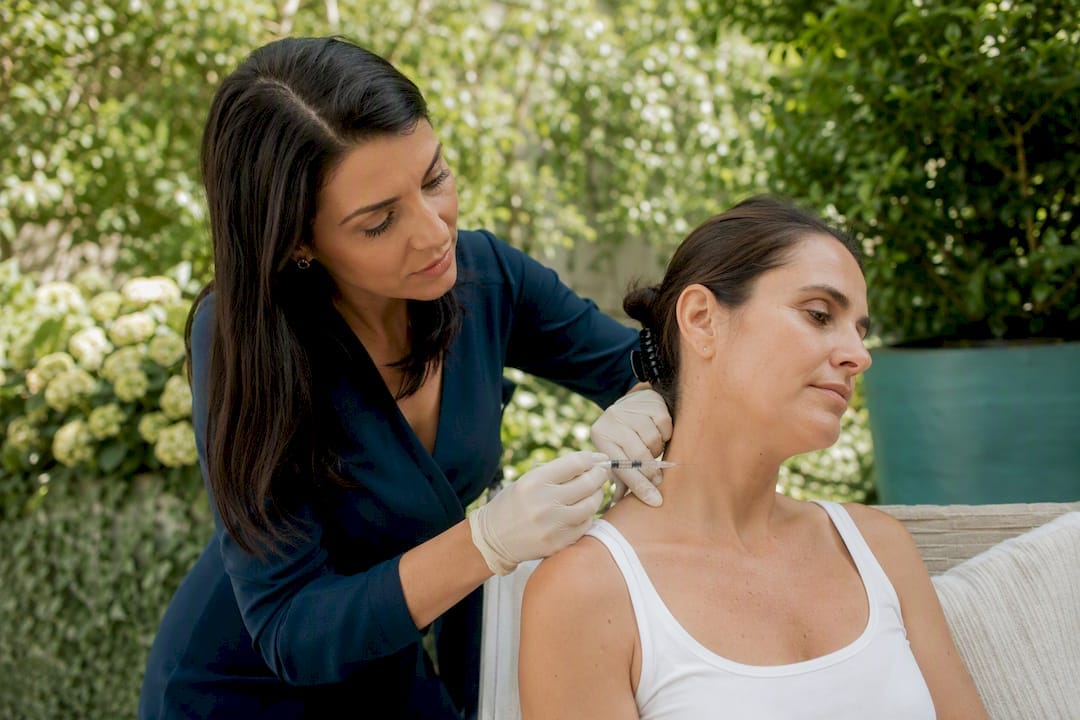
- Neuromodulator injections for platysmal bands. Botulinum toxin relaxes the vertical bands that show up when the platysma muscle weakens, using roughly 10 to 30 units per side depending on band severity. Effects peak at one to two weeks and last about three to four months before a repeat session is needed.
- Hyaluronic acid fillers and skin boosters. These add volume where it’s been lost and can smooth transitional areas between the chin and neck, though they play a more supporting role than a primary one in most neck plans; learn more about the science and skincare benefits of hyaluronic acid in this Hyaluronic acid: Science, benefits, and skincare uses resource.
- Collagen biostimulators, including polynucleotides. These regenerative injectables stimulate the skin’s own collagen production rather than adding volume directly. A recent prospective study combining platelet-rich plasma with hyaluronic acid over three monthly sessions found a 48% increase in neck skin firmness at three months, with the improvement holding for several months after the final treatment. That’s a meaningful data point for anyone weighing regenerative options over a single quick fix, and it’s the strongest short-term evidence currently available for combination injectable protocols. Cosmolaser Medical Centre’s collagen biostimulator treatments follow this same regenerative principle.
- Deoxycholic acid injections (ATX-101) and fat-reduction technologies. For submental fat that persists despite diet and exercise, deoxycholic acid dissolves fat cells directly, while cryolipolysis and laser lipolysis use cold or light energy to the same end. Controlled studies have shown meaningful improvement in submental fat with good tolerability across these noninvasive approaches, though most patients need two to four sessions spaced several weeks apart, with some swelling in between.
Pro Tip: Ask your provider what specific setting or dose they use on necks versus faces. If the answer is “the same as the face,” that’s worth a second opinion, since neck skin simply cannot tolerate identical energy levels without added risk.
Side effects across these categories tend to be mild but real: temporary swelling and bruising after injectables, redness or firmness after energy devices, and occasional asymmetry with neuromodulators that resolves as the product wears off. Maintenance is ongoing rather than one-and-done. Neuromodulators need repeating every three to four months, energy devices typically need annual touch-ups, and biostimulators often require a series followed by maintenance sessions every year or two.
Surgical Options and When They Make Sense
Surgery becomes the better choice when skin excess is significant enough that no amount of tightening technology will resolve it, because devices and injectables can’t remove tissue that needs to be excised. A neck lift is not a single procedure but a category that includes several distinct techniques depending on what needs correcting.
- Anterior submental neck lift. Performed through a small incision under the chin, this approach directly addresses platysmal banding and submental fat, often combined with liposuction, without the longer incisions of a full lift.
- Periauricular neck lift. Incisions run around the ear, allowing the surgeon to redrape and tighten loose neck skin, this is the approach of choice when skin excess, not just muscle or fat, is the dominant problem.
- Platysmaplasty. This directly repairs or tightens the platysma muscle itself, correcting the vertical bands that neuromodulators can only temporarily relax.
- Submental liposuction. Used alone for younger patients with good skin elasticity and isolated fat, or combined with a lift when skin laxity is also present.
Combining platysmaplasty with skin excision during a lift, sometimes alongside submental liposuction, tends to produce the most durable correction when bands and redundant skin coexist. That’s a meaningfully different result than injectables alone can offer, since surgery physically removes excess tissue rather than just relaxing muscle or stimulating collagen.
Recovery from a neck lift typically runs one to two weeks before returning to normal activities, with residual swelling settling over one to three months. Most procedures use local anesthesia with sedation rather than general anesthesia, though that varies by extent of surgery. Risks include scarring, temporary numbness, asymmetry, and, in rare cases, nerve irritation affecting lip movement. The upside is longevity: surgical results commonly last seven to ten years or longer, far outlasting any non-surgical modality, which is exactly why surgery remains the right call for patients with substantial skin excess rather than a fallback for people who simply want to avoid needles.

The Smartest Sequence for Combining Treatments
Treating the neck in the right order matters as much as choosing the right treatments. The general principle: address the deepest problem first, then tighten and resurface, and finish with injectables for fine contouring. Doing this backward, resurfacing skin that’s still being pulled down by unaddressed fat, wastes both money and downtime.
- Platysmal bands with mild laxity. Start with neuromodulator injections to relax the bands, then follow with an energy-based tightening series once the bands are controlled.
- Submental fat with crepey overlying skin. Address the fat first, through deoxycholic acid or a lipolysis technique, then move to skin tightening once the fat volume has resolved and swelling has settled.
- Texture and pigmentation as the dominant complaint. Skip fat and muscle treatments entirely and go straight to resurfacing and topical care, since the underlying structure isn’t the issue.
Multimodal protocols that pair energy devices with injectables and topical skincare tend to produce better patient retention and satisfaction than any single treatment used alone, largely because each modality is doing a job the others can’t. Spacing between sessions typically runs four to six weeks for most non-surgical modalities, giving collagen time to remodel and swelling time to resolve before the next intervention.
Pro Tip: If you’re combining an energy device with resurfacing, ask your provider to use more conservative settings than they would on a face-only case. Neck skin needs a gentler touch every step of the way, not just for one treatment.
How to Choose the Right Treatment and Provider
Matching your case to the right category starts with an honest read on severity. Mild cases, minor banding or early skin laxity, usually respond well to non-surgical treatments alone. Moderate cases, visible submental fat plus some skin excess, often need a combination of fat reduction and tightening. Severe cases, significant redundant skin that folds on itself, typically require surgery because no device can remove tissue that needs excising.
Before committing to a plan, ask your provider these specific questions:
- What is your training and experience specifically with neck treatments, not just facial procedures?
- Which device models do you use, and why did you choose them for the neck?
- What is your protocol if a complication occurs?
- Can I see before-and-after photos of patients with anatomy similar to mine?
- What does your follow-up schedule look like after treatment?
Watch for red flags that suggest a provider is prioritizing sales over safety: guarantees of permanent results from a single session, treatment plans made without a physical exam, or aggressive resurfacing settings applied to thin neck skin without adjustment. A conservative, staged approach is the mark of a provider who understands how differently the neck behaves compared to the face.
Cost varies widely by modality and region, and providers should give you a written estimate for your specific plan rather than a generic price list, since a single-session neuromodulator treatment and a multi-session surgical recovery plan sit at entirely different price points. If your provider can’t explain why your quoted cost fits your specific anatomy and goals, ask them to walk through it again before booking.
A Clinician’s Approach to Treatment Planning
Dr Anoop Suresh Babu of Cosmolaser Medical Centre emphasizes conservative energy settings and anatomy-first sequencing for every neck case, particularly given how much slower neck skin recovers compared to the face…
What the Treatment Journey Actually Looks Like
Most patients start with a consultation where their anatomy gets mapped to a plan, move into a sequenced series of treatments spaced weeks apart, and settle into periodic follow-ups to maintain results. If you’re weighing your options, book an assessment and bring the consultation questions above. The right plan is the one built around your neck, not a trending procedure name.
— Dr Anoop Suresh Babu
Where to Start Your Neck Rejuvenation Plan
Many patients bounce between separate providers for injectables, a different clinic for laser work, and a surgeon for anything more serious, which means starting the anatomy conversation over each time. Cosmolaser Medical Centre in Sharjah builds your neck plan around a single consultation, with all the relevant modalities, skin tightening, endolift, collagen biostimulators, and double-chin reduction for submental fat, available under one roof and one coordinated follow-up schedule.
That matters for UAE patients specifically, since regional heat and sun exposure accelerate the texture and pigmentation changes that show up on the neck years before they appear on the face. Cosmolaser Medical Centre’s team evaluates your platysma, fat compartments, and skin quality together, then builds a customized, multimodal sequence rather than selling you a single device pass. If you’re ready to see what a plan tailored to your neck actually looks like, explore combination aesthetic treatment options or book a consultation directly through the clinic to get your anatomy mapped and your treatment sequence started.
Key Takeaways
- A personalized, anatomy-driven plan combining non-surgical and surgical options usually beats any single-technology approach.
- Non-surgical treatments suit mild to moderate concerns; surgery is the right call once skin excess is too significant for devices to resolve.
- Sequence matters: treat fat first, then tighten and resurface, and finish with injectables for refinement.
- Ask providers about their specific neck experience, device settings, and complication protocols before committing.
- Book a medical assessment before choosing a treatment so your plan matches your actual anatomy.
This article is general information, not a substitute for advice from a qualified doctor. Consult a qualified healthcare professional about your own circumstances before acting on anything here.
Sources
- Prospective study of PRP + HA for neck skin firmness (2026)
- Clinical review of neck anatomy and injectable treatment for platysmal bands (PMC, 2020)
- Neck aging and rejuvenation: assessment and treatment (StatPearls/NCBI, 2023)
FAQ
What Is the Best Procedure for Neck Rejuvenation?
There’s no single best procedure. A personalized combination matched to your platysma, fat, and skin condition consistently outperforms any single treatment, with surgery reserved for significant skin excess.
What Is the Best Treatment for an Aging Neck?
It depends on what’s driving the aging: platysmal bands respond best to neuromodulators, submental fat to lipolysis or liposuction, and loose skin to energy devices or surgical excision.
Can I Reverse Aging on My Neck?
You can meaningfully improve firmness, texture, and contour through combination treatment, and a recent study found a 48% increase in neck skin firmness three months after a PRP and hyaluronic acid protocol, though full reversal of severe skin excess typically requires surgery.
Can I Tighten a Saggy Neck Without Surgery?
Mild to moderate laxity often responds well to energy-based devices and biostimulators, but severe redundant skin that folds on itself usually needs surgical excision since no non-surgical treatment removes excess tissue.