Picosecond and Q-switched lasers are the two device categories that clear freckles most reliably, with picosecond technology generally producing higher clearance and less thermal damage to surrounding skin. A retrospective analysis of 730 nm picosecond treatment found that 90% of patients achieved 95% or greater lesion clearance at six months, with post-inflammatory hyperpigmentation (PIH) in only two patients out of the sample. The real caveat isn’t the device. It’s your skin type, which determines settings, pulse selection, and how conservative the plan needs to be.
- Picosecond lasers (730 nm, 755 nm): highest clearance, lowest PIH risk in the studies cited
- Q-switched Nd:YAG/532 nm: dependable for epidermal pigment, more common globally
- Fractional Erb:YAG or CO2: used when resurfacing matters alongside pigment removal
Quick fact: Mayo Clinic notes that laser and intense pulsed light treatments for spots like these often need just one or two sessions, though temporary darkening or crusting is a known risk. Book a consult with a dermatologist-led clinic and insist on a test patch before committing to a full treatment plan.
Key Takeaways
Picosecond lasers at 730 nm currently offer the strongest combination of clearance and safety for freckles, with skin tone determining the exact protocol.
| Point | Details |
|---|---|
| Picosecond leads on evidence | Studies show up to 95% clearance at six months with low PIH incidence in the sample. |
| Multiple sessions are typical | Clearance rises from roughly 53% after one session to 78% after two, per retrospective data. |
| Darker skin needs conservative protocols | Fitzpatrick IV through VI patients need test patches and priming to reduce PIH risk. |
| Sunscreen prevents recurrence | Daily broad-spectrum sun protection is the main defense against freckles returning. |
| Cosmolaser Medical Centre offers medically supervised options | Picosecond and fractional technologies are available under physician-guided treatment plans in Sharjah. |
Table of Contents
- What Is Laser Treatment for Freckles and How Does It Work?
- What Types of Lasers Treat Freckles Best?
- What Happens During a Laser Freckle Treatment Session?
- What Are the Risks and Side Effects of Laser Freckle Removal?
- How Should You Care for Your Skin After Laser Freckle Treatment?
- Who Is the Best Candidate for Laser Freckle Removal?
- How Many Sessions Does Freckle Removal Take and What Does It Cost?
- How Does Cosmolaser Medical Centre Approach Freckle Treatment?
- Sources
- FAQ
What Is Laser Treatment for Freckles and How Does It Work?
Freckles, known clinically as ephelides, are small, flat, light brown marks that darken with sun exposure and often fade in winter. They differ from solar lentigines (sun spots or age spots), which are larger, more stable pigmented patches that don’t fluctuate seasonally and tend to appear later in life. Both respond to laser, but the underlying tissue behaves differently, which is part of why device choice matters.
Laser treatment works through selective photothermolysis: light of a specific wavelength gets absorbed by melanin in the pigmented cells while sparing the surrounding skin. Nanosecond and Q-switched lasers rely on a photothermal effect, heating and destroying pigment. Picosecond lasers deliver energy in ultra-short bursts that create a photomechanical effect, shattering pigment particles with less heat spread and less collateral damage.
- Before any cosmetic laser, a qualified clinician should examine each lesion
- Any spot that’s changed shape, color, or size recently needs evaluation, not treatment, since ruling out suspicious lesions comes first
What Types of Lasers Treat Freckles Best?
Device selection depends on lesion type, skin tone, and how much downtime you can tolerate.
Picosecond lasers deliver the strongest evidence for freckle clearance with minimal PIH. A split-face trial comparing 730 nm and 755 nm picosecond devices found comparable clearance around 69% for both, but patients rated the 730 nm titanium sapphire laser as noticeably less painful. That pain difference matters more than it sounds. Less discomfort usually means better tolerance for the multiple passes some lesions need.
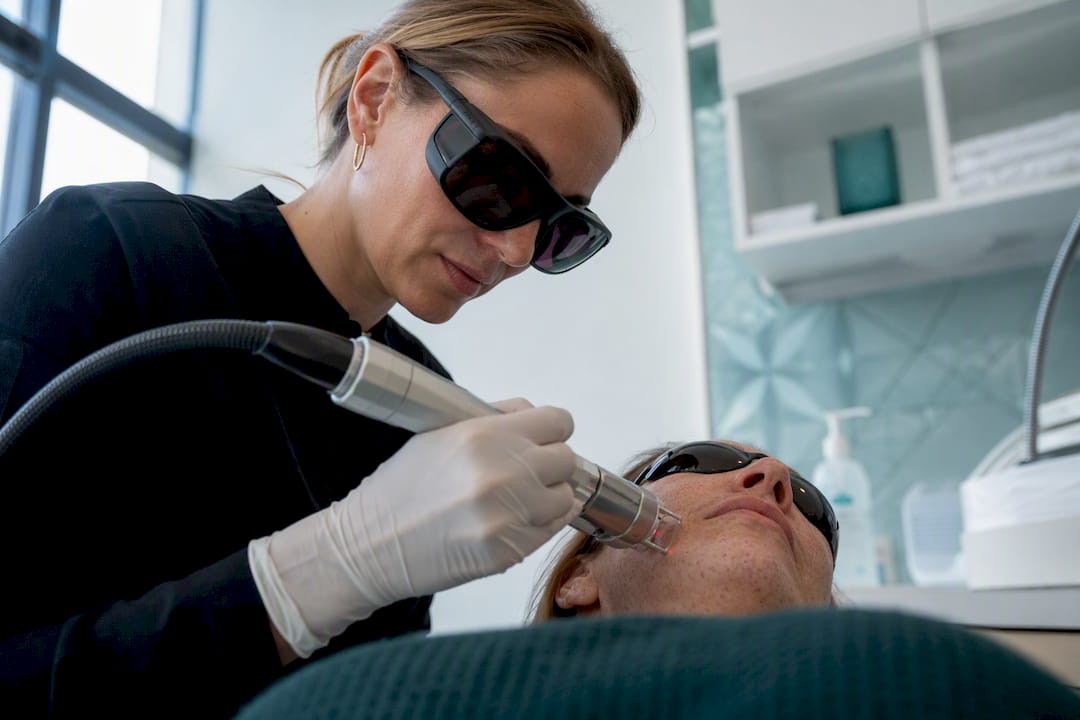
Q-switched devices (Nd:YAG at 1064 nm, frequency-doubled at 532 nm, ruby at 694 nm) remain a classic choice, especially where picosecond technology isn’t available. They work well on epidermal pigment but carry a higher thermal burden than picosecond systems.
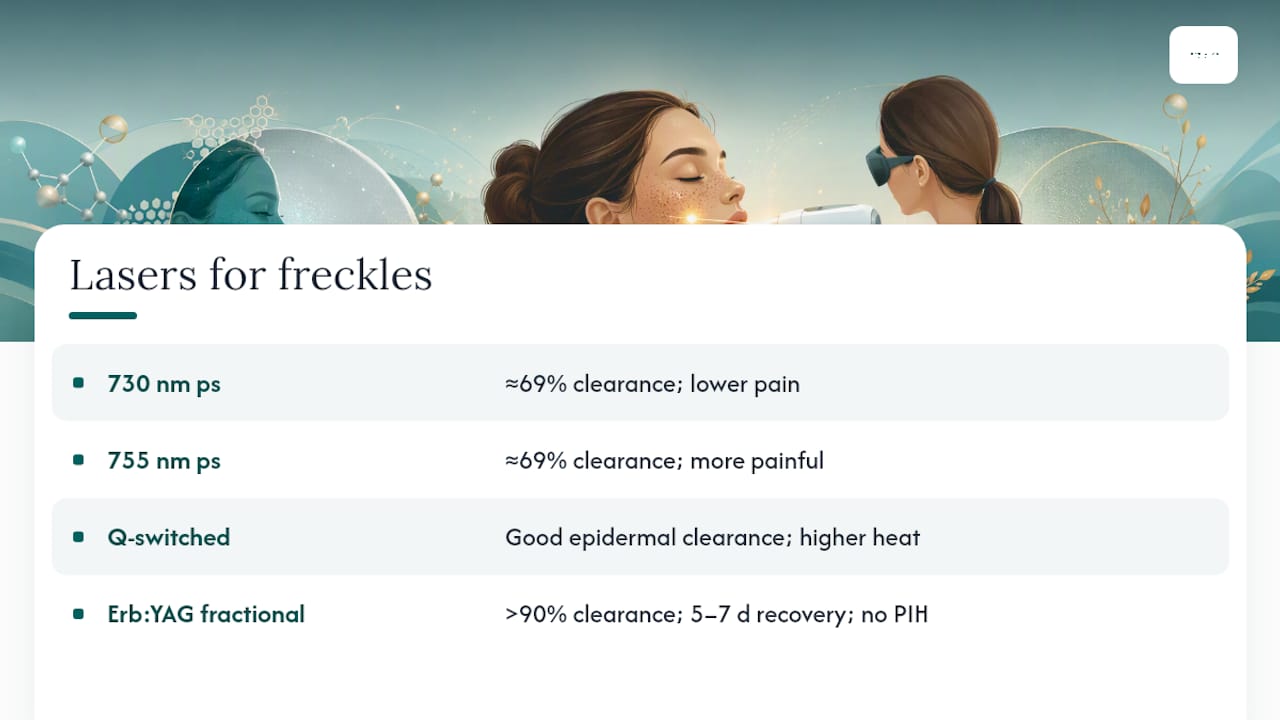
Alexandrite lasers at 755 nm show solid efficacy but tend to sting more than 730 nm picosecond alternatives, based on the same split-face data above.
Erbium (Er:YAG) and fractional CO2 lasers resurface skin rather than just targeting pigment. A study of nonablative fractional Erb:YAG in Asian patients with Fitzpatrick III/IV skin reported over 90% clearance after one session, 5 to 7 days of recovery, and no PIH at six months. Cosmolaser Medical Centre’s picosecond platform reflects this same lower-heat philosophy.
IPL/BBL treats broad areas with many small spots or diffuse sun damage rather than isolated freckles, though darker skin tones need cautious settings to avoid uneven pigment response.
Pro Tip: Ask your clinic which wavelength they’re using and why. “Picosecond” alone isn’t enough information. The specific nanometer setting changes both pain and clearance outcomes.
What Happens During a Laser Freckle Treatment Session?
- Pre-visit prep. Bring photos of your freckles in different seasons, and disclose every medication and supplement, especially blood thinners or retinoids, since these affect healing and bruising risk.
- Test patch. Especially for medium to darker skin, clinicians treat a small area first and wait days to weeks to check for unexpected pigment response before committing to the full area.
- Anesthesia. Most sessions use topical numbing cream applied 20 to 30 minutes beforehand; some picosecond treatments need no anesthesia at all given the shorter, less painful pulses.
- Treatment. The provider delivers pulses across each lesion, sometimes with multiple passes, using in-session cooling to protect surrounding tissue. Sessions typically run 15 to 30 minutes depending on the area treated.
- Immediate aftermath. Expect redness (erythema) right away and possible pinpoint scabbing (often described as tiny dark crusts) within a day or two, usually resolving within a week.
What Are the Risks and Side Effects of Laser Freckle Removal?
Redness and mild swelling are near-universal and typically fade within 24 to 72 hours. Fine scabbing over each treated freckle is expected. It’s the skin’s normal healing response and shouldn’t be picked or scrubbed off.
The bigger concern is post-inflammatory hyperpigmentation, particularly for Fitzpatrick skin types IV through VI. Clinical reviews on lasers for skin of color consistently flag PIH as the dominant risk in darker skin and recommend conservative energy settings, mandatory test patches, and pre-treatment topical priming to reduce that risk before any full session begins.
By the numbers: In the 730 nm picosecond retrospective study, only 2 patients in the entire sample developed PIH, an unusually low rate that supports picosecond technology’s lower thermal footprint. Hypopigmentation and scarring are rarer still, usually tied to overly aggressive settings or inadequate spacing between sessions.
- Erythema: expected, resolves in days
- Scabbing: normal, don’t pick at it
- PIH: the real risk in darker skin, mitigated by conservative settings and priming
- Hypopigmentation/scarring: uncommon with properly spaced, well-calibrated treatment
How Should You Care for Your Skin After Laser Freckle Treatment?
Cooling the treated area for the first few hours calms inflammation and reduces swelling. Keep the skin clean with a gentle, fragrance-free cleanser, and resist the urge to pick at any scabbing. That’s the single fastest way to trade a freckle for a scar or a patch of PIH.
Clinics typically recommend a structured topical schedule: a gentle moisturizer for the first several days, followed by tyrosinase inhibitors (like those found in brightening serums) once the skin has re-epithelialized, if your provider advises it. Daily broad-spectrum sunscreen is non-negotiable and is the single biggest factor separating durable results from recurrence. Cosmolaser Medical Centre’s recovery guide walks through the specifics in more depth.
- Cool the area for the first few hours post-treatment
- Cleanse gently, avoid picking scabs
- Apply sunscreen daily without exception
- Contact your clinic if you notice pus, spreading redness, or fever, which signal infection rather than normal healing
Pro Tip: Set a calendar reminder to reapply sunscreen every two hours if you’re outdoors in the UAE sun during recovery. Heat and UV exposure are the two fastest ways to undo a good result.
Who Is the Best Candidate for Laser Freckle Removal?
Freckles generally respond faster and more predictably to laser than solar lentigines, since ephelides sit more superficially in the skin. That said, both lesion types are treatable with the right device and settings.
Skin tone drives almost every clinical decision here. Fitzpatrick I to III skin tolerates a wider range of wavelengths and energy levels with lower PIH risk. Fitzpatrick IV through VI needs picosecond technology or conservative Q-switched settings, mandatory test patching, and often pre-treatment priming with topical agents to reduce melanocyte reactivity before the laser ever touches the skin.
- Isolated freckles on lighter skin: broadest device options, fastest results
- Freckles or lentigines on medium to darker skin: picosecond preferred, test patch mandatory
- Any lesion with irregular borders, rapid change, or bleeding: needs dermatology evaluation, possibly biopsy, before any cosmetic treatment is considered
Cosmolaser Medical Centre’s guidance on pigmentation removal by skin tone covers this decision tree in more detail for UAE patients weighing their options.
How Many Sessions Does Freckle Removal Take and What Does It Cost?
Most picosecond and Q-switched treatments clear freckles in one to three sessions, spaced four to eight weeks apart to let skin fully heal between rounds. A 2023 retrospective analysis found lesion clearance rates of 53.1% after one 730 nm picosecond treatment and 78.4% after two, which tells you plainly that a single session rarely finishes the job for most patients.
Field treatments like IPL/BBL for widespread sun damage often need more sessions since they’re addressing volume rather than isolated spots. Once maximum clearance is reached, expect occasional maintenance sessions, particularly if sun exposure continues.
Pricing varies by device, number of lesions, and clinic expertise, so ask these questions at booking:
- Which specific wavelength and device will be used on my skin type?
- How many sessions does your team typically recommend for lesions like mine?
- Is the test patch included in the initial consultation fee?
- What’s the total cost across the full recommended course, not just one session?
How Does Cosmolaser Medical Centre Approach Freckle Treatment?
Cosmolaser Medical Centre’s clinical team offers picosecond laser technology alongside fractional CO2 resurfacing and Endolift, all under medical oversight rather than purely cosmetic operation. That distinction shapes every treatment plan the clinic writes.
A proper freckle consultation should never skip the test patch, especially for medium to darker skin tones. Settings that work beautifully on one patient can cause hyperpigmentation on another, and the only way to know is to test before committing to a full session.
An initial visit at Cosmolaser Medical Centre includes a skin assessment, photo documentation, a test patch when your skin tone calls for one, and a written plan covering device choice, session count, and cost estimate before any treatment begins.
- Picosecond and fractional laser technologies under physician-guided protocols
- Individualized device and setting selection based on Fitzpatrick type
- Aftercare instructions and follow-up scheduling built into every treatment plan
A Clinician’s Honest Take on Freckle Removal Expectations
Most disappointment with laser freckle removal traces back to two habits: skipping sunscreen afterward and chasing a single aggressive session instead of a properly spaced series. Sunscreen isn’t an accessory to the treatment. It’s the actual long-term defense against recurrence. When you come in for a consult, bring your full medication and skincare product list. What you’re using at home matters as much as what happens under the laser.
Book a Freckle Evaluation at Cosmolaser Medical Centre
Deciding between picosecond, Q-switched, and fractional options isn’t something you should guess at from an article, however detailed. It depends on your specific skin tone, lesion pattern, and sun exposure history. Cosmolaser Medical Centre’s initial visit is built to answer that question directly rather than sell you a package before your skin has been properly assessed.
Your first appointment includes a full skin assessment, photo documentation for tracking progress, a test patch if your Fitzpatrick type calls for one, and a written plan with device choice and cost estimate before you commit to anything. Bring a list of every medication, supplement, and skincare product you’re currently using so the treating clinician can tailor settings accordingly. If you’re in Sharjah or elsewhere in the UAE and ready to find out which laser fits your skin, book a pigmentation consultation and get a real answer instead of a generic recommendation.
Sources
Explore Cosmolaser Medical Centre’s picosecond laser page and types of laser skin treatments guide, or review Aurea Biotech’s aesthetic technology overview for broader device context.
This article is general information, not a substitute for advice from a qualified doctor. Consult a qualified healthcare professional about your own circumstances before acting on anything here.
- Effectiveness of 730 nm Picosecond Laser for the Treatment of Freckles and Solar Lentigines: A Retrospective Analysis
- Nonablative fractional Erbium:YAG study in Asian patients (Skin types III/IV)
- Comparison of the efficacy and safety of a 730 nm picosecond titanium sapphire laser and a 755 nm picosecond alexandrite laser for the treatment of freckles in Asian patients
FAQ
Do Freckles Return After Laser Treatment?
Freckles can return if sun exposure continues without consistent sunscreen use, since recurrence is largely driven by UV exposure rather than the laser failing. Clinics consistently point to daily sun protection as the deciding factor between lasting results and relapse.
What Is the Best Laser for Freckles?
Picosecond lasers, particularly at 730 nm, currently show the highest clearance rates with the lowest hyperpigmentation risk in the available clinical data, though Q-switched and fractional Erb:YAG remain solid options depending on skin tone and lesion type.
How Many Sessions Are Needed to Remove Freckles?
Is Laser Freckle Removal Safe for Darker Skin Tones?
Yes, when the provider uses picosecond technology or conservative Q-switched settings, performs a test patch first, and applies pre-treatment topical priming to reduce PIH risk in Fitzpatrick IV through VI skin.
Can Freckles Be Completely Removed, or Just Lightened?
Many patients achieve near-complete clearance, with one study reporting 95% or greater clearance in most participants at six months, though results depend on lesion depth, skin tone, and how well sun protection is maintained afterward.