Q-Switch laser treatment is genuinely effective for many pigmentation problems, but it comes with a catch most marketing materials leave out: you will likely need multiple sessions, and some conditions relapse. The 1064 nm Nd:YAG wavelength is the workhorse here, shattering pigment particles deep in the skin through a process called selective photothermolysis. It works well for tattoos, nevus of Ota, Hori’s nevus, and sunspots, and it can help melasma when used carefully. Clinical protocols typically call for 5 to 10 sessions, and some published data on laser toning for melasma show relapse rates as high as 58.8% within about a year of stopping treatment.
Before booking, know this much:
- Best uses: tattoo removal, nevus of Ota, Hori’s nevus, solar lentigines (sunspots), selective use for melasma
- Typical course: 5 to 10 sessions, spaced weeks apart depending on the condition
- Main risks: post-inflammatory hyperpigmentation (PIH) and hypopigmentation, especially in darker skin
- Next step: get a proper diagnosis from a qualified dermatologist at a licensed UAE clinic, such as Cosmolaser Medical Centre, before committing to a treatment plan
Key Takeaways
Q-Switch laser treatment clears many dermal and mixed pigmentation problems effectively, but success depends on accurate diagnosis, multiple sessions, and disciplined aftercare.
| Point | Details |
|---|---|
| Wavelength drives depth | 1064 nm targets deeper dermal pigment; 532 nm treats superficial epidermal lesions. |
| Expect multiple sessions | Most protocols run 5 to 10 sessions depending on the condition being treated. |
| Melasma relapses more | Some studies report relapse up to 58.8% within a year without maintenance care. |
| Darker skin needs caution | Conservative fluence and wider intervals reduce PIH risk in Fitzpatrick III to VI skin. |
| Pair laser with topicals | Multimodal plans combining laser, topical therapy, and sun protection outperform laser alone. |
| Diagnosis comes first | A Wood’s lamp exam and dermoscopy determine pigment depth before choosing Q-Switch or Pico. |
| Cosmolaser Medical Centre | Offers dermatologist-led consults, patch testing, and documented protocols for pigmentation cases in Sharjah, UAE. |
This article is general information, not a substitute for advice from a qualified doctor. Consult a qualified healthcare professional about your own circumstances before acting on anything here.
Table of Contents
- How Does Q-Switch Laser Work on Pigmentation?
- Which Pigmentation Conditions Respond Best to Q-Switch Laser?
- Are You a Good Candidate for Q-Switch Laser Treatment?
- What Happens During a Q-Switch Laser Session?
- How Many Sessions Does Q-Switch Laser Take?
- What Does the Clinical Evidence Say About Q-Switch Laser?
- What Are the Risks of Q-Switch Laser Treatment?
- How Should You Care for Your Skin After Q-Switch Laser?
- Q-Switch vs Pico Laser: Which Is Better for Pigmentation?
- How Do You Choose a Qualified Clinic for Q-Switch Treatment?
- A Practitioner’s View on When Q-Switch Laser Makes Sense
- Book a Q-Switch Pigmentation Consultation at Cosmolaser Medical Centre
- Sources
- FAQ
How Does Q-Switch Laser Work on Pigmentation?
Q-Switch lasers rely on selective photothermolysis, a principle that lets a laser target pigment cells without cooking the surrounding skin. The laser fires nanosecond pulses, bursts of light lasting billionths of a second, that heat melanin particles so fast they shatter into fragments small enough for the body’s immune cells to clear away. Picosecond lasers work on the same idea but pulse even faster, in trillionths of a second, which changes the mechanical effect on tissue rather than just the heat. That distinction matters when choosing between the two, and we cover it more in the comparison section below.
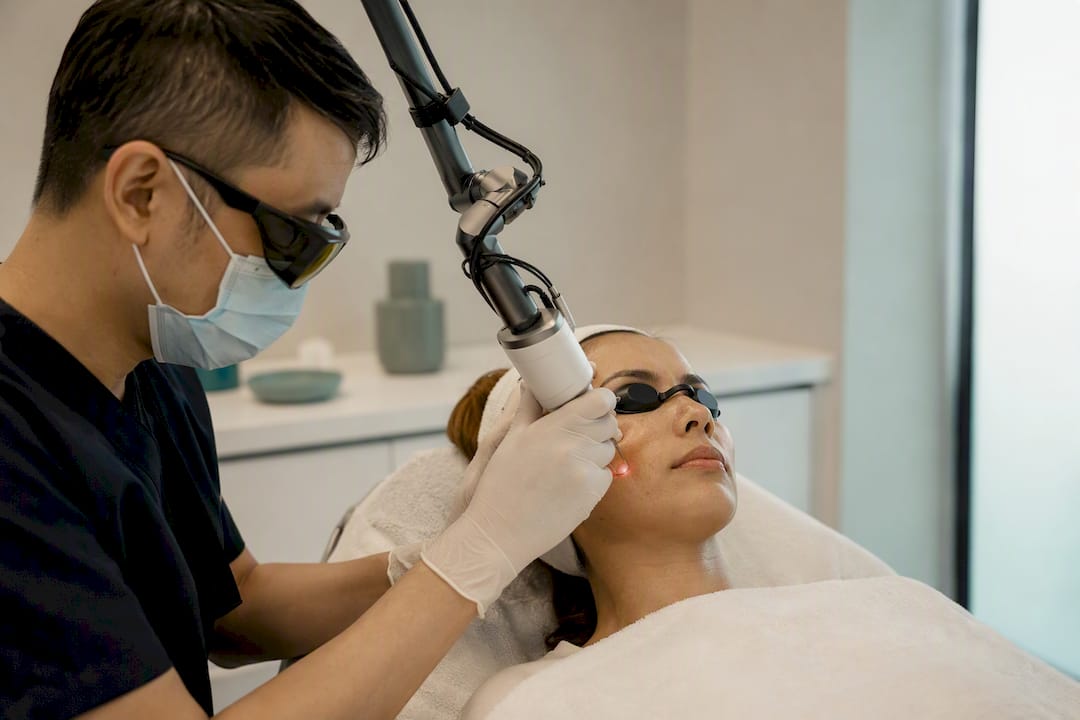
Two wavelengths dominate Q-Switch practice, and each one goes after a different depth of skin. The 1064 nm wavelength penetrates deeper, making it the choice for dermal pigment like nevus of Ota or deep melasma components. The 532 nm wavelength stays closer to the surface, targeting epidermal lesions such as freckles and superficial sunspots.
Picture it as a simple chain: wavelength determines depth, depth determines target.
- 1064 nm → dermal layer → nevus of Ota, Hori’s nevus, deep melasma pigment, black tattoo ink
- 532 nm → epidermal layer → sunspots, freckles, superficial lentigines, red or orange tattoo ink
Fluence (energy density), spot size, and pulse width all interact to determine how aggressively the laser treats tissue. Higher fluence breaks up pigment faster but raises the risk of PIH. Larger spot sizes with a flat “top-hat” beam profile distribute energy more evenly, which is why many low-fluence toning protocols use them to reduce hot spots on the skin’s surface.
Pro Tip: If you have Fitzpatrick skin type III through VI, ask your clinician for a test patch on an inconspicuous area first. Conservative initial settings reduce the odds of triggering rebound pigmentation before you commit to a full course.
Which Pigmentation Conditions Respond Best to Q-Switch Laser?
Not every dark spot responds the same way, and matching your diagnosis to realistic expectations saves time and money.
Good response, often with fewer sessions:
- Tattoo ink (especially black and dark blue pigments)
- Nevus of Ota (bluish-gray facial birthmark)
- Hori’s nevus (acquired bilateral nevus of Ota-like macules)
Variable response, requiring patience and combination care:
- Melasma, particularly the dermal or mixed-depth component
- Lichen planus pigmentosus
- Other acquired dermal melanoses
Poor or limited candidates for laser as a first step:
- Widespread epidermal hyperpigmentation, which often responds better initially to topical agents and chemical peels before any laser is considered
Dermatologists narrow down which category a patient falls into using a Wood’s lamp examination and dermoscopy, both of which reveal whether pigment sits in the epidermis, the dermis, or both. That distinction changes the entire treatment plan. Mixed-depth pigmentation, common in melasma, rarely clears with a laser alone. A five-year clinical series in Fitzpatrick III to IV patients found that sequential laser sessions paired with topical regimens produced substantial reduction, but the treatment courses ran five to nine months on average, underscoring that this is a process, not a single visit.
Are You a Good Candidate for Q-Switch Laser Treatment?
A good candidate usually has stable, localized pigment with a depth confirmed by clinical exam, along with realistic expectations about the number of sessions ahead. If you are hoping for a single treatment to erase years of melasma, that expectation needs adjusting before you start.
Signs you may be suitable:
- Your pigmentation has a clear, diagnosed cause (tattoo, birthmark, sunspot, or dermal melasma component)
- You can commit to multiple sessions spaced over weeks or months
- You understand results build gradually and some maintenance may be needed
Contraindications and cautions:
- Active skin infection or inflammation at the treatment site
- Recent isotretinoin use (most clinics require a waiting period)
- Pregnancy
- Unhealed wounds or active cold sores in the area
- Expecting permanent, one-time clearance of melasma, which is not a realistic promise
Bring a short history to your consultation: any prior laser or peel treatments, a note on medications, and photos showing how the pigment has changed over time. If you have previously developed PIH from a procedure, say so upfront. For Fitzpatrick III through VI skin, clinicians deliberately dial back fluence and widen intervals between sessions, since longer wavelengths and conservative settings reduce PIH risk in darker skin tones.
What Happens During a Q-Switch Laser Session?
A typical visit follows a predictable sequence, whether you are treating a small sunspot or a broader area of melasma.
- Assessment and documentation. The clinician examines the lesion, often with a Wood’s lamp, and takes baseline photographs. This is also when informed consent is reviewed and current medications are checked.
- Patch test, if needed. For darker skin tones or first-time patients, a small test spot confirms how the skin reacts before full treatment begins.
- Topical numbing (optional). Depending on the area and sensitivity, a numbing cream may be applied 20 to 30 minutes beforehand.
- Laser passes. The clinician moves the handpiece across the target area in controlled passes. Low-fluence toning protocols aim for mild pinkness with no frosting, while higher-fluence treatments for tattoos or discrete lesions may show a whitish frosting endpoint. A session typically runs 10 to 30 minutes depending on the area treated.
- Cooling and immediate aftercare. A cooling device or cold compress calms the skin right after treatment, and the clinician gives specific instructions for the following days.
Expect mild redness for a few hours to a day. Some pigmented spots darken temporarily before flaking off over the following one to two weeks, which is a normal part of the process rather than a setback. Your clinician should record the exact settings used, fluence, spot size, and wavelength, so future sessions can be adjusted based on how your skin responded.
How Many Sessions Does Q-Switch Laser Take?
Patience is part of the deal with Q-Switch treatment. Most protocols call for 5 to 10 sessions, though the exact number and spacing depend heavily on what you’re treating.
- Nevus of Ota / Hori’s nevus: often 4 to 6 sessions, spaced 4 to 8 weeks apart
- Sunspots and superficial lentigines: frequently 2 to 4 sessions with visible fading after the first
- Melasma (laser toning protocols): 6 to 10 sessions, often weekly or biweekly, with a higher relapse risk than other conditions
By the Numbers: Published data on low-fluence Q-Switch toning for melasma report relapse rates of up to 58.8% within roughly one year of stopping treatment, which is why most dermatologists pair laser sessions with a maintenance skincare plan rather than treating melasma as a one-and-done fix.
A rough timeline looks like this: session one produces little visible change beyond mild redness; by sessions three to five, most patients notice gradual lightening; by session eight to ten, results typically plateau, and the focus shifts to maintenance visits every few months to catch early signs of relapse before it becomes visible again.
What Does the Clinical Evidence Say About Q-Switch Laser?
The research base for Q-Switch Nd:YAG treatment is substantial for tattoo removal and dermal melanoses, and it’s improving steadily for melasma. Reviews confirm the nanosecond-pulse mechanism is well established at both 1064 nm and 532 nm for a wide range of pigmented lesions.
Newer trial data is worth paying attention to. A 2025 prospective split-face study combined low-fluence Q-Switched 1064 nm with a microsecond pulse width mode and found better short-term relapse-free outcomes compared to low-fluence Q-Switch alone, with no serious study-related adverse events reported. That dual-mode approach suggests the field is moving toward combination protocols rather than single-setting treatments, especially for melasma with a vascular or photoaging component.
By the Numbers: Clinical series report treatment courses for dermal melanoses averaging 5 to 9 months of sequential sessions, reinforcing that meaningful pigment reduction is a gradual process, not an overnight result.
The evidence has real limits worth knowing about:
- Protocols vary widely across studies, making direct comparisons difficult
- Many trials follow patients for only months, not years, so long-term relapse data is thinner than we’d like
- Melasma specifically shows higher and more unpredictable relapse than other pigment conditions
The clinical takeaway is consistent across the literature: multimodal management, laser plus topical therapy plus disciplined sun protection, produces better outcomes and higher patient satisfaction than laser treatment alone.
What Are the Risks of Q-Switch Laser Treatment?
No laser treatment is risk-free, and understanding the downsides upfront helps you spot problems early rather than panicking over normal healing.
- Post-inflammatory hyperpigmentation (PIH): the most common complication, especially in medium to dark skin tones treated with settings that are too aggressive
- Mottled hypopigmentation: patchy lightening that can occur with overly frequent or high-fluence toning sessions
- Purpura: small bruise-like marks that can appear after higher-fluence treatments, particularly for tattoo removal
- Transient erythema and crusting: temporary redness and scabbing over treated pigment, typically resolving within one to two weeks
- Infection: rare, but possible if aftercare instructions are ignored
Clinics manage these risks through conservative settings for darker skin, larger spot sizes to distribute energy evenly, longer intervals between sessions, and mandatory patch testing for new patients. Topical adjuncts applied right after treatment also help calm the skin and reduce inflammation.
Contact your clinic if you notice: pigment that appears to be worsening or spreading rather than fading, signs of infection like increasing warmth or pus, or any unusual reaction that doesn’t settle within the timeframe your clinician described.
How Should You Care for Your Skin After Q-Switch Laser?
What you do in the weeks after treatment matters as much as the laser session itself. Skipping aftercare is one of the fastest ways to trigger the exact rebound pigmentation you were trying to treat.
- Sun protection is non-negotiable. Use a broad-spectrum SPF 50 or higher daily, and favor physical blockers containing zinc oxide or titanium dioxide over chemical-only formulas.
- Keep cleansing gentle. Avoid exfoliating acids, scrubs, or retinoids until the treated area has fully healed.
- Follow your prescribed topical regimen. Many dermatologist-guided plans include non-hydroquinone brighteners or kojic acid, with retinoids reintroduced once skin has recovered.
- Book a follow-up. Most clinics schedule a review within 4 to 8 weeks after finishing a course, then periodic checks afterward to catch early relapse.
- Avoid known triggers. Tanning beds, prolonged heat exposure (saunas, hot yoga), and certain fragranced cosmetics can all provoke pigment to return.
Given the UAE’s intense year-round sun exposure, sunscreen discipline arguably matters more here than almost anywhere else in the world. Skipping it, even for a few days after treatment, can undo weeks of progress.
Q-Switch vs Pico Laser: Which Is Better for Pigmentation?
The core difference comes down to pulse speed and how each laser physically breaks apart pigment. Q-Switch lasers fire in nanoseconds and rely mostly on a photothermal effect, heat-driven fragmentation. Pico lasers pulse in picoseconds, producing more of a photoacoustic, or mechanical shattering, effect with less collateral heat.
That mechanical difference has practical consequences:
- Best for tattoos and stubborn dermal pigment: Pico often needs fewer sessions due to its more efficient fragmentation
- Best for established, budget-conscious protocols: Q-Switch remains a well-documented, widely available option with a long safety record
- PIH risk: generally lower with Pico due to reduced heat generation, though outcome still depends heavily on operator skill and settings
- Cost considerations: Pico platforms tend to carry a higher per-session cost given the newer technology involved
Diagnosis always comes before device selection. A clinician should determine the depth and type of your pigment first, then explain why they’re recommending a particular laser platform for your case rather than defaulting to whichever machine happens to be available.
Pro Tip: Ask for a documented protocol before your first full session, the wavelength, spot size, and fluence they plan to use. A clinic that can’t answer this clearly is one to reconsider.
How Do You Choose a Qualified Clinic for Q-Switch Treatment?
The technology only performs as well as the person operating it, so vetting the clinic matters as much as understanding the laser itself.
Verify before booking:
- Licensed dermatologist oversight, not just a technician running the device unsupervised
- Documented device model and settings for each session
- A clear informed consent process that explains realistic outcomes and risks
- A standardized photography protocol for before-and-after comparisons
- Visible sterile practice standards in the treatment room
Ask to see documented case examples for skin similar to yours, ideally your own Fitzpatrick type, since results and risk profiles differ meaningfully across skin tones.
Red flags worth walking away from:
- Promises of a “permanent cure” for melasma, a condition known for relapse even under optimal care
- No patch test offered for darker skin types
- Vague or missing protocol documentation
- Pressure to prepay for a large package before your first consultation
Cosmolaser Medical Centre, based in Sharjah, is one regional example of a clinic structured around this kind of documented, dermatologist-led approach to laser pigmentation treatment, with protocols recorded session by session rather than applied on a one-size-fits-all basis.
A Practitioner’s View on When Q-Switch Laser Makes Sense
Q-Switch is first-line for nevus of Ota, Hori’s nevus, and most tattoo removal. For melasma, it’s better viewed as an adjunctive tool, one piece of a plan that includes topicals and disciplined sun protection, not a standalone fix. We lean conservative on fluence and interval spacing for medium to dark skin tones, since the relapse and PIH data make that caution worth the extra patience. If you’re preparing for a consultation, bring a clear timeline of how your pigmentation has changed. It tells a clinician more than a single photo ever could.
Book a Q-Switch Pigmentation Consultation at Cosmolaser Medical Centre
Cosmolaser Medical Centre’s pathway for pigmentation cases starts the same way for every patient: an initial dermatology consultation, a Wood’s lamp exam and photographic documentation, a patch test when indicated, and a written protocol specifying wavelength, spot size, and fluence before any full session begins.
That structured start matters more than it sounds. It’s the difference between a clinic guessing at settings and one adjusting your plan based on how your specific skin actually responds. Follow-up visits are built into the plan from day one, not added as an afterthought once results stall. If you’re in Sharjah or elsewhere in the UAE and want to know whether Q-Switch, Pico, or a combination approach fits your pigmentation, explore the clinic’s types of laser skin treatments or book a consultation with a dermatologist aesthetician to get a proper diagnosis and a session plan built around your skin type and history.
Sources
- Novel melasma therapy using combined low fluence and microsecond pulse Q switched 1064 nm Nd:YAG laser | Scientific Reports
- Optimizing Q-switched lasers for melasma and acquired dermal melanoses – Indian Journal of Dermatology, Venereology and Leprology
- Multimodality treatment study for hyperpigmentation
FAQ
What Are the Disadvantages of Q-Switch Laser?
The main drawbacks are the need for multiple sessions, temporary redness or crusting after treatment, and a risk of post-inflammatory hyperpigmentation or hypopigmentation, particularly in darker skin tones. Melasma treated with Q-Switch toning also carries a notable relapse risk without ongoing maintenance care.
Can Hyperpigmentation Be Removed by Laser?
Laser treatment, especially Q-Switch Nd:YAG, can significantly reduce many forms of hyperpigmentation, including sunspots, nevus of Ota, and dermal melasma components. Results vary by condition, and multimodal care combining laser with topicals and sun protection tends to produce more durable outcomes than laser alone.
What Removes Pigmentation Permanently?
No single treatment guarantees permanent removal of all pigmentation types, since conditions like melasma are prone to relapse even after successful laser courses. The most durable results come from combining an accurately diagnosed laser protocol with strict sun protection and prescribed topical maintenance, which is the approach clinics like Cosmolaser Medical Centre build into their treatment plans.
How Many Q-Switch Sessions Do I Need for Sunspots?
Sunspots and superficial lentigines often respond within 2 to 4 sessions, faster than deeper pigment conditions like nevus of Ota or melasma, which typically require 5 to 10 sessions total.
Is Q-Switch or Pico Laser Better for Melasma?
Both platforms are used for melasma, but the choice depends on pigment depth and skin type rather than one device being universally superior. A dermatologist should assess your specific case with tools like a Wood’s lamp before recommending Q-Switch, Pico, or a combination approach.