
For most people with reactive, easily flushed, or barrier-compromised skin, the safest facial route is red or blue LED light therapy, a hydrating or calming barrier facial, a customized HydraFacial, or a gentle enzyme or mandelic acid treatment. The options to skip, or only attempt under a dermatologist’s direct supervision, are microdermabrasion, strong chemical peels, vigorous manual extractions, and hot steam.
That single distinction (calming versus abrasive) explains almost every good or bad outcome sensitive skin has in a treatment room. Facials that hydrate, cool, and use light-based technology tend to calm an already-reactive complexion. Facials built around friction, heat, or high-strength acids tend to push a fragile barrier past its limit.
- LED light therapy calms inflammation through light exposure, not heat or contact, which is why it’s often recommended for rosacea and acne-related redness.
- Hydrating and barrier-repair facials rebuild the skin’s moisture barrier instead of stripping it, reducing stinging and tightness.
- HydraFacial uses a customizable, low-friction process that skips aggressive extraction when the barrier is fragile, with mild redness typically settling within about 72 hours.
- Gentle enzyme and mandelic acid treatments exfoliate through slow chemical action rather than mechanical scrubbing, so there’s far less trauma to the surface.
- Microdermabrasion, strong peels, and vigorous extractions rely on physical or chemical force that a weakened barrier simply can’t absorb without flaring.
Key Takeaways
Sensitive skin does best with calming, low-friction facials like LED therapy, hydrating treatments, and customized HydraFacial sessions, while abrasive or high-heat procedures raise the risk of flares.
| Point | Details |
|---|---|
| Choose calming over abrasive | Prioritize LED therapy, hydrating facials, and customized HydraFacial over anything mechanical or acid-heavy. |
| Skip aggressive exfoliation | Avoid microdermabrasion, strong peels, and vigorous extraction unless a dermatologist supervises a modified version. |
| Always patch test first | Request a patch test 24 to 48 hours before any new product touches your face. |
| Protect skin after treatment | Wear daily sunscreen and skip retinoids for 48 to 72 hours post-facial to let the barrier settle. |
| Get medical oversight when unsure | Cosmolaser Medical Centre offers licensed clinician consultations and customizable, patch-tested protocols for reactive skin in the UAE. |
Table of Contents
- Sensitive Skin Facial Options and Why Standard Facials Backfire
- Which Facial Treatments Work Well for Sensitive Skin?
- Which Facial Treatments Should You Avoid With Sensitive Skin?
- How Do You Choose a Clinic for a Sensitive Skin Facial?
- What Happens During and After a Sensitive Skin Facial?
- Why Medical Oversight Changes the Risk Profile
- A Local Option for Medically Supervised Sensitive Skin Care
- Sources
- FAQ
Sensitive Skin Facial Options and Why Standard Facials Backfire
Sensitive or sensitized skin isn’t a single diagnosis. It’s a description of how skin behaves: it stings, flushes, tightens, or breaks out in response to things that a resilient complexion barely notices. Some of this is genetic (true rosacea, eczema, or a naturally thin stratum corneum). Some of it is acquired, caused by over-exfoliation, sun damage, or recent use of retinoids and acids that leave the barrier temporarily compromised.
The common thread is a weakened skin barrier and a hyper-reactive nervous system in the skin itself, so triggers that a normal facial treats as routine become genuine risks. In a treatment room, four things cause most of the damage:
- Heat and steam, which dilate blood vessels and can worsen rosacea-related redness or trigger a flush that lasts for hours.
- Mechanical friction, from brushes, suction devices, or manual extraction, which can micro-tear a fragile surface.
- High-concentration actives, including strong glycolic or salicylic formulations meant for resilient, oil-heavy skin.
- Fragrance and heavy preservatives, common in mass-market spa products but a frequent trigger for contact irritation.
A responsible provider will screen for signs that call for medical oversight before any hands-on treatment: an active eczema flare, a rosacea breakout with visible pustules, or recent retinoid or acid use within the past week. When any of these show up during consultation, the right move is a referral, not a modified facial. Facials for sensitive skin built around calming ingredients and light therapy tend to sidestep these triggers by design, which is why they dominate every credible list of safe treatments.
Which Facial Treatments Work Well for Sensitive Skin?
The safest sensitive-skin facials share one trait: they add moisture, calm inflammation, or exfoliate gently, without heat, suction trauma, or high-strength acids. Here’s what tends to hold up well, and where each one fits.
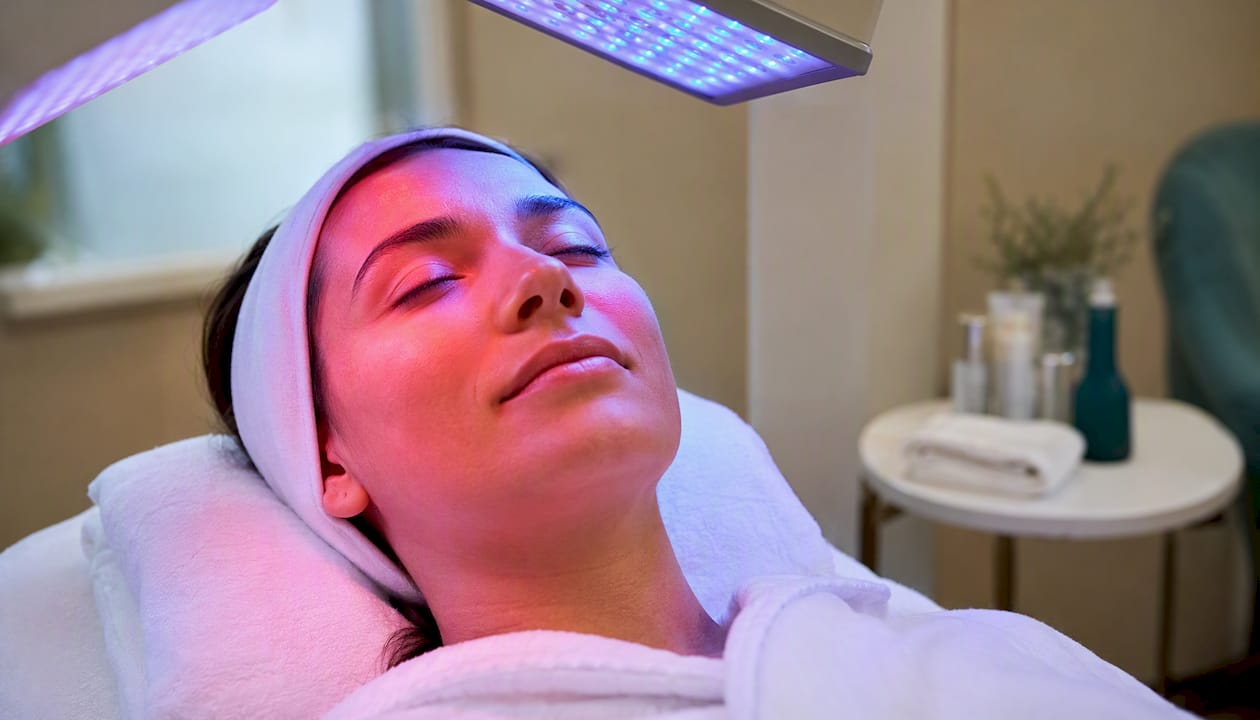
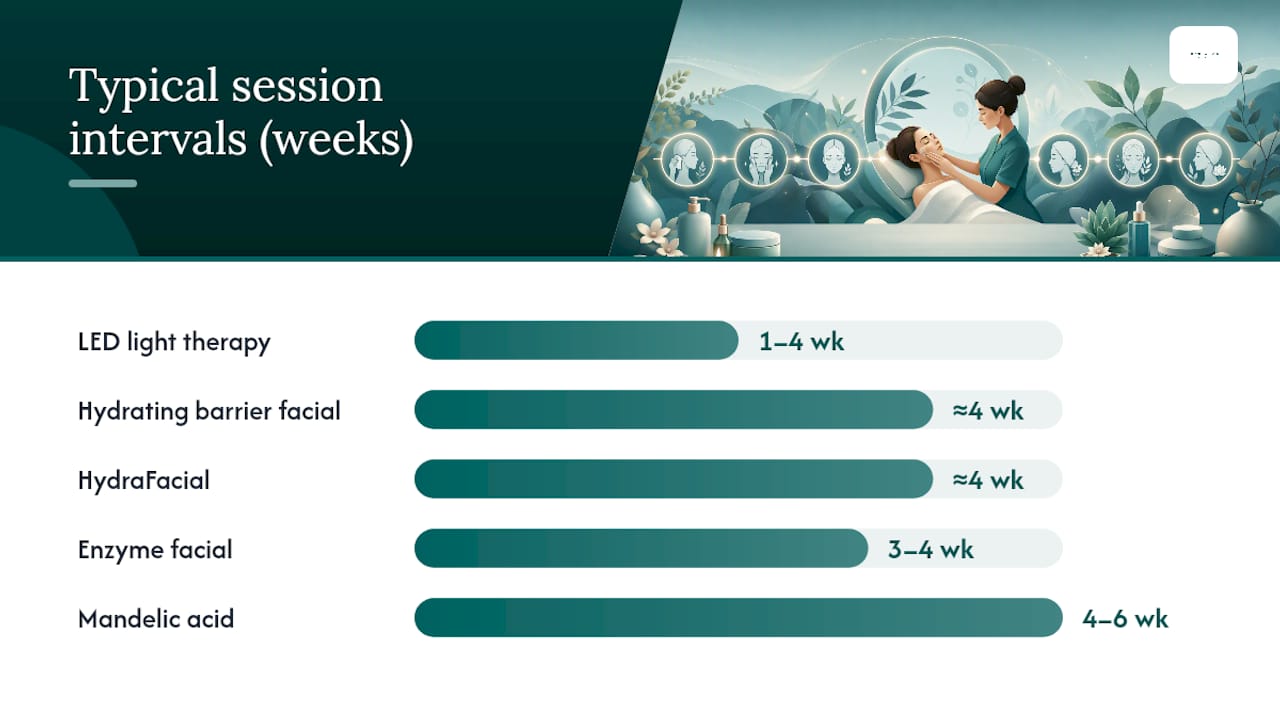
Red and blue LED light therapy works through light exposure rather than physical contact, reducing inflammation in rosacea-prone and acne-affected skin without touching or heating the surface. It carries essentially no downtime and can be added to almost any other calming facial. Estheticians typically recommend it weekly during an active flare, then monthly for maintenance. It’s a strong starting point for almost anyone unsure where to begin.
Hydrating and barrier-repair facials focus on ceramides, ceramide-adjacent lipids, and humectants that rebuild the skin’s outer defense layer rather than removing anything. Expect no downtime beyond a temporary flush that fades within an hour or two. Monthly sessions work well for ongoing maintenance, and this is often the safest entry point for anyone with active eczema-adjacent dryness.
HydraFacial stands out because it’s customizable session to session. The device cleanses, gently extracts, and infuses serums like hyaluronic acid, peptides, and antioxidants, and a provider can skip the vacuum extraction step entirely for reactive clients. Mild redness typically resolves within 72 hours, and maintenance sessions spaced about a month apart are common. It suits nearly everyone except those with active open lesions or a severe flare in progress.
Gentle enzyme facials use fruit-derived enzymes to dissolve dead surface cells without any scrubbing or abrasive tool. Downtime is minimal, usually a light glow rather than redness, and they work well every three to four weeks. They’re a good fit for anyone who wants smoother texture without the risk profile of a chemical peel.
Mandelic acid treatments deserve a specific mention because mandelic acid has a larger molecule size than glycolic or salicylic acid, so it penetrates more slowly and evenly. That translates to gentler exfoliation with less sting, which is why it’s frequently the only acid recommended for reactive skin. Sessions every four to six weeks are typical.
Lymphatic-support hydrating facials, built around gentle manual drainage techniques rather than deep massage, reduce puffiness and support circulation without mechanical stress. They pair well with hydrating serums and suit anyone dealing with sluggish, congested-looking skin alongside sensitivity.

Professional hyaluronic acid and peptide serum infusions, delivered via ultrasound or low-pressure devices rather than needles, add hydration and support collagen without breaking the skin. These are frequently layered into other calming facials rather than booked as a stand-alone treatment.
| Treatment | Why it suits sensitive skin | Downtime / reactions | Recommended frequency | Best candidate / caution |
|---|---|---|---|---|
| Red/blue LED therapy | Reduces inflammation via light, no contact or heat | None; occasional mild warmth | Weekly during flares, then monthly | Rosacea, acne-related redness; safe for nearly everyone |
| Hydrating/barrier-repair facial | Rebuilds barrier lipids instead of stripping them | Minimal; brief flush | Monthly | Dry, tight, eczema-adjacent skin |
| HydraFacial | Customizable pressure and serum choice; skips extraction if needed | Mild redness, usually gone in 72 hours | Monthly | Most sensitive skin types except active flares |
| Gentle enzyme facial | Chemical dissolution, zero mechanical friction | Minimal; light glow | Every 3–4 weeks | Anyone wanting smoother texture without acids |
| Mandelic acid treatment | Larger molecule, slower penetration, less sting | Mild tingling, rarely visible redness | Every 4–6 weeks | Reactive skin needing gradual exfoliation |
| Lymphatic-support facial | Manual drainage without deep pressure | None | Every 3–4 weeks | Congested, puffy, sensitive combination skin |
In the UAE, where sun exposure and air conditioning both stress the skin barrier year-round, these calming categories tend to outperform anything abrasive. Clinics offering combined facial and laser protocols often layer LED into a hydrating facial specifically to counter that dryness-plus-heat combination local patients deal with constantly.
Which Facial Treatments Should You Avoid With Sensitive Skin?
Several popular treatments belong on a caution list, not because they don’t work, but because their mechanism of action is friction, heat, or high-strength chemistry, exactly what a compromised barrier can’t tolerate.
- Microdermabrasion physically abrades the surface with crystals or a diamond tip, stripping the barrier and often triggering prolonged redness or post-inflammatory hyperpigmentation in reactive skin.
- Aggressive chemical peels, particularly high-concentration glycolic or TCA formulations, dissolve the skin’s protective lipid layer faster than sensitive skin can regenerate it.
- Vigorous manual extractions create micro-trauma around the follicle, which can worsen inflammation and, in rosacea-prone skin, contribute to visible broken capillaries over time.
- Dermaplaning on an unstable barrier removes surface cells and fine hair with a blade, a technique that assumes a stable, resilient starting point sensitive skin often doesn’t have.
- Certain microneedling protocols create controlled micro-injuries that resilient skin heals from efficiently, but reactive skin may respond with extended redness or flare-ups instead.
- Steam and high-frequency devices, when used on rosacea-prone skin, dilate blood vessels and can trigger a flush that lingers well past the appointment.
The mechanism matters more than the marketing. Barrier stripping removes the skin’s own defense before it’s had a chance to recover. Thermal dilation from steam widens blood vessels that are already prone to staying open too long in rosacea patients. Mechanical trauma from extraction or blades creates inflammation the skin has to spend days resolving instead of simply staying calm.
Pro Tip: If a provider insists a milder version of one of these treatments could still work for you, ask specifically for a lower acid concentration, a mandatory patch test 24 to 48 hours beforehand, and wider spacing between sessions than they’d normally recommend. A dermatologist supervising a modified peel or a conservative pass with radiofrequency microneedling is a very different risk profile than the same treatment booked at a walk-in spa with no medical backup.
How Do You Choose a Clinic for a Sensitive Skin Facial?
Picking the right provider matters more for sensitive skin than for almost any other skin type, because the margin for error is smaller. Use this sequence before you book anything:
- Confirm licensed clinical oversight. Ask whether a dermatologist or licensed aesthetician reviews treatment plans, not just whoever is available that day.
- Ask about their patch-test policy. A provider who skips this step for new clients, especially anyone with a history of reactions, is a warning sign.
- Request ingredient transparency. Ask specifically whether the products used are fragrance-free and hypoallergenic, and whether they use a recognized calming line such as Dermalogica UltraCalming or an equivalent.
- Confirm the treatment can be customized on the spot. A provider should be willing to skip extraction, swap serums, or shorten a session if your skin looks reactive that day.
- Ask about the escalation path. If something goes wrong mid-treatment, who handles it, and is a physician reachable on-site or nearby?
At the consultation itself, come with specific questions: Will extraction happen, and can it be skipped? Is steam part of the protocol, and can it be omitted? Which serums will actually touch your skin? Is LED available as an add-on, and at what wavelength? What’s the realistic downtime for someone with your specific skin history?
Watch for red flags that suggest a spa isn’t equipped for reactive skin: no consultation before treatment begins, a fixed menu that doesn’t flex for individual skin conditions, refusal to patch test, or staff who can’t clearly explain their own qualifications. Clinics that publish a detailed pre-treatment checklist or explain the role of licensed aestheticians in their process are generally more transparent about exactly this kind of screening.
What Happens During and After a Sensitive Skin Facial?
A calming or hydrating facial, and a customized HydraFacial with an LED add-on, both tend to follow a similar rhythm, even though the tools differ.
- Arrival and consultation. The provider reviews your skin history, current products, any prescription topicals, and recent reactions.
- Gentle cleanse. A fragrance-free, low-pH cleanser removes surface debris without disrupting the barrier.
- Tailored treatment step. This is where HydraFacial’s vacuum settings get adjusted, or where a barrier-repair mask replaces anything abrasive, depending on what your skin needs that day.
- Serum infusion. Hyaluronic acid, peptides, or antioxidants are applied, chosen specifically to avoid known irritants.
- LED exposure, if included, typically runs 10 to 20 minutes and requires no recovery time.
- Cooling mask and sun protection. A calming mask settles any temporary flush, and broad-spectrum sunscreen is applied before you leave.
Mild redness is common and usually resolves within a few hours to 72 hours, depending on how reactive your skin was going in. That timeline shortens with gentler treatments like LED alone and extends slightly with anything involving even minimal extraction.
Aftercare matters as much as the treatment itself:
- Wear sun protection daily, especially in the UAE’s climate, where UV exposure is intense year-round and can undo calming work almost immediately.
- Avoid retinoids and strong actives for at least 48 to 72 hours post-treatment to let the barrier settle.
- Space sessions appropriately. Monthly works for most hydrating facials and HydraFacial; every four to six weeks suits mandelic acid and enzyme treatments.
- Seek help immediately if you notice a spreading rash, blistering, or severe swelling rather than the expected mild, short-lived flush.
Why Medical Oversight Changes the Risk Profile
A clinic setting with dermatologist involvement offers something a standalone spa can’t: someone qualified to intervene if a treatment doesn’t go as planned. That’s not a small distinction for reactive skin, where a facial that looks routine on paper can still trigger an unexpected response.
Medical oversight means access to prescription-level interventions when a reaction does occur, a genuine escalation path rather than a shrug and a cold compress, and devices used under documented clinical protocols instead of guesswork. It also means the provider treating you has likely seen a wider range of reactive skin presentations and knows the difference between an expected mild flush and a reaction that needs to stop the session.
A genuinely sensitive-skin-safe clinic visit should leave you with documented consultation notes, a written list of every product that touched your skin, and clear pre- and post-care instructions, not a verbal “you’ll be fine.”
The checklist worth confirming before any appointment: a documented consultation covering your history, a patch test on file, a written ingredient list you can review afterward, and a follow-up plan if your skin reacts differently than expected. This article’s clinical perspective is provided by Dr Anoop Suresh Babu, whose view on where to start treatment appears below, alongside the clinic’s own skin rejuvenation best practices for patients managing reactive skin long term.
Where to start, and when to wait
The safest starting point for most new patients with reactive skin is a barrier repair or hydrating facial, with an LED add-on if there’s visible redness, or a HydraFacial with extraction intentionally skipped. Starting conservatively lets a provider see how your skin actually responds before introducing anything more targeted.
Delay any facial and see a dermatologist first if you have an active flare, open lesions, uncontrolled acne, or a new, unexplained rash. Treating over an active flare rarely improves it and can genuinely make things worse.
One thing worth remembering: sensitive skin management is a long-term maintenance strategy, not a single corrective fix. Consistency with gentle, well-spaced treatments beats chasing a dramatic one-time result.
A Local Option for Medically Supervised Sensitive Skin Care
If you’d rather not gamble on a spa menu built for average skin, Cosmolaser Medical Centre in Sharjah offers something most walk-in facial studios can’t: a licensed clinical team that customizes every step, from extraction to serum choice, around what your skin is actually doing that day, not a fixed treatment card.
Services relevant to reactive and sensitive skin at the clinic include:
- Customized HydraFacial sessions with extraction adjusted or skipped based on your skin’s condition
- LED light therapy add-ons for inflammation and redness management
- Barrier-repair and hydrating facials built around fragrance-free formulations
- Consultation with a dermatologist or aesthetician before any treatment begins
- Patch testing and full ingredient disclosure for every product used
Before your visit, bring a list of your current skincare products and note any prescription topicals you’ve used recently, including retinoids or acids, so the team can plan around them. If you’re ready to get a professional read on which treatment fits your skin, you can consult a dermatologist aesthetician at Cosmolaser Medical Centre and book a consultation that starts with a real assessment, not a guess.
Sources
- Hydrafacial treatments offer benefits for all skin types — Franciscan Health
- Plasticsurgery
- Can You Ever Get a Facial Treatment If You Have Sensitive Skin? — SELF
- Facials for Sensitive Skin: A Pro Guide | MMM Beauty
This article is general information, not a substitute for advice from a qualified doctor. Consult a qualified healthcare professional about your own circumstances before acting on anything here.
FAQ
What Is the Best Facial for Sensitive Skin?
A hydrating or barrier-repair facial paired with LED light therapy is generally the safest starting point, since it calms inflammation without heat, friction, or strong acids.
Is HydraFacial Good for Very Sensitive Skin?
Yes, when a provider customizes the settings and skips or lightens extraction; HydraFacial’s serum infusion step supports hydration, and mild redness typically resolves within 72 hours.
What Should a Sensitive Skin Facial Regimen Look Like?
A sound regimen combines monthly hydrating or HydraFacial sessions with occasional LED add-ons, fragrance-free products, daily sun protection, and a pause on retinoids for a few days after each visit.
Which Facial Treatments Should Sensitive Skin Avoid?
Microdermabrasion, high-strength chemical peels, vigorous manual extractions, and steam-based treatments carry the highest risk of triggering redness, flare-ups, or prolonged irritation.
When Should Someone With Sensitive Skin See a Dermatologist Before a Facial?
Anyone with an active eczema flare, a rosacea breakout, uncontrolled acne, or a new unexplained rash should get a dermatologist’s evaluation before booking any facial treatment.