Adult orthodontics options include clear aligners, ceramic (tooth-colored) braces, lingual braces, and traditional metal braces. For most adults in the UAE seeking a discreet solution for mild-to-moderate crowding or spacing, clear aligners or ceramic braces are the most practical starting point. Complex bite problems or skeletal discrepancies typically call for fixed appliances or a combined orthodontic-surgical pathway.
- Clear aligners: Removable, nearly invisible trays changed on a set schedule. Best for mild-to-moderate crowding, spacing, and relapse cases.
- Ceramic (tooth-colored) braces: Fixed brackets that blend with enamel. Strong clinical control with better aesthetics than metal.
- Lingual braces: Bonded to the tongue side of teeth. Truly hidden, suited to image-conscious adults with moderate-to-complex needs.
- Traditional metal braces: Maximum clinical control and predictability. Best for complex bite correction.
- Surgical orthodontics: Reserved for skeletal jaw discrepancies that braces alone cannot correct.
Cosmolaser Medical Centre in Sharjah offers in-person consultations, CBCT-guided diagnosis, and the full range of adult orthodontic treatments. Booking a records appointment is the first step toward a precise treatment plan.
Key Takeaways
Adults in the UAE have four main orthodontic options — clear aligners, ceramic braces, lingual braces, and metal braces — and the right choice depends on case complexity, periodontal health, and lifestyle, not aesthetics alone.
| Point | Details |
|---|---|
| Four main options | Clear aligners, ceramic braces, lingual braces, and metal braces each suit different case complexities and visibility needs. |
| Periodontal health first | Active gum disease or decay must be stabilized before any orthodontic appliance is placed. |
| Typical treatment duration | Most comprehensive adult cases take 12–24 months; minor corrections can finish in under 12 months. |
| Retention is permanent | Retainers must be worn long-term after treatment to prevent relapse — this is a lifelong commitment. |
| Local UAE consultation | Cosmolaser Medical Centre in Sharjah provides CBCT-guided diagnosis, full appliance options, and payment plans for adult patients. |
Table of Contents
- Why do adults choose orthodontic treatment?
- What adult orthodontics options are available in the UAE?
- What does the adult orthodontic treatment process look like?
- How much does adult orthodontic treatment cost in the UAE?
- Are there risks or suitability concerns specific to adults?
- How should you care for your teeth during and after treatment?
- How do you choose the right treatment and what should you ask at your UAE consultation?
- What Cosmolaser Medical Centre offers for adult orthodontics in Sharjah
- Book your adult orthodontic consultation at Cosmolaser Medical Centre
- Sources
- FAQ
Why do adults choose orthodontic treatment?
Adult demand for orthodontic care is at an all-time high, according to the American Association of Orthodontists. The motivations split roughly into two categories: cosmetic confidence and functional oral health.
On the cosmetic side, adults report that misaligned teeth affect professional confidence, social interactions, and satisfaction with their appearance. On the functional side, malocclusion (a poor bite) causes uneven tooth wear, jaw muscle strain, difficulty chewing, and in some cases speech problems. Correcting alignment reduces those long-term risks.
The oral-health case for treatment is equally strong:
- Straight teeth are easier to clean. Crowded or overlapping teeth trap plaque in areas that a toothbrush and floss cannot reach effectively, raising the risk of decay and periodontal disease.
- Correcting a deep overbite or crossbite reduces abnormal wear on enamel surfaces.
- Proper occlusion distributes biting forces evenly, protecting restorations such as crowns and veneers from premature failure.
Cleveland Clinic notes that adults can be treated effectively at any age, though tooth movement may be slightly slower than in adolescents because adult bone is denser and fully set. That means treatment timelines can run a few months longer, and any active gum disease or untreated decay must be stabilized before appliance placement begins. Adults with a history of periodontal treatment, significant bone loss, or multiple restorations should have a periodontal assessment before starting orthodontics.
What adult orthodontics options are available in the UAE?
The four main treatment categories each carry a different balance of visibility, clinical control, and lifestyle impact. Understanding those trade-offs helps you arrive at a consultation with a clear sense of your priorities.
Clear aligners
Clear aligners are custom-formed sets of transparent trays, each worn for about 22 hours per day and changed on a schedule set by your orthodontist. According to the AAO, they commonly treat gapped teeth, crowding, overbites, underbites, open bites, and crossbites, with suitability depending on case complexity and patient compliance.
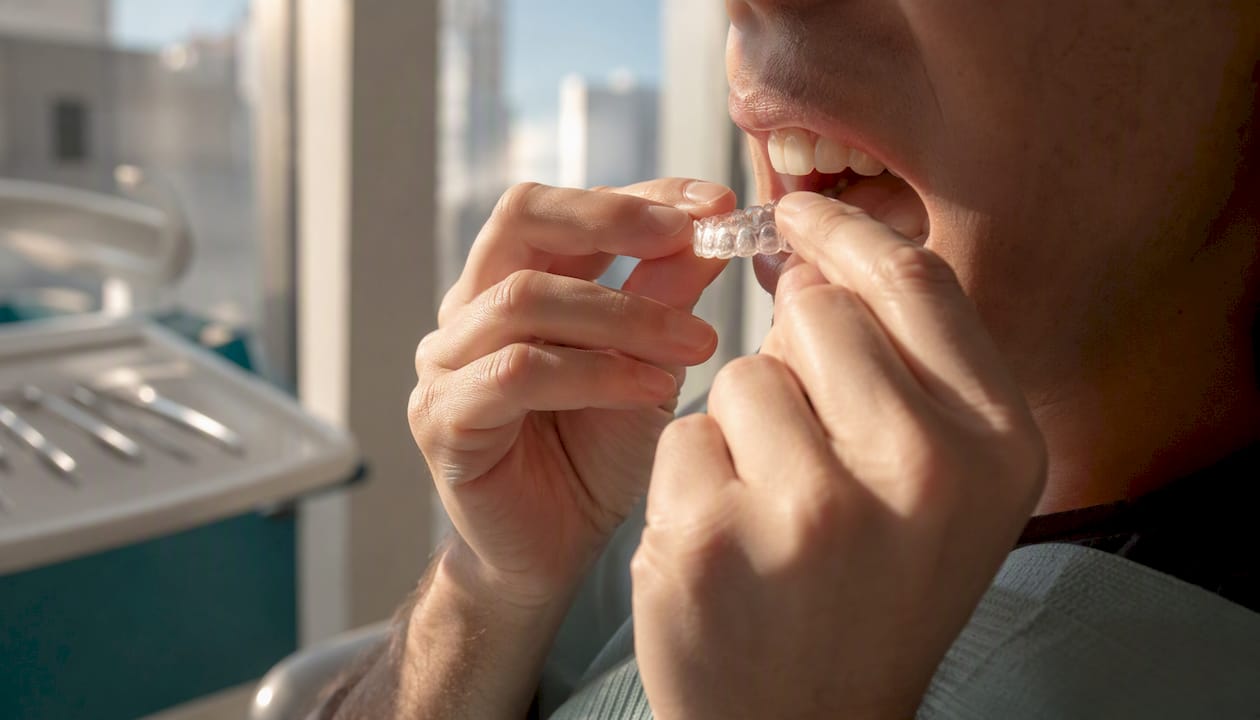
Pros: Nearly invisible in daily life; removable for meals and cleaning; no food restrictions; smooth plastic is generally comfortable against soft tissue.
Cons: Require strict discipline — removing them for more than two hours a day slows tooth movement. Not suitable for every complex bite problem. Attachments (small tooth-colored buttons bonded to teeth) are often needed, which reduces invisibility slightly.
Adult-specific note: Patients with implants, bridgework, or significant bone loss may not be ideal candidates. Your orthodontist will assess whether aligner mechanics can generate the forces needed given your restorative history.
Ceramic (tooth-colored) braces
Ceramic brackets are bonded to the front of teeth just like metal braces but are made from tooth-colored or clear ceramic material. Modern options, including 3D-printed ceramic bracket systems, offer a closer match to natural enamel while retaining the clinical control of a fixed appliance.
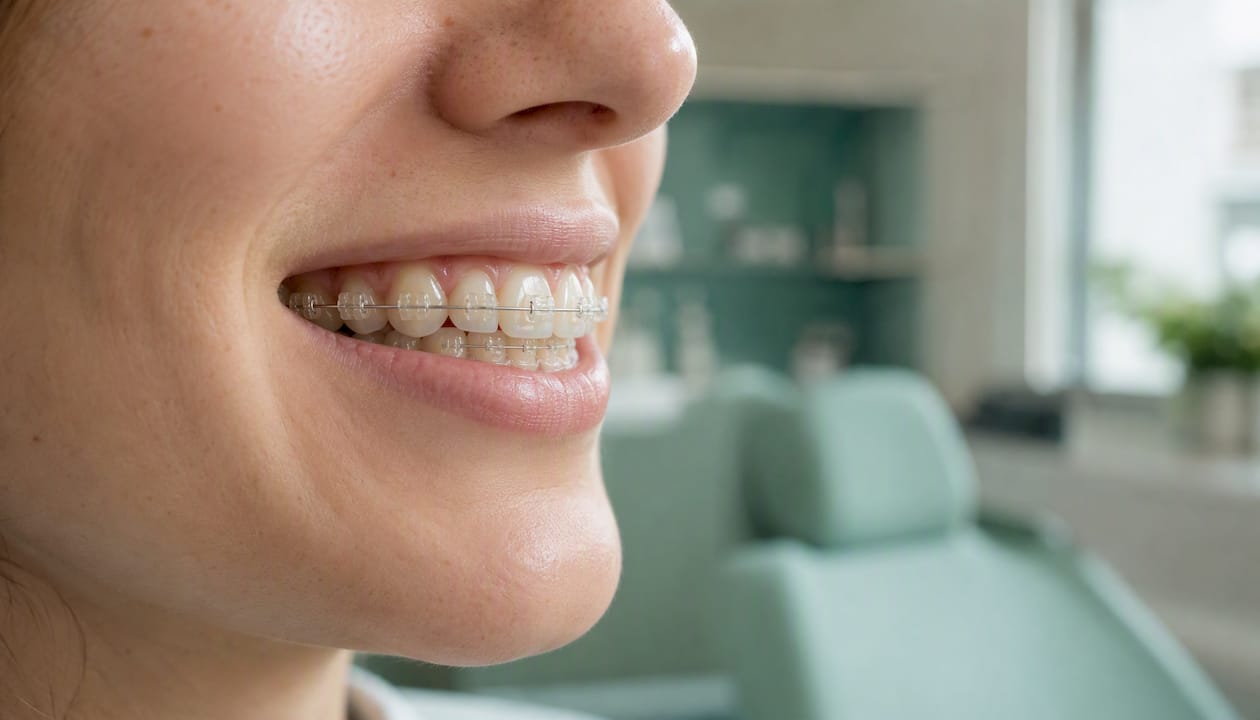
Pros: Fixed to the teeth, so compliance is not a variable. Offer strong clinical control for a wide range of case complexities. More discreet than metal at conversational distance.
Cons: Ceramic brackets are slightly larger than metal ones and can stain if patients consume coffee, tea, or heavily pigmented foods regularly. The elastic ties that hold the wire can also discolor between appointments.
Adult-specific note: For adults who want a fixed appliance with better aesthetics, ceramic braces are often the most practical middle ground. They handle moderate-to-complex cases well and are widely available at specialist clinics across the UAE. You can review fixed-braces options at Cosmolaser Medical Centre for a sense of what the workflow involves.
Lingual braces
Lingual braces are bonded to the tongue-facing (lingual) surfaces of teeth, making them completely invisible from the front. They require specialist training to place and adjust, and the brackets are custom-fabricated for each patient’s tooth anatomy.
Pros: Truly hidden — no visible hardware at all. Suitable for moderate-to-complex cases in the hands of a trained specialist.
Cons: The tongue contacts the brackets constantly, which can cause temporary speech changes and discomfort, particularly in the first few weeks. Adjustments are more technically demanding, and treatment may cost more than labial (front-facing) fixed appliances.
Traditional metal braces
Metal braces remain the most clinically versatile option. They apply consistent, controlled force through brackets and archwires, and an orthodontist can make precise adjustments at each visit.
Pros: Handle the widest range of case complexities, including severe crowding, significant bite discrepancies, and cases requiring tooth torque or rotation that aligners struggle to achieve. Generally the most cost-effective fixed appliance.
Cons: Visible at normal conversational distance. Require dietary modifications (avoiding hard, sticky, or crunchy foods). Oral hygiene requires more effort around brackets and wires.
Surgical orthodontics
When a jaw discrepancy is skeletal rather than dental, braces or aligners alone cannot fully correct the problem. Surgical orthodontics combines pre-surgical orthodontic alignment with orthognathic surgery performed by an oral and maxillofacial surgeon, followed by post-surgical finishing. This pathway is reserved for adults with significant skeletal class II or class III relationships, severe open bites, or facial asymmetries. Your orthodontist will refer you to an oral surgeon when this is indicated.
Pro Tip: Before choosing an appliance based on appearance alone, ask your orthodontist to show you a digital simulation of tooth movement for your specific case. Some movements — particularly significant rotations or vertical corrections — are more predictably achieved with fixed appliances than with aligners, regardless of how discreet the aligner looks.
| Feature | Clear Aligners | Ceramic Braces | Lingual Braces | Metal Braces |
|---|---|---|---|---|
| Visibility | Near-invisible | Low (tooth-colored) | Invisible | High |
| Best case complexity | Mild to moderate | Mild to complex | Moderate to complex | Mild to complex |
| Typical duration | 6–18 months | 12–24 months | 12–24 months | 12–24 months |
| Removable | Yes | No | No | No |
| Maintenance demand | High (compliance) | Moderate | Moderate to high | Moderate |
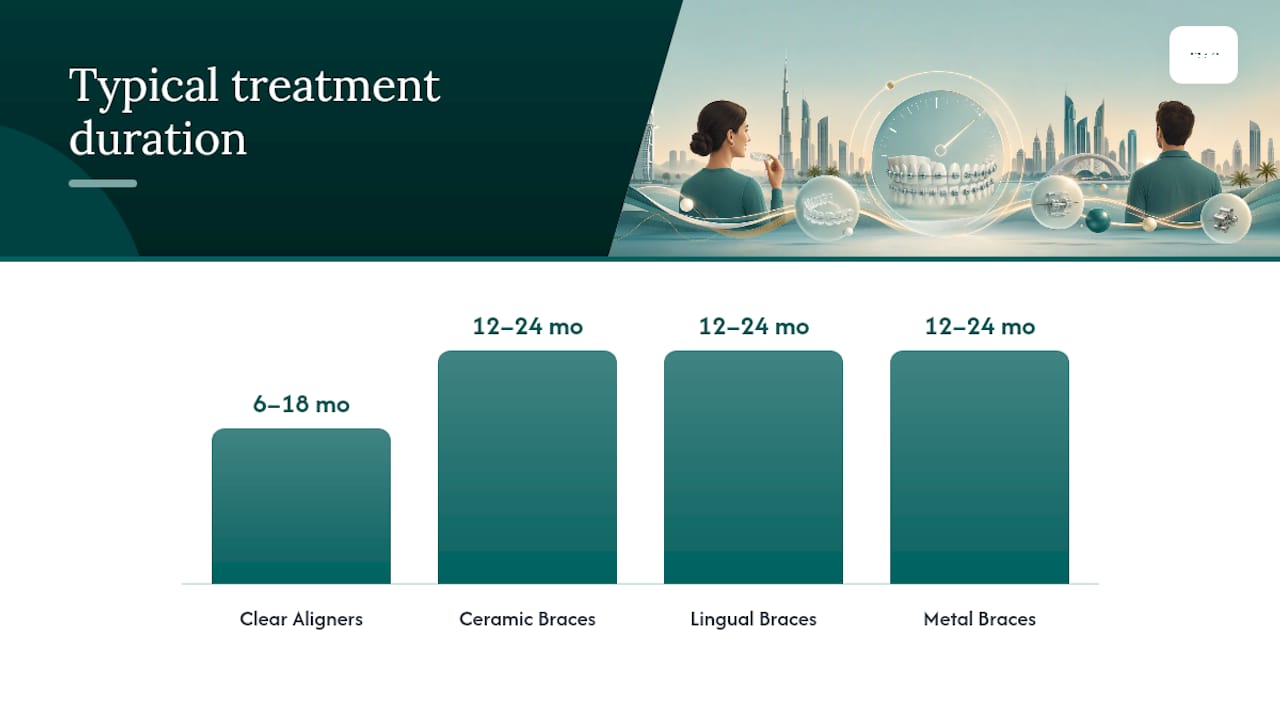
Duration ranges are illustrative. Your orthodontist will give a case-specific estimate after records.
What does the adult orthodontic treatment process look like?
Understanding the sequence of visits helps set realistic expectations and reduces anxiety about committing to treatment.
- Initial consultation: A clinical examination of your teeth, gums, and bite. Your orthodontist discusses your goals and gives a preliminary sense of which options suit your case.
- Diagnostic records: Cleveland Clinic describes a standard assessment as including intraoral scans or impressions, clinical photographs, and radiographic imaging. A CBCT (cone-beam computed tomography) scan is ordered when root positions, bone levels, or airway anatomy need detailed evaluation.
- Treatment planning: The orthodontist reviews records, maps out tooth movements, and prepares a written treatment plan with a timeline and cost estimate. For aligner cases, a digital simulation is generated.
- Appliance placement: Brackets are bonded (fixed appliances) or the first set of trays is delivered (aligners). The orthodontist explains care instructions and what to expect in the first week.
- Progress appointments: Fixed-appliance patients typically attend every 6–8 weeks for wire changes and adjustments. Aligner patients check in every 8–12 weeks, with tray changes at home in between. Some clinics offer remote monitoring via intraoral scan apps between visits.
- Refinement phase: Near the end of treatment, minor tooth positions are fine-tuned. Aligner patients often receive a refinement series of additional trays.
- Debond and finish: Brackets are removed (or the final aligner tray is worn), teeth are polished, and retainers are fitted.
- Retention: Retainers are placed immediately after active treatment ends. This phase is permanent for most adults.
Typical adult treatment runs 12–24 months for comprehensive cases. Minor relapse corrections or limited alignment cases can finish in under 12 months. Adults generally move teeth slightly more slowly than adolescents, so a case that might take 14 months in a teenager could take 18 months in a 40-year-old. Your orthodontist will factor this into the timeline estimate.
How much does adult orthodontic treatment cost in the UAE?
Precise costs depend on case complexity, appliance type, the specialist’s experience, and the specific clinic. An in-clinic records appointment is the only way to get an accurate quote for your case.
For reference, clinic-published example ranges from international markets show the following approximate figures: clear aligners $3,500–$6,000; ceramic braces $4,000–$7,000; metal braces $3,500–$7,500. These are market examples from outside the UAE and should not be read as fixed UAE prices. Actual fees at UAE clinics vary and are quoted in AED after a clinical assessment.
Financing and insurance tips for UAE patients:
- Ask your clinic whether in-house installment plans are available. Many UAE dental clinics offer monthly payment arrangements that spread the cost over the active treatment period.
- Check your UAE health insurance policy specifically for orthodontic coverage. Most basic plans in the UAE do not cover adult orthodontics, but enhanced or premium tiers sometimes include a partial orthodontic benefit with a lifetime cap. Confirm the exact benefit, any age limits, and whether pre-authorization is required before starting treatment.
- If your employer provides group medical insurance, request the policy schedule from HR and look for the “dental” or “orthodontic” section.
- Some clinics accept major credit cards with zero-interest installment options through UAE banks. Confirm this at the time of your consultation.
- Retain all receipts and treatment documentation. Some UAE residents can claim orthodontic expenses under flexible spending arrangements tied to their employment benefits.
Are there risks or suitability concerns specific to adults?
Adult orthodontic treatment is safe and effective for the vast majority of patients, but several clinical factors require attention before and during treatment.
Common risks to discuss with your orthodontist:
- Root resorption: Orthodontic forces can cause minor shortening of tooth roots in some patients. This is usually clinically insignificant, but adults with already-short roots or a history of trauma to teeth warrant monitoring with periodic X-rays.
- Temporary soreness: Teeth and gums are typically sore for 2–4 days after each adjustment or tray change. Over-the-counter analgesics manage this well for most patients.
- Relapse: Teeth will shift back toward their original positions if retainers are not worn consistently after treatment. This risk is lifelong, not just in the first year.
- Hygiene challenges: Fixed appliances create more surfaces for plaque to accumulate. Adults who do not adapt their cleaning routine face a higher risk of white-spot lesions (early decay) around brackets.
Eligibility checklist before starting:
- Gums must be healthy and stable. Active periodontal disease must be treated and controlled first. The AAO advises that an orthodontist will assess bite complexity and restorative history before recommending an appliance.
- All active decay must be restored before appliance placement.
- Existing restorations (crowns, bridges, implants) affect treatment planning. Implants cannot be moved orthodontically — they are anchored in bone — so their position must be factored into the treatment plan from the start. For patients considering implants alongside orthodontics, coordinating with a specialist in dental implant planning is advisable.
- Patients with significant bone loss from periodontal disease may still be candidates, but tooth movement must be slower and more carefully monitored.
Special warnings:
Smokers face a higher risk of periodontal complications during orthodontic treatment. Nicotine impairs blood flow to the gums, slowing tissue healing and increasing the risk of bone loss. Patients who smoke should discuss this openly with their orthodontist and ideally reduce or stop smoking before starting treatment. Uncontrolled systemic conditions such as unmanaged diabetes also affect periodontal health and should be stabilized in coordination with a physician.
How should you care for your teeth during and after treatment?
Daily oral hygiene during orthodontic treatment requires more effort than usual, but the habits are straightforward once established.
During active treatment:
- Brush after every meal, not just twice a day. Food trapped around brackets or under aligner edges accelerates plaque buildup.
- Use an interdental brush (also called a proxy brush) to clean around bracket bases and under archwires. Standard floss alone cannot reach these areas effectively with fixed appliances.
- Water flossers (oral irrigators) are a useful supplement for fixed-appliance patients, particularly those with tight contacts.
- Aligner wearers should rinse trays with cool water each time they remove them and clean them with a soft toothbrush. Hot water warps the plastic.
- Avoid coffee, tea, and deeply pigmented foods while wearing ceramic brackets, or brush promptly after consuming them to reduce staining of elastic ties.
- Coordinate with your general dentist for routine cleanings every 3–6 months during treatment. Professional cleaning removes calculus that home tools cannot.
After treatment — retainers:
Retainers are not optional. They are the mechanism that holds the result of your investment in place. Two main types are used:
- Removable Hawley or clear retainers: Worn full-time initially (typically the first 3–6 months), then nightly long-term. Clear retainers are more discreet; Hawley retainers are more durable.
- Fixed (bonded) retainers: A thin wire bonded to the tongue side of the front teeth. Provides continuous retention without reliance on patient compliance. Many adults prefer a bonded retainer on the lower front teeth combined with a removable retainer on the upper arch.
Most orthodontists recommend wearing removable retainers nightly indefinitely. Teeth continue to shift throughout life, and the retainer is the only thing that prevents gradual relapse. Consistent aftercare is what separates a lasting result from one that drifts back within a few years. For a broader perspective on why post-treatment care matters, the aftercare principles that apply to aesthetic procedures translate directly to orthodontic retention.
Pro Tip: If you lose or break a retainer, contact your orthodontist within 48 hours. Even a few days without a retainer in the first year after treatment can allow measurable shifting, particularly in the lower front teeth.
How do you choose the right treatment and what should you ask at your UAE consultation?
The right appliance is the one that matches your clinical needs, not just your aesthetic preference. A few structured questions at your consultation will help you evaluate whether the plan is sound.
Decision factors to weigh:
- Case complexity: Mild crowding or spacing is manageable with most options. Significant bite problems, rotations, or vertical discrepancies narrow the field toward fixed appliances or surgical pathways.
- Aesthetics: How visible is the appliance in your professional and social life? Lingual braces and clear aligners offer the most discretion; metal braces the least.
- Treatment time: Some options are faster for specific movements. Ask for a realistic estimate, not a best-case scenario.
- Oral-health status: Periodontal history, existing restorations, and bone levels all affect which appliances are appropriate.
- Lifestyle: Frequent travel, public speaking, or a demanding meal schedule may favor removable aligners. Patients who know they will struggle with compliance may do better with fixed appliances.
Questions to bring to your consultation:
- What diagnostic records will you take today, and will a CBCT scan be needed for my case?
- Which appliance do you recommend for my specific bite problem, and why?
- What is the realistic treatment timeline for my case, including any refinement phase?
- What does the retention plan look like after active treatment ends?
- What is the full cost breakdown, and are payment plans available?
- Will I need to see a periodontist or oral surgeon as part of my treatment?
- What happens if I need a crown or other restorative work during treatment?
Red flags to watch for:
- A treatment plan offered without clinical records, photographs, or imaging.
- Vague timelines (“about a year, maybe less”) with no case-specific rationale.
- No mention of retention planning.
- Pressure to start immediately without time to review the written plan and cost estimate.
For a detailed look at when aligners are appropriate versus when fixed braces are the stronger clinical choice, the adult braces guide at Cosmolaser Medical Centre covers the key decision criteria.
What Cosmolaser Medical Centre offers for adult orthodontics in Sharjah
Cosmolaser Medical Centre, based in Sharjah, provides in-person adult orthodontic consultations and treatment across the full range of appliance types. The clinic’s diagnostic workflow includes intraoral scanning and CBCT imaging where clinically indicated, giving the orthodontic team a precise three-dimensional picture of root positions, bone levels, and jaw anatomy before any appliance is placed.
Services available for adult orthodontic patients:
- Clear aligner therapy (Cosmolaser aligners page) for mild-to-moderate cases
- Fixed ceramic and metal braces for moderate-to-complex cases
- CBCT-guided treatment planning and intraoral scanning
- Coordination with periodontists and oral surgeons for multidisciplinary cases
- Restorative coordination, including implant planning for patients who need teeth replaced before or after orthodontic movement
What to expect at your first visit:
The initial consultation at Cosmolaser Medical Centre includes a clinical examination, a discussion of your goals, and a review of which treatment options suit your case. Diagnostic records (scans, photographs, and X-rays) are taken at the records appointment, after which the orthodontist prepares a written treatment plan with a timeline and cost estimate. Payment plan options are available for patients who prefer to spread the cost over the treatment period.
Cosmolaser Medical Centre serves patients across Sharjah and the wider UAE. To book a specialist orthodontic consultation, visit Cosmolaser or contact the clinic directly.
Pro Tip: Bring any recent dental X-rays or panoramic radiographs from your general dentist to your first appointment. This can reduce the number of additional records needed and speed up the planning process significantly.
What adults often underestimate about orthodontic timing
Most adults who delay treatment cite the same concern: they worry the process will be too visible, too long, or too disruptive to daily life. Those concerns are real, but they tend to be overstated relative to the actual experience.
The more consequential issue is oral-health timing. Adults who have untreated gum recession, early bone loss, or failing restorations and delay orthodontics while those conditions progress often find that their treatment options narrow over time. A tooth that could have been moved at 35 with careful periodontal monitoring may be non-movable at 50 due to bone loss. The window for orthodontic correction is not infinite.
The practical advice is to get a records appointment now, even if you are not ready to commit to treatment. Knowing the current state of your bone levels, root lengths, and bite gives you a clinical baseline. If your periodontal health is stable, you can start when the timing suits you. If there are issues, you will know what to address first. Aesthetics matter, but periodontal stability is the prerequisite that makes every other choice possible.
Book your adult orthodontic consultation at Cosmolaser Medical Centre
Cosmolaser Medical Centre in Sharjah offers adult patients a structured, specialist-led consultation that goes beyond a quick visual check. Your first appointment includes a clinical examination, intraoral scan, and a frank discussion of which appliance type fits your case, your timeline, and your budget. You leave with a written treatment plan and a clear cost estimate, not a vague quote.
Payment plans are available for patients who prefer to distribute the cost across the treatment period. The clinic serves patients across Sharjah and the UAE. To schedule your records appointment and get a precise plan for your case, visit Cosmolaser Medical Centre and book online, or call the clinic directly during UAE business hours.
Sources
The following sources informed this guide and are available for further reading:
- Are braces worth it for adults? | Cleveland Clinic Health Essentials
- Adult Braces & Aligners in Boca Raton & Boynton Beach | Zipper Orthodontics
This article is general information, not a substitute for advice from a qualified doctor. Consult a qualified healthcare professional about your own circumstances before acting on anything here.
FAQ
What type of braces are best for adults?
The best appliance depends on your specific bite problem and oral-health status. Clear aligners suit mild-to-moderate cases where discretion is a priority; ceramic or lingual braces offer better aesthetics than metal for more complex cases; and traditional metal braces provide the highest clinical control for severe bite discrepancies. An orthodontist determines the right fit after reviewing your records.
Can adults get orthodontic treatment at any age?
Yes. Cleveland Clinic confirms that adults can be candidates for braces or aligners at any age, provided gum disease and active decay are stabilized first. Treatment may take slightly longer than in younger patients due to denser adult bone.
Is it worth getting braces at 40?
For most adults, yes. Correcting misalignment at 40 improves oral hygiene access, reduces abnormal tooth wear, and can resolve bite-related discomfort. The clinical outcome is comparable to younger patients, though the timeline may be modestly longer.
Is 20 too late for braces?
Twenty is well within the optimal window for orthodontic treatment. Adult bone is fully mature by the early twenties, which means tooth movement is predictable and stable. Many adults complete comprehensive treatment in their twenties, thirties, and beyond with excellent results.
How do I find an orthodontist for adults in the UAE?
Look for a specialist clinic that takes full diagnostic records (intraoral scan, CBCT where indicated, clinical photographs) before presenting a treatment plan. Cosmolaser Medical Centre in Sharjah offers specialist adult orthodontic consultations with CBCT-guided planning and the full range of appliance options for UAE patients.