
Laser therapy can meaningfully reduce visible pigmentation — including sun spots, post-inflammatory hyperpigmentation (PIH), and certain types of melasma — but it is not a permanent cure for hormonally driven conditions, and realistic outcomes depend heavily on the device used, the operator’s experience, and your commitment to maintenance. Clinical evidence confirms that combining laser sessions with doctor-guided maintenance programs reduces relapse risk, though melasma in particular tends to recur without ongoing care. If you are dealing with dark spots, uneven skin tone, or post-acne discoloration, the most productive first step is a dermatologist-led consultation at a licensed clinic like Cosmolaser Medical Centre in Sharjah, where your pigment type and Fitzpatrick skin type can be properly assessed before any device is used.
Lasers commonly improve:
- Solar lentigines and age spots (sun-induced epidermal pigment)
- Post-inflammatory hyperpigmentation from acne, injury, or procedures
- Melasma (epidermal, dermal, or mixed — with important caveats)
- Freckles and lentigines
- Nevus of Ota and other dermal pigmented lesions
- Tattoo-related pigmentation
Key Takeaways
Laser therapy reduces many types of visible pigmentation effectively, but melasma and PIH in darker skin tones require conservative, multi-session protocols combined with ongoing topical maintenance to achieve durable results.
| Point | Details |
|---|---|
| Laser works, but not equally for all pigment | Solar lentigines respond quickly; melasma and dermal PIH require more sessions and ongoing maintenance. |
| Device and operator choice determine safety | Longer wavelengths (1064 nm) and low-fluence toning reduce PIH risk in Fitzpatrick types III–VI. |
| Melasma has high relapse risk | Without daily SPF 50+ sunscreen and tyrosinase inhibitors, pigment typically returns after laser clearance. |
| Assessment before treatment is non-negotiable | Wood’s lamp and Fitzpatrick typing guide device selection and prevent adverse outcomes. |
| Cosmolaser Medical Centre | Offers dermatologist-supervised pigmentation consultations, low-fluence Nd:YAG toning, and picosecond treatments in Sharjah. |
Table of Contents
- What types of pigmentation can a laser actually treat?
- Which laser is right for your pigmentation type?
- Who is a good candidate, and how do clinics assess you?
- What results should you realistically expect?
- What are the risks, and how do clinics reduce them?
- How to prepare and what to do after each session
- How Cosmolaser Medical Centre treats pigmentation
- What affects the cost of laser pigmentation treatment?
- A clinician’s perspective on realistic outcomes
- Cosmolaser Medical Centre’s pigmentation services
- Sources
- FAQ
What types of pigmentation can a laser actually treat?
Not all dark spots are the same, and the distinction matters clinically. Melasma is a chronic, often hormonally triggered condition producing symmetrical patches on the face; it sits in the epidermis, dermis, or both, which is why it responds unpredictably to laser. Post-inflammatory hyperpigmentation develops after skin trauma — acne, burns, or even a prior cosmetic procedure — and is primarily epidermal in most patients, though it can extend deeper in darker skin tones. Solar lentigines (sun spots and age spots) are discrete, flat, epidermal lesions that respond well to targeted laser energy. Freckles are similar but genetically driven and tend to recur with sun exposure. Nevus of Ota is a dermal melanocytic lesion requiring devices that penetrate deeper tissue layers.
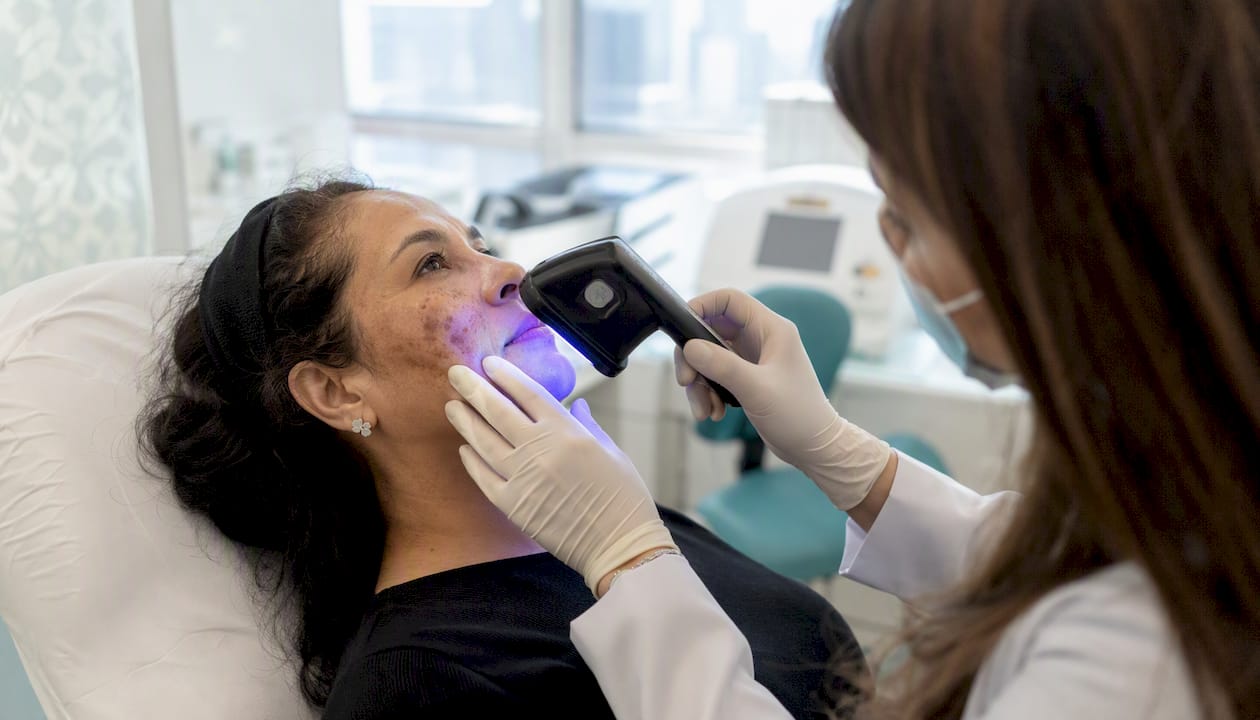
Why does this matter? Because epidermal pigment absorbs laser energy near the skin surface, while dermal pigment requires longer wavelengths and deeper penetration. A device calibrated for one depth can worsen pigmentation at another. Accurate diagnosis — not just a visual inspection — is what guides the right device choice and the right settings.
Pro Tip: Ask your clinician whether your pigmentation is epidermal, dermal, or mixed before agreeing to any treatment. A Wood’s lamp assessment takes minutes and can prevent weeks of wasted sessions on the wrong device.
If you are dealing with post-acne hyperpigmentation specifically, the treatment pathway differs from melasma management, and a combined approach addressing both pigment and scar texture is often more appropriate.
Which laser is right for your pigmentation type?
The laser types used in clinical practice fall into several categories, each targeting pigment through a different mechanism of pulse duration, wavelength, and tissue depth.
Picosecond lasers deliver ultrashort pulses (measured in trillionths of a second) that shatter melanin granules through a photomechanical effect rather than heat. This reduces thermal damage to surrounding tissue and can clear many benign pigmented lesions in fewer sessions for some patients. Picosecond systems are particularly suited to stubborn mixed pigmentation and tattoo ink removal.
Q-switched Nd:YAG (1064 nm) is the workhorse for darker skin tones. At 1064 nm, the wavelength penetrates deeper and is comparatively safer for Fitzpatrick types IV–VI when parameters are conservative. Low-fluence Q-switched toning — using large spot sizes and sub-injury energy levels across multiple sessions — reduces thermal injury and is preferred for melasma management in skin of color. Combined low-fluence and microsecond pulse strategies can improve melasma outcomes while lowering the risk of paradoxical darkening.
Fractional non-ablative and ablative lasers (including erbium:YAG and CO2 fractional) create microscopic columns of controlled thermal injury, stimulating remodeling while leaving surrounding tissue intact. They address mixed lesions and skin texture simultaneously but carry higher downtime and a meaningful PIH risk in darker skin types — making them less appropriate as a first-line pigmentation device for Fitzpatrick IV–VI.
IPL (intense pulsed light) is not a true laser but a broad-spectrum light source. It works for superficial epidermal pigment in lighter skin types and is generally not recommended for darker skin tones or dermal pigmentation.
Emerging multi-wavelength approaches — such as a dual-wavelength 589/1319 nm device studied in a small prospective trial — showed significant improvement in facial hyperpigmentation with good tolerability, pointing toward more targeted combination strategies in clinical practice.
| Laser type / wavelength | Best for | Suitable skin types (Fitzpatrick) | Sessions needed | Downtime | Common risks | Maintenance required |
|---|---|---|---|---|---|---|
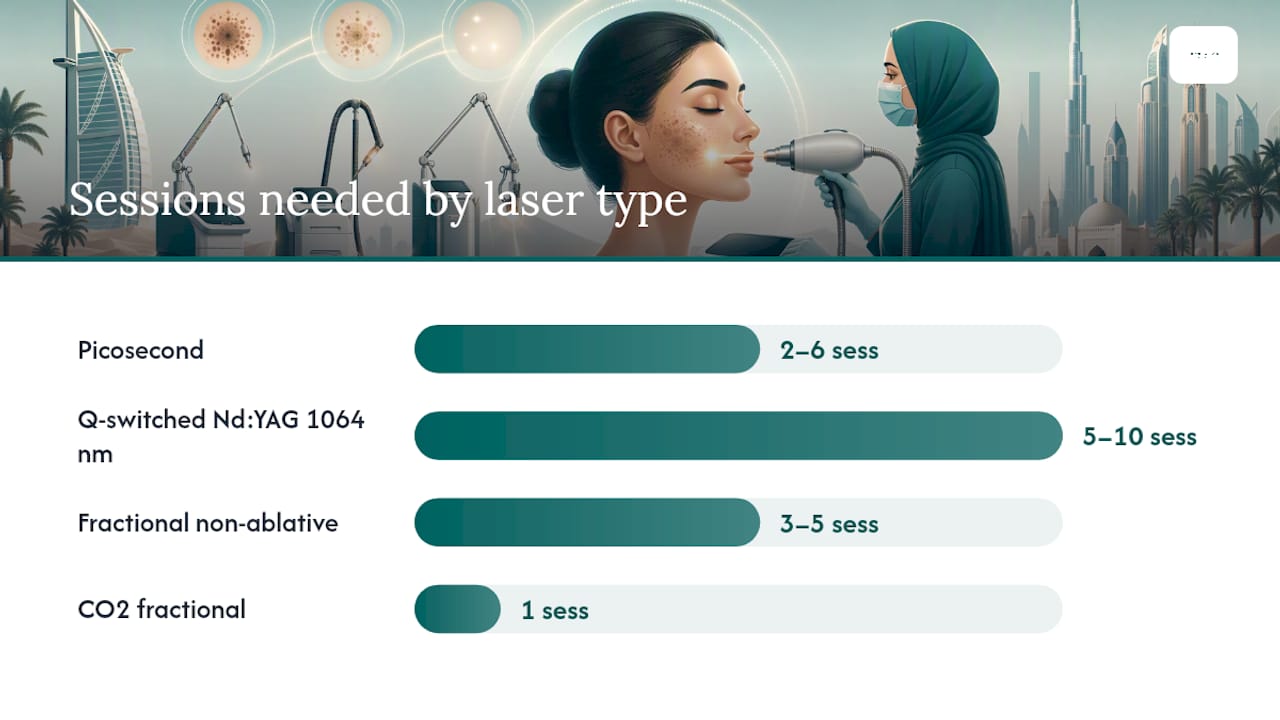
| Picosecond | Stubborn mixed pigment, tattoo ink, benign lesions | II–V (with care) | 2–6 | Minimal | Transient redness, PIH risk in darker types | Sunscreen, topicals |
| Q-switched Nd:YAG 1064 nm (low-fluence toning) | Melasma, dermal/mixed pigment, darker skin | III–VI | 5–10 | Minimal | PIH if fluence too high | Tyrosinase inhibitors, sunscreen |
| Fractional non-ablative | Mixed lesions, texture + pigment | II–IV | 3–5 | 2–5 days | PIH, prolonged redness | Sunscreen, periodic touch-ups |
| CO2 fractional (ablative) | Resurfacing, deep mixed lesions | II–III (caution IV+) | 1–3 | 5–10 days | PIH, scarring, hypopigmentation | Intensive post-care |
| IPL | Superficial epidermal pigment, solar lentigines | I–III | 3–5 | Minimal | PIH in darker skin, paradoxical darkening | Sunscreen |
Laser toning techniques using low fluence and large spot sizes are particularly relevant for patients with Fitzpatrick types III–VI — a significant proportion of the UAE patient population — where the margin between therapeutic effect and PIH induction is narrow.
Who is a good candidate, and how do clinics assess you?
A patient’s suitability for laser pigmentation treatment is never determined by the lesion alone. Hormonal history, medication use, recent tanning, and skin type all influence both device selection and the risk of adverse outcomes. Rushing to laser without this context is one of the most common reasons patients experience worsening rather than improvement.
A good candidate for laser therapy is generally someone with stable, non-infected pigmentation who has realistic expectations, is not pregnant, and is not on isotretinoin (which should be paused for at least six months before ablative procedures in most protocols). Active skin infections, uncontrolled systemic conditions, and a history of keloid scarring are standard contraindications.
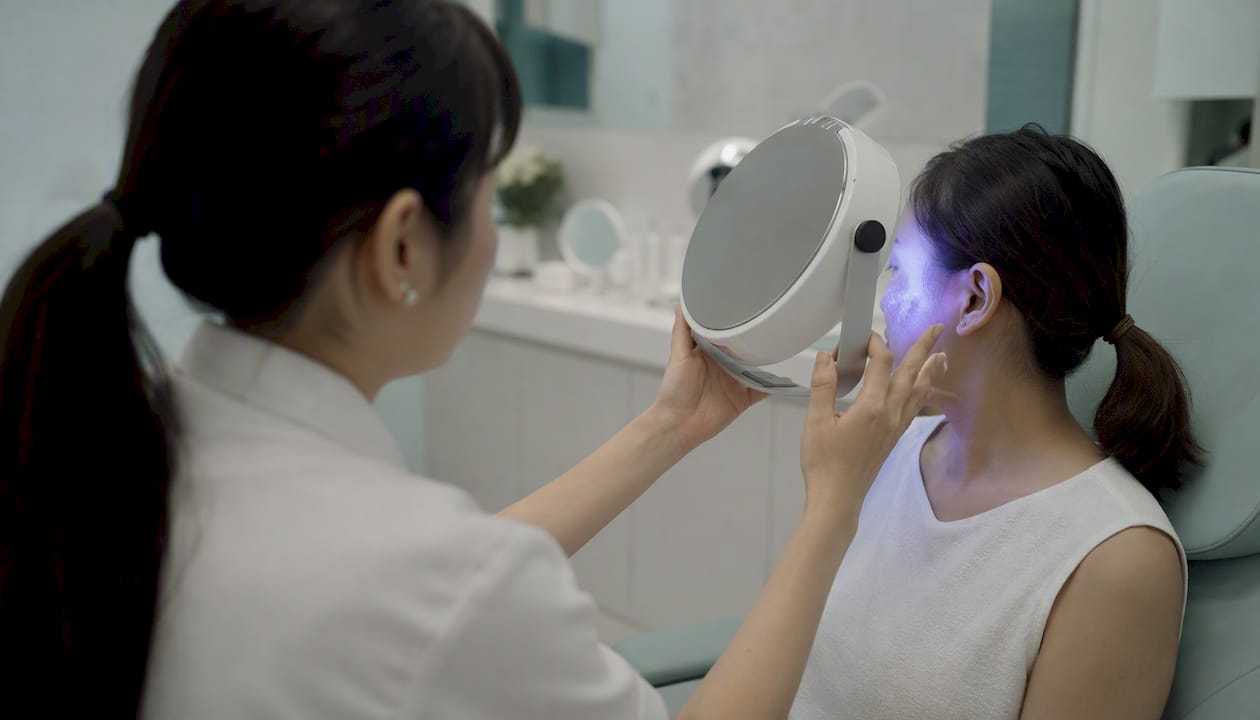
Assessment at a qualified clinic involves several steps. Fitzpatrick skin typing establishes baseline photosensitivity and PIH risk. Wood’s lamp examination differentiates epidermal from dermal pigment — epidermal lesions fluoresce more clearly under UV light, while dermal lesions appear less distinct. Clinical photography creates a documented baseline for tracking progress. A thorough medical history covers hormonal triggers (oral contraceptives, pregnancy history, thyroid conditions), photosensitizing medications, and prior treatments.
Systematic review evidence positions laser as a second-line option for melasma and PIH, with topical tyrosinase inhibitors — such as hydroquinone, kojic acid, or tranexamic acid — recommended as first-line therapy. Clinics that follow evidence-based protocols will often trial topical therapy for several weeks before introducing laser, particularly for melasma. Laser is reserved for refractory cases or where the pigment is confirmed to be dermal or mixed and unlikely to respond to topicals alone.
Timing matters too. Recent tanning, a chemical peel within the past two to four weeks, or recent isotretinoin use are all reasons to delay treatment and reschedule.
What results should you realistically expect?
Session counts vary by device and lesion type. Low-fluence Nd:YAG toning for melasma typically requires 5–10 sessions spaced two to four weeks apart, with gradual lightening across the course rather than dramatic single-session clearing. Picosecond treatments for discrete benign lesions may produce visible improvement in 2–6 sessions for some patients. Fractional approaches for mixed pigment and texture generally run 3–5 sessions with longer intervals.
Melasma has a well-documented relapse tendency. Even after significant clearance, UV exposure, hormonal fluctuation, or stopping maintenance topicals can trigger recurrence within weeks. This is not a failure of the laser — it reflects the chronic nature of the condition. Patients who maintain daily high-SPF broad-spectrum sunscreen and continue doctor-prescribed topical maintenance after their laser course consistently show more durable results.
Before-and-after photography using standardized lighting and angles is the clinical standard for tracking improvement. Some clinics also use validated pigment indices such as the Melanin Index or MASI (Melasma Area and Severity Index) score to quantify change objectively. These tools matter because they remove subjectivity from the assessment and give both the clinician and the patient a clear picture of progress.
- Melasma: gradual lightening over 5–10 sessions; high relapse risk without maintenance
- PIH from acne or injury: often responds in 3–6 sessions; deeper dermal PIH takes longer
- Solar lentigines and age spots: frequently show significant clearing in 1–3 sessions with appropriate devices
- Tattoo pigment: variable, depending on ink color and depth; multiple sessions expected
Good aftercare practices between sessions are as important as the treatment itself, particularly for patients with darker skin tones.
| Condition | Typical sessions | Downtime per session | Visible improvement timeline |
|---|---|---|---|
| Melasma (low-fluence toning) | 5–10 | Minimal (hours) | Gradual over 2–3 months |
| PIH (epidermal) | 3–6 | Minimal to mild | 4–8 weeks |
| Solar lentigines | 1–3 | Minimal | 1–3 weeks post-treatment |
| Tattoo pigment | 4–10+ | Mild | Progressive per session |
What are the risks, and how do clinics reduce them?
The most common side effects after laser pigmentation treatment are transient: redness, mild swelling, and crusting that resolve within days. More significant risks include PIH — particularly in Fitzpatrick types IV–VI — hypopigmentation (loss of pigment), blistering, and, in rare cases, scarring. Paradoxical darkening can occur with certain tattoo inks, particularly those containing titanium dioxide.
The single greatest predictor of a complication is not the device — it is the protocol. Aggressive one-off high-fluence sessions on darker skin, performed by operators who do not account for Fitzpatrick type, are responsible for the majority of serious adverse outcomes seen after laser pigmentation procedures.
Clinicians reduce risk through several concrete steps: performing a test spot two to four weeks before a full treatment to observe the skin’s response; using conservative fluence settings and spacing sessions appropriately; applying topical preconditioning agents (such as hydroquinone or azelaic acid) in the weeks before treatment to suppress melanocyte activity; and using active cooling during the procedure to protect the epidermis. Post-care protocols — avoiding active ingredients like retinoids and AHAs for a defined window, applying physical sunscreen immediately, and using barrier-supporting emollients — are non-negotiable.
Pro Tip: If a clinic offers a single high-powered session promising dramatic results for melasma or PIH on darker skin, treat that as a red flag. Evidence-backed protocols for these conditions are gradual, conservative, and multi-session by design.
Unlicensed operators and clinics without dermatologist oversight are a genuine safety concern. Always verify that the clinic uses medically approved devices and that a qualified physician oversees your treatment plan.
How to prepare and what to do after each session
Pre-treatment preparation sets the foundation for a safe outcome.
- Avoid deliberate tanning and prolonged unprotected sun exposure for at least four weeks before treatment
- Pause photosensitizing medications (certain antibiotics, retinoids) only when your doctor advises it is safe to do so
- Stop topical retinoids and exfoliating acids (AHAs, BHAs) as instructed, typically one to two weeks before
- Schedule treatment away from major social events — mild redness and crusting are normal in the days following
- Disclose all supplements and medications at your consultation, including hormonal contraceptives
Immediately after treatment, the skin is sensitive and the barrier is temporarily compromised. Gentle cleansing with a non-foaming, fragrance-free cleanser, a physical (mineral) sunscreen with SPF 50 or higher applied every two hours outdoors, and a simple emollient to support barrier recovery are the core post-care steps. Avoid heat, steam, and active skincare ingredients for the window your clinician specifies — typically five to seven days for most laser modalities.
Long-term maintenance is where results are preserved. Daily broad-spectrum SPF 50+ sunscreen is non-negotiable, particularly in the UAE’s high-UV environment. Doctor-prescribed tyrosinase inhibitors — compounds that interrupt melanin synthesis, such as tranexamic acid, kojic acid, or hydroquinone — reduce the rate of pigment rebound. Routine review visits allow the clinician to adjust the maintenance plan as your skin responds. Post-treatment skincare is not optional — it is the mechanism by which laser results last.
How Cosmolaser Medical Centre treats pigmentation
At Cosmolaser Medical Centre, no laser session begins without a complete dermatologic assessment. The device, the settings, and the session count are determined by the patient’s skin type, pigment depth, and medical history — not by a standard protocol applied to everyone who walks in.
The clinic’s patient pathway follows a stepwise structure. A dermatologic assessment establishes Fitzpatrick skin type and uses Wood’s lamp examination to characterize pigment depth. Where melasma or PIH is the primary concern, a trial of medical topical therapy is often initiated first, consistent with evidence-based sequencing that positions laser as a second-line tool. When laser is indicated, a test spot is performed and reviewed before any full-face treatment begins.
Sessions use conservative fluence settings, with parameters adjusted based on the skin’s response at each visit. Photo documentation at each stage creates a clear record of progress and informs decisions about continuing, pausing, or modifying the treatment plan. Where clinically appropriate, lasers are combined with combination aesthetic approaches — including medical-grade peels or fractional work — to address both pigment and texture simultaneously.
Pro Tip: Ask to see your before-and-after photos at each follow-up visit. Objective documentation is one of the clearest signs that a clinic is tracking your results rather than simply selling sessions.
All treatments at Cosmolaser Medical Centre are performed under dermatologist supervision, with qualified laser operators and calibrated, medically approved devices. Informed consent and pre-treatment counseling are standard steps, not optional extras.
What affects the cost of laser pigmentation treatment?
Pricing for laser pigmentation treatment varies, and understanding the drivers helps you compare quotes accurately.
- Device type: Picosecond systems and advanced Q-switched platforms typically carry higher per-session costs than IPL or basic laser modalities
- Number of sessions: A package of 8–10 low-fluence toning sessions costs more in total than a 2–3 session course for discrete sun spots, even if the per-session rate is similar
- Lesion size and depth: Larger treatment areas and deeper dermal pigmentation require more time and energy per session
- Provider experience and clinic credentials: Dermatologist-supervised clinics with medically approved devices operate at a different cost structure than non-medical aesthetic centers
- Included follow-up and maintenance: Some clinics price per session only; others include post-treatment review visits and starter maintenance products in a package
Questions worth asking at your consultation: What are the operator’s qualifications? Does the clinic perform a test spot before full treatment? How many sessions are realistically expected for your specific condition? What aftercare is included? Is pricing per session or per package, and what does each include?
Pro Tip: A lower per-session price at a clinic that does not perform test spots or Wood’s lamp assessment is not a saving — it is a risk. The cost of treating a PIH complication from an aggressive protocol almost always exceeds the cost of doing it correctly from the start.
The practical next step is to schedule a dermatologist-led consultation with photo documentation so you receive a treatment plan and a realistic cost estimate based on your actual condition.
A clinician’s perspective on realistic outcomes
Patients often arrive expecting laser to be a one-time solution. The honest clinical picture is more nuanced. For solar lentigines and discrete epidermal lesions, laser therapy can produce dramatic, durable results with minimal maintenance. For melasma and PIH in darker skin types — which describes a significant proportion of patients in the UAE — laser is a powerful tool, but only within a broader management plan that includes topical maintenance, sun protection, and realistic timelines.
Shared decision-making is central to good outcomes. A patient who understands that melasma may lighten significantly but requires ongoing maintenance is far better positioned to sustain their results than one who expects a permanent cure after three sessions. The clinician’s role is to set that expectation clearly, choose the safest device for the individual’s skin type, and build a plan that accounts for the chronic nature of the condition.
Cosmolaser Medical Centre’s pigmentation services
Patients dealing with dark spots, melasma, or post-acne discoloration get more than a laser session at Cosmolaser Medical Centre — they get a structured clinical plan. The clinic offers pigmentation consultations with Wood’s lamp assessment, low-fluence Nd:YAG toning, picosecond laser treatments, fractional options, and doctor-prescribed topical maintenance programs, all under dermatologist supervision.
A booked consultation includes a full dermatologic assessment, Fitzpatrick skin typing, Wood’s lamp examination, a test spot where indicated, a written treatment plan, and a clear cost estimate. Informed consent and pre-treatment counseling are part of every appointment. To take the next step, visit Cosmolaser Medical Centre to book your consultation online or contact the clinic directly in Sharjah. Patients who want to understand the clinical case for laser treatments before booking will find detailed guidance on the clinic’s website.
Sources
The following clinical studies and reviews informed this article’s guidance on laser therapy for pigmentation:
- Advancements in Laser Therapies for Dermal Hyperpigmentation in Skin of Color: A Comprehensive Literature Review and Experience of Sequential Laser Treatments in a Cohort of 122 Indian Patients – PMC
- Novel melasma therapy using combined low fluence and microsecond pulse Q switched 1064 nm neodymium doped yttrium aluminium garnet laser | Scientific Reports
- A Single-Center, Open-Label, Prospective Study of a 589/1319 nm Dual Wavelength Laser for the Treatment of Facial Hyperpigmentation – JDDonline – Journal of Drugs in Dermatology
- Review of Laser Treatments for Post-Inflammatory Hyperpigmentation in Skin of Color | American Journal of Clinical Dermatology
This article is general information, not a substitute for advice from a qualified doctor. Consult a qualified healthcare professional about your own circumstances before acting on anything here.
FAQ
Can laser remove hyperpigmentation permanently?
Laser can produce significant and long-lasting clearance of many pigmented lesions, but conditions like melasma are chronic and tend to recur without ongoing maintenance including daily sunscreen and topical tyrosinase inhibitors. Discrete lesions such as solar lentigines often respond more durably.
How many sessions does pigmentation laser treatment take?
Session counts depend on the condition and device: solar lentigines may clear in 1–3 sessions, while melasma treated with low-fluence Nd:YAG toning typically requires 5–10 sessions, and post-acne hyperpigmentation generally falls in the 3–6 session range.
How long does pigmentation take to fade after laser?
Epidermal pigmentation often shows visible fading within one to three weeks after each session, while dermal or mixed pigmentation lightens more gradually over two to three months across a full treatment course. Melasma improvement is progressive rather than immediate.
Is laser safe for darker skin tones?
Yes, when the correct device and parameters are used. Low-fluence Q-switched 1064 nm Nd:YAG toning is well-established for Fitzpatrick types III–VI, and picosecond systems also carry a favorable safety profile when settings are adapted appropriately. Fitzpatrick typing and a test spot before full treatment are essential safeguards.
What is the difference between laser and IPL for pigmentation?
Laser delivers a single, precise wavelength of light, allowing targeted treatment of specific pigment depths. IPL uses a broad spectrum of light and is generally limited to superficial epidermal pigment in lighter skin types. For darker skin tones or dermal pigmentation, laser — particularly 1064 nm Nd:YAG — is the safer and more effective choice.