
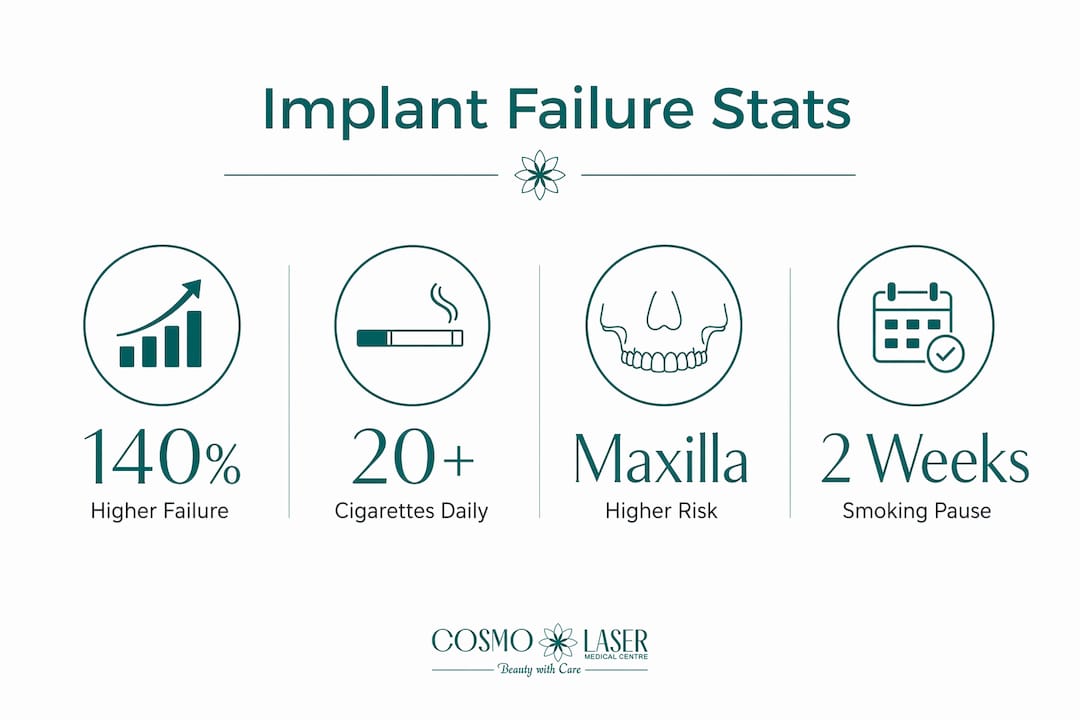
Smokers face a 140.2% higher risk of dental implant failure compared with non-smokers, based on a systematic review covering more than 150,000 implants. That figure reflects the overall failure risk, with a pairwise meta-analysis showing an odds ratio of 2.402 (p < 0.001), and this elevated risk persists regardless of implant duration. For early implant failure specifically, a 2024 meta-analysis found the risk is 159% higher in smokers (OR 2.59, 95% CI 2.08–3.23).
Key facts at a glance:
- Smokers carry a 140.2% higher overall implant failure risk than non-smokers at both implant and patient level (OR 2.402)
- Early implant failure risk is 159% higher in smokers, with an odds ratio of 2.59 (95% CI 2.08–3.23)
- Marginal bone loss around implants averages 0.580 mm more in smokers than in non-smokers
- Heavy smokers (more than 20 cigarettes per day) show survival rates of 84.6% versus 94.4% in non-smokers
- The risk does not diminish over time; meta-regression confirms no significant reduction with longer follow-up
- Smoking is not an absolute contraindication, but it demands personalised clinical planning
Cosmolaser Medical Centre provides this evidence-based guidance to help smokers make fully informed decisions about their dental care.
Table of Contents
- How smoking affects oral health and implant integration
- What are the specific risks of dental implants for smokers?
- Steps smokers can take to improve dental implant success
- Why bone grafting may be necessary for smokers
- Summary: what smokers need to know about dental implants
- UK healthcare guidance on dental implants for smokers
- Cosmolaser Medical Centre: expert dental implant care for smokers
- FAQ
- Key takeaways
How smoking affects oral health and implant integration
Tobacco toxins disrupt two processes that are fundamental to implant success: angiogenesis (the formation of new blood vessels) and osteogenesis (new bone growth). Without adequate blood supply and bone regeneration, the titanium implant post cannot fuse reliably with the surrounding jaw bone, a process clinicians call osseointegration.
The biological effects are wide-ranging:
- Reduced blood flow: Nicotine causes vasoconstriction, limiting the oxygen and nutrients that reach healing tissues around the implant site
- Impaired immune response: Smoking suppresses neutrophil and macrophage activity, leaving the surgical site more vulnerable to bacterial infection
- Disrupted bone metabolism: Tobacco compounds interfere with osteoblast function, slowing the mineralisation of new bone around the implant
- Elevated peri-implantitis risk: Smokers show higher rates of peri-implant inflammation, a condition that progressively destroys the bone supporting the implant
- Compromised wound healing: Reduced collagen synthesis and delayed epithelial closure extend recovery time after surgery
Peri-implantitis deserves particular attention. Studies consistently report a higher incidence of this condition in smokers, and once established, it accelerates crestal bone loss in a way that is difficult to reverse. The oral microbiota in smokers also shifts towards more pathogenic bacterial profiles, compounding the inflammatory burden around the implant.
Pro Tip: Tell your implant clinician your full smoking history, including daily cigarette count and how long you have smoked. This information directly shapes the treatment plan, the surgical protocol, and the monitoring schedule your team will put in place.
What are the specific risks of dental implants for smokers?
The clinical data on smokers’ dental implant risks is consistent across multiple large-scale reviews. The failure rate differential is not marginal; it is clinically significant at every anatomical site.
| Outcome measure | Smokers | Non-smokers | Source |
|---|---|---|---|
| Overall implant failure risk (OR) | 2.402 | Reference | PMC8780868 |
| Early implant failure risk (OR) | 2.59 | Reference | PubMed 39393606 |
| Maxillary implant failure (OR) | 2.910 | Reference | PMC8780868 |
| Mandibular implant failure (OR) | 2.866 | Reference | PMC8780868 |
| Mean marginal bone loss difference | +0.580 mm | Reference | PMC8780868 |
| Heavy smoker survival rate (12 months) | 84.6% | 94.4% | PMC12902707 |
| Heavy smoker marginal bone loss | 1.5 ± 0.3 mm | 0.7 ± 0.6 mm | PMC12902707 |
Statistic to note: A 2024 meta-analysis found that smokers have a 159% higher risk of early implant failure, with an odds ratio of 2.59 and a 95% confidence interval of 2.08–3.23.
The dose-response relationship is particularly telling. Heavy smokers, defined as those consuming more than 20 cigarettes per day for over five years, experience marginal bone loss of 1.5 ± 0.3 mm within 12 months of final reconstruction. That is more than double the 0.7 ± 0.6 mm recorded in non-smokers over the same period. Patients who smoke fewer cigarettes daily still face elevated risk, but the data makes clear that intensity of use directly worsens outcomes.
Implant failure frequency is higher in the maxilla than the mandible among smokers. This reflects the generally lower bone density and reduced cortical bone volume in the upper jaw. Smoking’s negative effects on osseointegration appear powerful enough to override the mechanical advantage the mandible normally holds, producing statistically significant failure elevations in both jaws.
Steps smokers can take to improve dental implant success
Smoking is not an absolute contraindication for dental implant treatment, but it requires a structured, proactive approach from both patient and clinician. The evidence supports several practical measures that genuinely reduce risk.
Before surgery:
- Aim to stop smoking at least two weeks before the procedure; longer cessation periods yield better outcomes, though research on exact optimal timelines is ongoing
- Seek NHS Stop Smoking Services, which offer combination therapies including nicotine replacement, varenicline, and behavioural support
- Consider hypnotherapy for smoking cessation as a complementary approach, particularly for patients who have struggled with pharmacological methods alone
- Disclose your full smoking history to your dental team so they can adjust surgical planning accordingly
During the healing period:
- Avoid smoking entirely for at least two weeks post-surgery; the initial osseointegration phase is when the implant is most vulnerable
- Maintain meticulous oral hygiene, including interdental brushing and antibacterial mouthwash, to compensate for the reduced immune response that smoking causes
- Attend all scheduled follow-up appointments; smokers benefit from more frequent monitoring than non-smokers
For those unable to quit immediately:
- Reducing daily cigarette consumption still has a measurable positive effect on implant outcomes; a dose-response relationship means fewer cigarettes translates to lower risk
- Discuss nicotine replacement therapy with your GP as a bridge strategy during the perioperative period
- Be transparent with your clinician about any changes to your smoking habits throughout treatment
Pro Tip: Patients who combine NHS behavioural counselling with nicotine replacement therapy are significantly more likely to achieve sustained cessation than those using willpower alone. Ask your GP for a referral before your implant surgery date is confirmed.

Why bone grafting may be necessary for smokers
Smoking accelerates alveolar bone resorption and compromises bone quality over time, meaning many smokers present with insufficient bone volume at the implant site. Bone grafting addresses this deficiency by augmenting the jaw before or during implant placement.
Common grafting indications in smokers include:
- Reduced ridge height or width: Bone loss from tooth extraction, periodontitis, or smoking-related resorption may leave inadequate volume to anchor an implant securely
- Low bone density: Particularly relevant in the maxilla, where smokers already face the highest failure odds
- Socket preservation: Placing graft material immediately after extraction to maintain bone volume ahead of future implant placement
- Sinus lift procedures: Required when upper back teeth are missing and the sinus floor has dropped too close to the proposed implant site
Graft types used in clinical practice include autogenous bone (taken from the patient’s own body), allograft (donor bone), xenograft (bovine-derived), and synthetic materials such as hydroxyapatite. Each carries different resorption rates and integration timelines, and the choice depends on the volume needed, the patient’s medical history, and the clinician’s assessment of healing capacity.
For smokers, grafted sites carry additional complexity. Reduced blood supply and impaired immune function slow graft incorporation, and the risk of graft failure is higher than in non-smokers. Clinicians at Cosmolaser Medical Centre assess each patient’s bone volume and smoking status before recommending a grafting approach, ensuring the decision is grounded in individual anatomy rather than a one-size-fits-all protocol.
Summary: what smokers need to know about dental implants
The evidence is unambiguous, and the practical conclusions are clear.
- Smoking raises implant failure risk by 140.2%, with early failure risk rising by 159%
- Marginal bone loss is significantly greater in smokers, and the gap widens with heavier daily consumption
- The risk does not plateau or diminish with time; long-term implant maintenance requires sustained cessation efforts
- Cessation before and after surgery is the single most effective step a smoker can take to protect their implant
- Reducing daily cigarette intake, even without full cessation, produces measurable improvements in outcomes
- Bone grafting may be required to compensate for smoking-related bone deficiency, adding complexity and recovery time
- Personalised clinical planning, including enhanced monitoring and hygiene protocols, is non-negotiable for smokers
Informed decision-making starts with understanding these risks honestly. Smokers who proceed with implant treatment while continuing to smoke should do so with a clear picture of the elevated failure probability and the ongoing maintenance demands involved.
UK healthcare guidance on dental implants for smokers
In the United Kingdom, no single statutory body publishes a dedicated national guideline exclusively for dental implants in smokers, but several authoritative sources provide relevant direction. The National Institute for Health and Care Excellence (NICE) recommends that clinicians assess all modifiable risk factors, including tobacco use, before undertaking implant-supported rehabilitation. Smoking is consistently listed as a significant risk factor requiring patient counselling as part of the treatment planning process.
The British Society of Periodontology and Implant Dentistry (BSPID) aligns with European Federation of Periodontology (EFP) guidance, which states that individual behavioural counselling for smoking cessation should always be integrated into the treatment plan for patients receiving implant-supported restorations. The EFP further notes that there is insufficient evidence to support the view that e-cigarettes or water pipe smoking carry a materially lower risk for peri-implant disease than conventional cigarettes.
NHS Stop Smoking Services remain the most accessible route to cessation support in the UK, offering free combination therapy through GP practices, pharmacies, and specialist stop-smoking clinics. Patients planning implant surgery are strongly encouraged to engage with these services well in advance of their procedure date. The CDC also confirms that smoking is a leading cause of periodontal disease, the same pathological process that undermines peri-implant bone health.
Cosmolaser Medical Centre: expert dental implant care for smokers
Smokers considering implants need more than a standard treatment pathway. They need a clinical team that accounts for elevated failure risk from the outset, builds cessation support into the plan, and monitors outcomes with the frequency that the evidence demands.

Cosmolaser Medical Centre offers dental implant procedures delivered by qualified specialists who factor smoking status, bone quality, and individual healing capacity into every treatment plan. Rather than applying a generic protocol, the team conducts thorough pre-surgical assessments, including bone volume evaluation and a frank discussion of cessation timelines, to give each patient the best possible foundation for long-term implant success. For patients who want to address their overall oral and aesthetic health alongside implant treatment, Cosmolaser Medical Centre’s broader range of services, detailed in the combination aesthetic treatment guide, reflects the same patient-centred philosophy. Book a consultation with Cosmolaser Medical Centre to discuss your specific situation and receive a personalised treatment plan built around your needs.
FAQ
What percentage of dental implants fail in smokers?
A systematic review of more than 150,000 implants found that implants in smokers fail at a rate 140.2% higher than in non-smokers, with an odds ratio of 2.402. A 2024 meta-analysis found early failure risk significantly higher in smokers, with an odds ratio of 2.59.
Can an oral surgeon tell if you smoke?
Yes. Clinicians can identify signs of tobacco use through visual examination of oral tissues, and smoking status can be confirmed objectively via a urinary cotinine assay, a biomarker test that detects nicotine metabolites. Accurate disclosure is always in the patient’s best interest, as it directly shapes the surgical and monitoring plan.
Can you smoke while wearing a dental implant?
Smoking while an implant is in place persistently elevates the risk of peri-implantitis and marginal bone loss. Meta-regression data confirms the negative effect of smoking on implant survival does not diminish over time, so the risk is ongoing rather than limited to the healing phase.
How long should you stop smoking after dental implant surgery?
Clinical guidance recommends avoiding smoking for at least two weeks post-surgery, covering the critical early osseointegration window. Longer cessation periods produce better outcomes, and sustained cessation throughout the implant’s lifetime is the most protective approach the evidence supports.
Key takeaways
Smokers face a clinically proven, dose-dependent increase in dental implant failure risk that persists throughout the implant’s lifetime, making cessation the single most effective protective measure available.
| Point | Details |
|---|---|
| Failure risk is sharply elevated | Smokers carry a 140.2% higher implant failure risk than non-smokers, with an odds ratio of 2.402. |
| Early failure is the greatest danger | Early implant failure risk rises by 159% in smokers, with an odds ratio of 2.59 (95% CI 2.08–3.23). |
| Heavy smoking compounds bone loss | Smokers consuming more than 20 cigarettes daily experience greater marginal bone loss within 12 months than non-smokers. |
| Risk does not fade with time | Meta-regression confirms no significant reduction in failure odds with longer follow-up, making lifelong cessation the only reliable mitigation. |
| Cosmolaser Medical Centre | Offers personalised dental implant planning that integrates smoking status, bone assessment, and cessation support from the first consultation. |