Full arch dental implants are fixed prostheses anchored to multiple titanium implants in the jawbone, restoring complete dental function and aesthetics for patients who have lost all teeth in one or both arches. Unlike removable dentures, these restorations stay in place permanently and are only removed by a dental professional for maintenance. For adults weighing their options in the UK, understanding the procedure, costs, and candidacy criteria is the foundation of a well-informed decision.
What are full arch dental implants and how do they work?
A full arch implant restoration replaces an entire row of teeth, typically 10 to 14, using a fixed prosthetic bridge secured to four to six titanium implants placed in the jawbone. The bridge is screwed into the implants and cannot be removed by the patient. This is the defining difference from a conventional denture.

The implants themselves act as artificial tooth roots. Once placed surgically, they undergo osseointegration, a biological process taking several months, in which the surrounding bone grows into and bonds with the titanium surface. This bond creates the stable foundation that gives fixed implants their characteristic strength and permanence.
Key features of full arch implant restorations:
- Implant count: typically four to six implants per arch, depending on bone volume and the chosen protocol
- All-on-4 technique: two anterior implants placed vertically, two posterior implants angled at 30°–45° to maximise bone contact and reduce the need for grafting
- Prosthetic materials: acrylic over a titanium bar, porcelain fused to metal, or monolithic zirconia
- Fixed, not removable: the bridge is screw-retained; only the dental team removes it for maintenance
- Bone preservation: implants stimulate the jawbone, preventing the resorption that occurs beneath conventional dentures
- Improved function: near-natural chewing force and speech stability compared with removable alternatives
How the full arch implant procedure works, step by step
- Initial consultation and imaging. A comprehensive assessment includes clinical examination, medical history review, and cone beam computed tomography (CBCT) scanning to evaluate bone volume and anatomy.
- Treatment planning. The surgical and prosthetic team maps implant positions digitally, often fabricating a surgical guide for precise placement.
- Extraction of remaining teeth (where required) on the day of surgery, with site preparation to receive the implants.
- Implant placement. Four to six implants are inserted per arch under local anaesthesia or sedation. Posterior implants are often angled strategically to engage denser bone and reduce need for grafting.
- Immediate loading (teeth-in-a-day). If adequate primary stability is achieved, a temporary fixed bridge is attached on the same day, allowing early function.
- Osseointegration period. Over the following 3–6 months, the bone bonds to the implant surfaces. Follow-up appointments monitor healing progress.
- Final prosthesis fabrication. Once osseointegration is confirmed, intraoral scans or impressions capture precise implant positions for the dental laboratory.
- Delivery and adjustment. The temporary bridge is removed, the permanent prosthesis is fitted, the bite and aesthetics are verified, and screws are torqued to specification.
- Ongoing monitoring. Regular professional check-ups continue at intervals determined by individual risk profile.
Who is a good candidate for full arch implants?
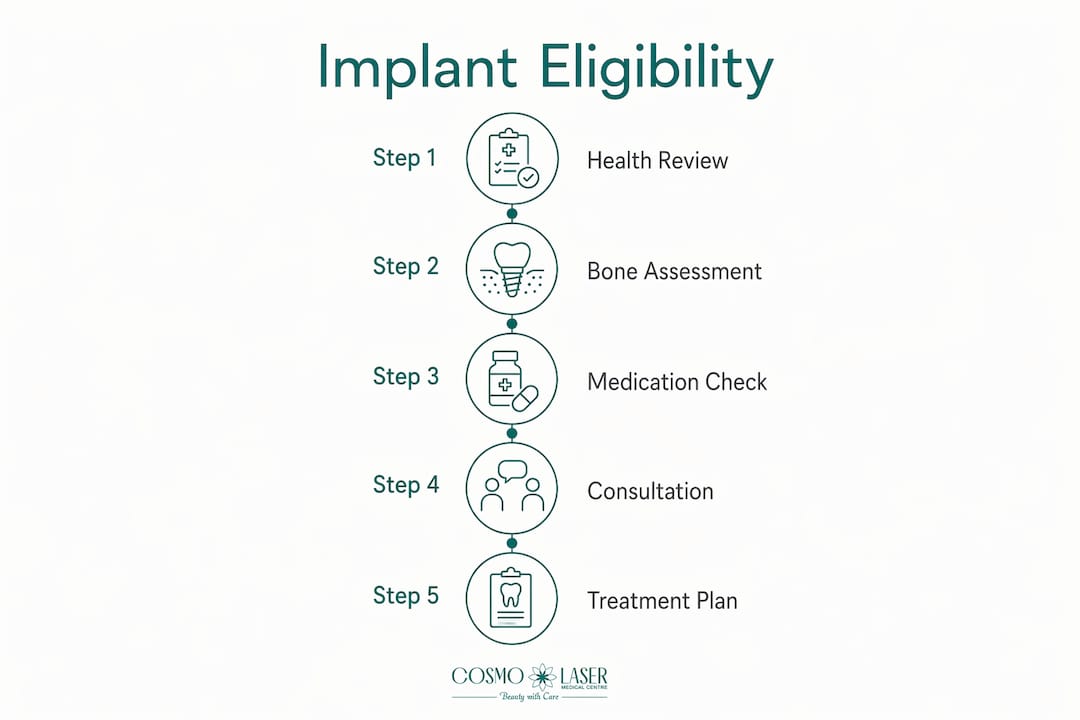
Candidacy depends on a combination of anatomical, medical, and lifestyle factors. A thorough clinical assessment is always required before any treatment plan is confirmed.
- Sufficient bone volume is the primary anatomical requirement. Patients with moderate bone loss may still qualify through angled implant placement. Severe atrophy may require zygomatic or pterygoid implants, which anchor in denser bone beyond the alveolar ridge to avoid grafting.
- Controlled systemic health. Conditions such as uncontrolled diabetes or autoimmune disorders that impair healing can affect implant candidacy. Well-managed systemic disease does not automatically exclude a patient.
- Non-smoking status. Smoking is associated with higher rates of implant failure and biological complications. Patients who smoke are counselled on the increased risk.
- Good oral hygiene capability. Patients must be able to maintain diligent home care around the prosthesis. Limited dexterity may favour removable implant-supported overdentures instead.
- Completed jaw growth. Full arch implants are generally not placed until skeletal maturity, typically in the late teens or early twenties.
- Realistic expectations. Patients should understand the treatment timeline, the maintenance commitment, and the possibility of needing additional procedures such as bone grafting.
For patients who do not meet the criteria for fixed implants, implant-supported overdentures offer improved stability over conventional dentures while remaining removable for cleaning.
Pro Tip: Before your first consultation, compile a full list of medications and any diagnosed systemic conditions. Certain drugs, including bisphosphonates, can affect bone healing and must be disclosed to your implant specialist before treatment planning begins.
What are the benefits and outcomes of full arch implants?
The clinical case for full arch implant restoration is well supported. Implant survival rates range from 92% to 99% over 5–10 years, with prosthetic survival around 95%, figures that reflect the maturity and reliability of modern implant protocols.
- Near-natural chewing function. Fixed implants transmit bite force directly through the implant to the bone, allowing patients to eat most foods without restriction.
- Speech stability. Because the prosthesis does not move, patients adapt quickly to normal speech patterns, unlike with conventional dentures that can shift.
- Bone preservation. Implants stimulate the jawbone mechanically, preventing the progressive resorption that occurs when teeth are absent.
- No adhesives required. The bridge is mechanically secured; there is no need for denture adhesive creams or pastes.
- Custom aesthetics. Prostheses are fabricated to match natural tooth colour, shape, and gum contour, producing a result that is difficult to distinguish from natural dentition.
- Quality of life. Patients consistently report improved confidence, social comfort, and dietary freedom following full arch restoration.
Full arch implants versus removable dentures: which is right for you?
The choice between fixed implants and removable dentures involves trade-offs across function, biology, cost, and maintenance.

| Feature | Fixed full arch implants | Removable dentures |
|---|---|---|
| Stability | Fixed; no movement during eating or speaking | Can slip; may require adhesive |
| Bone preservation | Yes; implants stimulate jawbone | No; bone continues to resorb |
| Upfront cost (per arch, UK) | £15,000–£35,000 | Much lower |
| Maintenance | Professional cleaning every 3–6 months | Removable for daily cleaning |
| Eating ability | Near-normal; most foods permitted | Restricted diet advisable |
| Prosthesis lifespan | 10–20+ years | 5–10 years before replacement |
| Surgery required | Yes | No |
Implant-supported overdentures (snap-in dentures) sit between these two options. They use 2–6 implants per arch to anchor a removable prosthesis, offering better stability than conventional dentures at a lower cost than fixed bridges. Snap-in implant dentures cost between £3,000 and £15,000 per arch; fixed All-on-4 bridges typically range from £18,000 to £35,000 per arch. Overdentures do not prevent bone loss as effectively as fixed implants, but they represent a practical middle ground for patients with health or budget constraints.
Pain, recovery, and what to expect during treatment
Most patients are surprised by how manageable the surgical experience is. The full arch procedure typically takes about one hour per arch under local anaesthesia or sedation, and discomfort is generally mild, with recovery resolving within days.
Key points on pain and recovery:
- During surgery: local anaesthesia eliminates pain at the surgical site; IV sedation is available for patients who prefer to be deeply relaxed or anxious
- Immediately post-surgery: swelling, bruising, and mild soreness are expected for the first 3–5 days
- Diet during healing: soft foods are recommended for the first several weeks to avoid placing excessive load on the implants
- Oral hygiene during recovery: gentle rinsing with prescribed antiseptic mouthwash; brushing around the prosthesis with a soft-bristle brush
- Pain management: over-the-counter analgesics such as ibuprofen or paracetamol are typically sufficient; stronger medication is prescribed when needed
Clinical note: The 10-day recovery window refers to the acute post-surgical phase. Full osseointegration takes 3–6 months, during which the temporary bridge remains in place and normal activities can resume within days of surgery.
How much do full arch implants cost in the UK, and what are your financing options?
Full arch implant treatment in the UK typically costs between £15,000 and £35,000 per arch, depending on the number of implants, prosthetic material, and whether additional procedures are required. This is a significant investment, and understanding what drives the variation helps patients compare quotes accurately.
- Implant count: four implants per arch costs less than six; more implants improve load distribution but add to the surgical and component fees
- Prosthetic material: acrylic is the most affordable option; zirconia can add £2,500–£7,000 per arch but is more resistant to staining and chipping
- Bone grafting or sinus lift: required when bone volume is insufficient; adds both cost and treatment time
- Sedation: IV sedation or general anaesthesia adds to the total; confirm whether it is included in any quoted price
- Follow-up care: some clinics bundle aftercare into the treatment fee; others charge separately for maintenance visits
For financing, many UK dental practices offer interest-free or low-interest payment plans spread over 12–60 months. Patients should ask specifically whether the quote covers the final prosthesis or only a provisional bridge, as this distinction can represent a substantial hidden cost. NHS provision for full arch implants is extremely limited; most patients fund treatment privately.
How long do full arch implants last, and how do you maintain them?
The implant fixtures themselves can last decades and, in many cases, a lifetime with proper care. The prosthetic bridge typically requires replacement or significant repair after 10–20 years, depending on material choice, bite force, and maintenance quality.
Recommended maintenance practices:
- Brush twice daily with a soft-bristle toothbrush, paying particular attention to the junction between the prosthesis and the gum tissue
- Use a water flosser to flush debris from beneath the bridge where conventional floss cannot reach effectively
- Interdental brushes help clean the inter-implant spaces and pontic sections
- Professional maintenance every 3–6 months, as recommended by the American College of Prosthodontists, with frequency adjusted to individual risk profile
- Annual or biennial radiographs to monitor bone levels around the implants and detect early signs of peri-implant disease
- Avoid hard or very sticky foods that place excessive mechanical stress on the prosthesis
Zirconia prostheses generally require less maintenance than acrylic due to superior stain and chip resistance, though the upfront cost is higher.
What are the risks and complications of full arch implants?
Full arch implant restoration carries risks that patients should understand before committing to treatment. Most complications are manageable when detected early.
- Peri-implant mucositis: reversible inflammation of the soft tissue around the implant, analogous to gingivitis; responds well to improved hygiene and professional cleaning
- Peri-implantitis: progressive bone loss around the implant caused by bacterial infection; more serious and harder to treat once established
- Screw loosening: mechanical loosening of the retaining screws; addressed at maintenance appointments and not typically a sign of implant failure
- Prosthetic fracture: acrylic bridges are more susceptible to fracture than zirconia; patients who grind their teeth face higher risk
- Implant failure: occurs when osseointegration does not complete; smoking, uncontrolled systemic disease, and poor bone quality are the primary risk factors
- Nerve or sinus involvement: rare but possible if implants are placed without adequate imaging guidance; CBCT planning significantly reduces this risk
Regular professional check-ups are the most effective safeguard. Early detection of mucositis or bone level changes allows intervention before complications become irreversible.
How to choose a dental clinic for full arch implants in the UK
Selecting the right provider is as consequential as the treatment itself. The outcome of full arch implant restoration depends heavily on surgical precision, prosthetic expertise, and long-term support.
- Verify specialist credentials: look for a prosthodontist, oral surgeon, or periodontist with documented postgraduate training in implant dentistry; the General Dental Council (GDC) register confirms UK registration
- Confirm CBCT imaging capability: clinics that offer in-house 3D CBCT scanning can plan implant positions with far greater accuracy than those relying on conventional radiographs alone
- Request a detailed written treatment plan: this should itemise implant count, prosthetic material, sedation, bone grafting (if applicable), and follow-up care, with no ambiguity about what is and is not included in the quoted fee
- Review case documentation: before-and-after records and documented clinical outcomes give a realistic picture of the clinic’s results
- Assess aftercare provision: a clinic that offers structured maintenance appointments and a clear protocol for managing complications is preferable to one that treats the delivery appointment as the end of the process
- Seek a second opinion for complex cases: patients with significant bone loss, systemic health conditions, or previous implant failures benefit from consulting more than one specialist before proceeding
Pro Tip: Ask the clinic directly whether the surgeon who places the implants and the prosthodontist who designs the prosthesis work together in-house. Fragmented care between separate providers can introduce communication gaps that affect the final result.
Pre-operative assessment and planning: what happens before surgery
Thorough pre-operative planning is what separates predictable outcomes from avoidable complications. The process begins with CBCT imaging, which produces a three-dimensional map of bone volume, density, and the positions of anatomical structures such as the maxillary sinus and inferior alveolar nerve. This data drives every subsequent decision, from implant length and angulation to whether bone augmentation is needed.
Digital workflows now allow clinicians to plan implant positions virtually and fabricate a surgical guide that translates that plan directly to the operating field. Intraoral scans or diagnostic impressions capture the existing occlusion and soft tissue contours, informing the design of the provisional prosthesis. Patients also undergo a full medical history review at this stage, as systemic conditions and medications must be factored into the anaesthetic and surgical plan.
Do you need bone grafting or a sinus lift before implants?
Not every patient requires bone augmentation, but it is a common consideration, particularly for patients who have been edentulous for several years. Bone resorbs progressively after tooth loss, and the posterior upper jaw is especially vulnerable due to the proximity of the maxillary sinus.
A sinus lift procedure raises the sinus membrane and places bone graft material in the resulting space, creating sufficient height for implant placement. Minor grafting at individual extraction sites is less involved and can often be performed simultaneously with implant surgery. The All-on-4 technique was specifically developed to reduce the need for grafting by angling posterior implants into denser anterior bone. For cases of severe maxillary atrophy, zygomatic implants that anchor in the cheekbone can deliver a fixed full arch bridge without any grafting at all.
Aftercare and maintenance: protecting your investment long term
The long-term success of full arch implants depends as much on aftercare as on the surgery itself. At home, patients should brush twice daily with a soft-bristle brush, use a water flosser beneath the bridge, and clean inter-implant spaces with interdental brushes. The prosthesis sits slightly above the gum tissue, and food debris collects in that space if hygiene is inconsistent.
Professional maintenance visits, scheduled every 3–6 months based on risk profile, allow the dental team to remove calculus with instruments compatible with implant surfaces, assess probing depths around each implant, and take periodic radiographs to monitor bone levels. The American College of Prosthodontists advises that removal of the fixed prosthesis at routine maintenance is not necessary unless hygiene cannot be achieved with the bridge in place, or mechanical complications require it.
How full arch implants affect speech and eating
The functional improvements from fixed implant restoration are among the most immediately noticeable benefits patients report. Conventional dentures shift during chewing and speaking, forcing patients to adapt their tongue and lip movements to compensate. A fixed bridge eliminates that instability entirely.
Speech typically normalises within a few weeks as patients adjust to the new prosthesis. Eating function improves substantially: patients can return to most foods, including those that were impossible with dentures, such as hard vegetables, crusty bread, and meat on the bone. The direct load transfer through the implant to the bone also provides proprioceptive feedback, the sense of pressure and resistance when biting, which conventional dentures cannot replicate.
Why choosing a qualified implant specialist in the UK matters
Full arch implant restoration is one of the most technically demanding procedures in dentistry. The consequences of poor planning or inadequate surgical technique, including nerve damage, implant failure, or prosthetic misfit, can be difficult and costly to correct. In the UK, the GDC regulates all dental professionals, but postgraduate training in implant dentistry varies considerably between practitioners.
Patients should look for clinicians who hold recognised postgraduate qualifications in implant dentistry, prosthodontics, or oral surgery, and who can demonstrate a documented case volume in full arch restoration specifically. Clinics offering comprehensive dental implant services with in-house CBCT imaging, digital planning, and structured aftercare provide the integrated environment that complex full arch cases require.
Key takeaways
Full arch dental implants, supported by four to six titanium implants per arch, deliver implant survival rates of 92%–99% over 5–10 years and represent the most durable fixed solution for complete tooth loss.
| Point | Details |
|---|---|
| Survival rates are high | Clinical data shows implant survival of 92%–99% over 5–10 years, with prosthetic survival around 95%. |
| UK costs vary widely | Costs per arch vary widely; zirconia prostheses tend to be more expensive than acrylic options. |
| Recovery is manageable | Acute post-surgical discomfort typically resolves in under two weeks; osseointegration requires several months. |
| Maintenance is non-negotiable | Professional check-ups every 3–6 months and twice-daily home hygiene protect long-term implant health. |
| Candidacy requires assessment | Bone volume, systemic health, and smoking status all determine eligibility; CBCT imaging is essential before planning. |
FAQ
Are full arch dental implants worth it?
For most patients with complete or near-complete tooth loss, fixed full arch implants offer superior function, bone preservation, and long-term value compared with removable dentures. Implant survival rates of 92%–99% over 5–10 years support their clinical reliability.
Does food get under full arch dental implants?
The prosthesis sits slightly above the gum tissue, and food debris can collect in that space. Daily use of a water flosser and interdental brushes clears this effectively, and professional cleaning at every maintenance visit addresses any residual build-up.
How painful is a full arch dental implant procedure?
The surgery itself is performed under local anaesthesia or sedation and is generally well tolerated. Post-operative discomfort is typically mild, lasting around 10 days, and is managed with standard over-the-counter analgesics in most cases.
How long do full arch dental implants last?
The implant fixtures can last decades and potentially a lifetime with proper care. The prosthetic bridge typically requires replacement or significant repair after 10–20 years, with longevity influenced by material choice, oral hygiene, and regular professional maintenance.