A zygoma implant is a specialised dental implant anchored into the zygomatic bone, commonly known as the cheekbone, rather than the upper jaw. For patients who have been told they lack sufficient maxillary bone for conventional implants, this approach offers a clinically proven alternative that avoids the lengthy process of bone grafting entirely. Zygomatic implants are indicated primarily for severe maxillary alveolar bone resorption, failed conventional implants or bone grafts, and conditions such as tumour resection or trauma that leave the upper jaw partially or completely absent.
The key advantages that make this treatment compelling are:
- Graftless solution: no bone graft surgery required before implant placement
- Shorter treatment timeline: prosthetic rehabilitation can often begin within days rather than months
- Immediate loading potential: in suitable cases, a fixed provisional prosthesis is fitted on the same day as surgery
- Broad indications: covers Cawood and Howell Class V/VI atrophy, post-oncological defects, cleft palate cases, and failed grafting histories
- Quad zygoma option: when anterior maxillary bone is also absent, two zygomatic implants placed on each side provide the necessary antero-posterior distribution for stable prosthetic support
Who qualifies for zygomatic implants?
Patient selection is the most consequential decision in zygomatic implant therapy. Not every patient with bone loss is a candidate, and equally, not every patient with bone loss needs to go straight to this option.
The primary indications are well established. Patients with severe maxillary alveolar bone loss, typically classified as Cawood and Howell Class V or VI, who cannot receive conventional implants due to insufficient bone volume or density, are the core group. Those who have experienced failed conventional implant therapy or unsuccessful bone grafting also qualify, as do patients who prefer to avoid staged grafting procedures altogether.
- Severe maxillary atrophy: insufficient residual bone height or width for standard implant placement
- Failed prior treatment: previous implants or bone grafts that did not achieve stable osseointegration
- Post-resection defects: partial or complete maxillectomy following benign or malignant tumour removal
- Congenital or traumatic defects: cleft palate, facial trauma, or developmental maxillary deficiency
- Patient preference: documented refusal of bone augmentation procedures, provided anatomy supports zygomatic placement
Contraindications include uncontrolled systemic conditions such as poorly managed diabetes, active bisphosphonate therapy affecting bone metabolism, untreated maxillary sinusitis, and insufficient zygomatic bone volume. Preoperative CBCT imaging is mandatory to assess zygomatic bone dimensions, sinus anatomy, and the relationship between the proposed implant trajectory and critical structures including the infraorbital nerve and orbital floor.
How is a zygoma implant procedure performed?
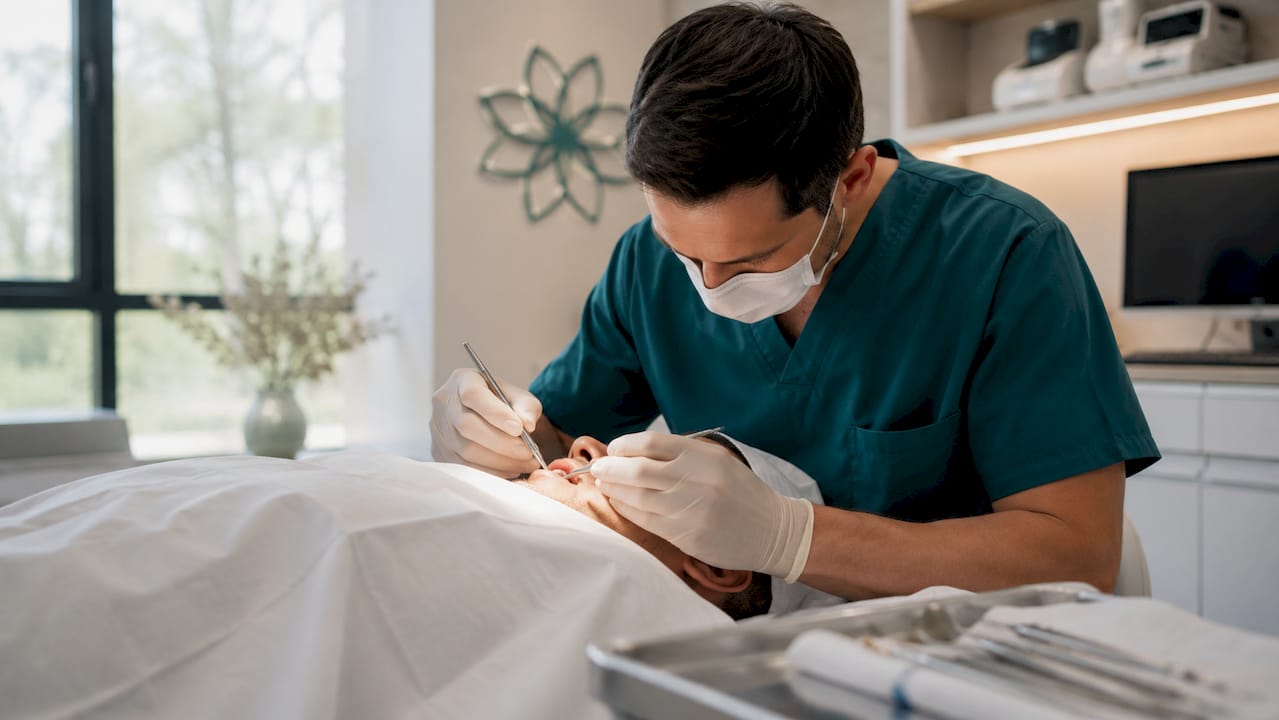
The surgical approach for placing a zygomatic dental implant is considerably more complex than standard implant surgery. The implant, typically 30–52.5 mm in length, traverses from the palatal or crestal region of the upper jaw through or alongside the maxillary sinus and anchors into the dense cortical bone of the zygomatic arch.
Preoperative planning
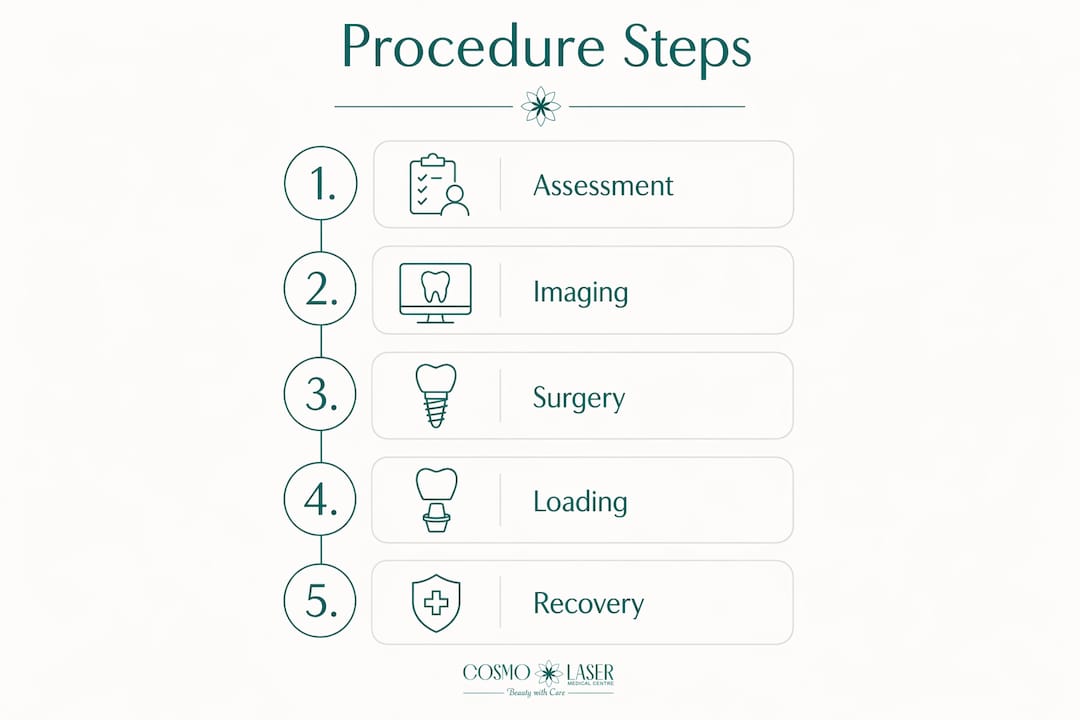
Accurate three-dimensional imaging is non-negotiable. Cone beam computed tomography (CBCT) or conventional CT scanning maps the zygomatic bone volume, sinus morphology, and the precise trajectory needed for safe implant insertion. Virtual surgical planning software allows the surgical team to simulate implant positioning before the patient enters theatre, reducing intraoperative uncertainty.
Surgical approaches
Two principal techniques are used in contemporary practice:
- Classical intrasinus approach (Brånemark protocol): the implant passes through the maxillary sinus, engaging the zygomatic bone at the apex. This technique offers reliable anchorage but carries a higher risk of sinus membrane perforation and subsequent sinusitis.
- Extrasinus (exteriorised) approach: the implant is positioned along the external lateral wall of the zygomatic-maxillary complex, avoiding direct sinus penetration. Extrasinus placement and immediate loading protocols help reduce sinus complications compared to the classical technique.
- ZAGA (Zygoma Anatomy-Guided Approach): a personalised protocol that adapts implant trajectory to the patient’s individual anatomy rather than applying a fixed surgical path, optimising soft tissue management and reducing tissue trauma.
Insertion and loading
Implants are placed under general anaesthesia or deep sedation. Drilling follows a carefully planned protocol, with the surgeon monitoring proximity to the infraorbital nerve and orbital structures throughout. Insertion torque must reach a threshold sufficient for primary stability before immediate loading is considered. When stability is confirmed, a provisional fixed prosthesis is attached on the same day.
Pro Tip: Ask your surgical team whether they use a ZAGA-trained approach or a standardised protocol. Anatomy-guided planning significantly reduces the risk of soft tissue complications and improves long-term prosthetic emergence profiles.
Surgical expertise is a decisive factor. The proximity of the maxillary sinus, infraorbital nerve, and orbital floor demands a surgeon with specific training in zygomatic implant placement. This is not a procedure that should be attempted by a generalist implant dentist without dedicated advanced training.
What do the clinical outcomes and success rates show?
The evidence base for zygomatic implants is now substantial, with long-term data from multiple systematic reviews and the ITI Consensus Workshop providing a clear picture of efficacy and risk.
Long-term survival averages 96.2% over a mean follow-up of approximately 6.3 years, which is clinically comparable to conventional implants in patients with adequate bone. Immediate loading protocols produce a survival rate of 98.1%, compared to 95% for delayed loading protocols over similar follow-up periods. Most failures occur within the first six months post-surgery, with an annual failure incidence of approximately 0.7% thereafter.
Common complications
- Sinusitis: the most frequently reported biological complication, with a prevalence of 14.2% over a mean follow-up of 65.4 months. Sinusitis can lead to implant loss if left untreated, but does not necessarily reduce overall survival when managed appropriately with antibiotics or surgical intervention.
- Oro-antral communication: an abnormal connection between the oral cavity and maxillary sinus, typically manageable with surgical closure.
- Infraorbital nerve paresthesia: temporary or, rarely, permanent altered sensation in the cheek and upper lip region due to proximity of the implant trajectory to the infraorbital nerve.
- Soft tissue complications: peri-implant soft tissue recession or poor emergence profile, more common with the classical intrasinus approach than with extrasinus techniques.
- Mechanical complications: prosthetic fractures or screw loosening, generally addressable through routine maintenance.
Most failures occur in the initial six months, reinforcing the importance of both surgical precision and diligent postoperative monitoring during the early healing phase.
Benefits and drawbacks compared to conventional implant treatment
Zygomatic implants offer a genuinely different risk-benefit profile from conventional dental implants. Understanding both sides helps patients make an informed choice alongside their clinical team.
Advantages
- No bone graft required: eliminates the need for autogenous bone harvesting or synthetic augmentation, removing an entire surgical stage and months of healing time
- Immediate functional rehabilitation: patients can receive a fixed provisional prosthesis on the day of surgery when primary stability is achieved, restoring speech, chewing, and aesthetics without delay
- Shorter overall treatment time: compared to a conventional implant pathway requiring bone grafting, the total treatment duration is considerably reduced
- Reliable anchorage in dense cortical bone: the zygomatic bone is predominantly cortical and highly resistant to resorption, providing stable long-term anchorage
- Quad zygoma biomechanics: when anterior maxillary bone is also absent, the quad zygomatic approach places two implants bilaterally, achieving the antero-posterior spread needed for optimal force distribution across the prosthesis
- Improved quality of life: patients report higher satisfaction and functional outcomes compared to bone grafting alternatives
Disadvantages
- Surgical complexity: the procedure demands specialist training and carries greater intraoperative risk than standard implant placement
- Sinus complications: sinusitis remains the most common biological risk, requiring ongoing monitoring and occasionally further intervention
- Specialist availability: not all implant centres offer zygomatic implant surgery; access to trained surgeons is more limited than for conventional implants
- Cost: the procedure is more expensive than standard implant treatment, reflecting the surgical complexity and specialist expertise involved
- Not universally indicated: patients with mild to moderate bone loss may achieve equivalent outcomes with short implants or bone augmentation, making zygomatic implants unnecessary in those cases
Conventional implants remain preferable when residual bone volume is sufficient for primary stability, when the patient is medically suitable for grafting, or when the anatomical risk profile makes zygomatic placement disproportionately hazardous.
UK costs and what patients commonly ask
What does zygomatic implant treatment cost in the UK?
Treatment in the UK typically ranges from £10,000 to £25,000 per arch, with London and the South East generally at the higher end of that range. The total cost depends on several factors: the number of implants placed (two versus four in a quad zygoma case), the loading protocol chosen, the complexity of any associated prosthetic work, and the level of anaesthetic care required.
NHS funding for zygomatic implants is extremely limited and generally restricted to post-oncological or trauma reconstruction cases. Most patients fund treatment privately, and it is worth asking prospective clinicians for a fully itemised treatment plan before committing.
Insurance coverage varies considerably. Some private dental insurance policies include complex implant surgery, but the majority do not cover zygomatic procedures as standard. Patients should review policy exclusions carefully and request written confirmation from their insurer before treatment begins.
Recovery and aftercare
Recovery from zygomatic implant surgery typically involves facial swelling and discomfort for one to two weeks, with most patients returning to normal daily activities within that period. A soft diet is maintained for several weeks while osseointegration progresses. Regular follow-up appointments monitor sinus health, soft tissue healing, and prosthetic stability. Thorough postoperative care is directly linked to long-term implant survival, particularly during the critical first six months when the majority of failures occur.

What specialists say about anatomy-guided techniques
The shift from standardised surgical protocols to personalised, anatomy-guided approaches represents one of the most clinically significant developments in zygomatic implant surgery over the past decade.
The ZAGA concept, developed to address the limitations of fixed surgical pathways, tailors implant positioning to the patient’s individual zygomatic anatomy. Rather than forcing a predetermined trajectory, the surgeon adapts the implant path to optimise soft tissue management, reduce the risk of sinus perforation, and achieve a prosthetic emergence profile that supports long-term oral hygiene. The clinical benefit is a reduction in soft tissue complications and improved peri-implant health over time.
Specialist consensus also emphasises the following:
- Multidisciplinary planning: successful outcomes depend on collaboration between the oral and maxillofacial surgeon, prosthodontist, and radiologist from the outset
- Preoperative sinus evaluation: identifying pre-existing sinus pathology before surgery reduces the risk of postoperative sinusitis and implant compromise
- Prosthetic design: the prosthesis must be designed in parallel with surgical planning, not as an afterthought, to achieve functional occlusion and aesthetic emergence
- Long-term monitoring: annual radiographic and clinical review allows early detection of peri-implant changes, sinus complications, or mechanical issues before they become irreversible
Surgical expertise and comprehensive patient assessment critically influence the success of zygomatic implant therapy. Patients should seek clinicians who can demonstrate specific training in zygomatic procedures and who work within a multidisciplinary restorative team. For patients considering dental implant options, a thorough specialist assessment is the essential first step.
Key takeaways
Zygomatic implants offer a clinically validated, graftless solution for severe maxillary bone loss, with a long-term survival rate of 96.2% and immediate loading survival reaching 98.1% when primary stability is achieved.
| Point | Details |
|---|---|
| Graftless rehabilitation | Zygomatic implants eliminate the need for bone grafting, significantly reducing treatment time and surgical stages. |
| Long-term survival | Mean survival of 96.2% over 6.3 years is comparable to conventional implants in patients with adequate bone. |
| Immediate loading benefit | Immediate loading achieves 98.1% survival versus 95% for delayed loading, improving both outcomes and patient experience. |
| Sinusitis is the main risk | Sinusitis occurs in approximately 14.2% of cases but is manageable and does not necessarily lead to implant loss. |
| Specialist expertise is essential | Surgical complexity and proximity to critical anatomy require a clinician with dedicated zygomatic implant training. |
FAQ
What is a zygomatic implant?
A zygomatic implant is a long dental implant anchored into the cheekbone (zygomatic bone) rather than the upper jaw, used when maxillary bone loss is too severe for conventional implants.
How much do zygomatic implants cost in the UK?
Treatment typically costs between £10,000 and £25,000 per arch in the UK, with London clinics generally at the higher end; costs vary based on the number of implants and the prosthetic protocol chosen.
What are the main disadvantages of zygomatic implants?
The principal drawbacks are surgical complexity, the requirement for a specialist surgeon, the risk of sinusitis (occurring in approximately 14.2% of cases), and higher cost compared to conventional implant treatment.
Do zygomatic implants last long-term?
Clinical data shows a mean survival rate of 96.2% over approximately 6.3 years, with most failures occurring within the first six months post-surgery; with proper case selection and follow-up, long-term function is well supported by evidence.
Who is not suitable for zygomatic implants?
Patients with uncontrolled systemic disease, active bisphosphonate therapy, untreated maxillary sinusitis, or insufficient zygomatic bone volume are generally not suitable candidates; a CBCT scan and specialist assessment determine eligibility.