
A dental implant is a titanium or zirconia post surgically placed into the jawbone to act as an artificial tooth root, providing stable, long-term support for crowns, bridges, or dentures. Unlike removable dentures, an implant fuses directly with living bone, restoring both function and appearance in a way that closely mimics a natural tooth. For adults in the UK weighing their tooth replacement options, understanding exactly what the procedure involves, what it costs, and what the long-term commitment looks like is the foundation of a sound decision.
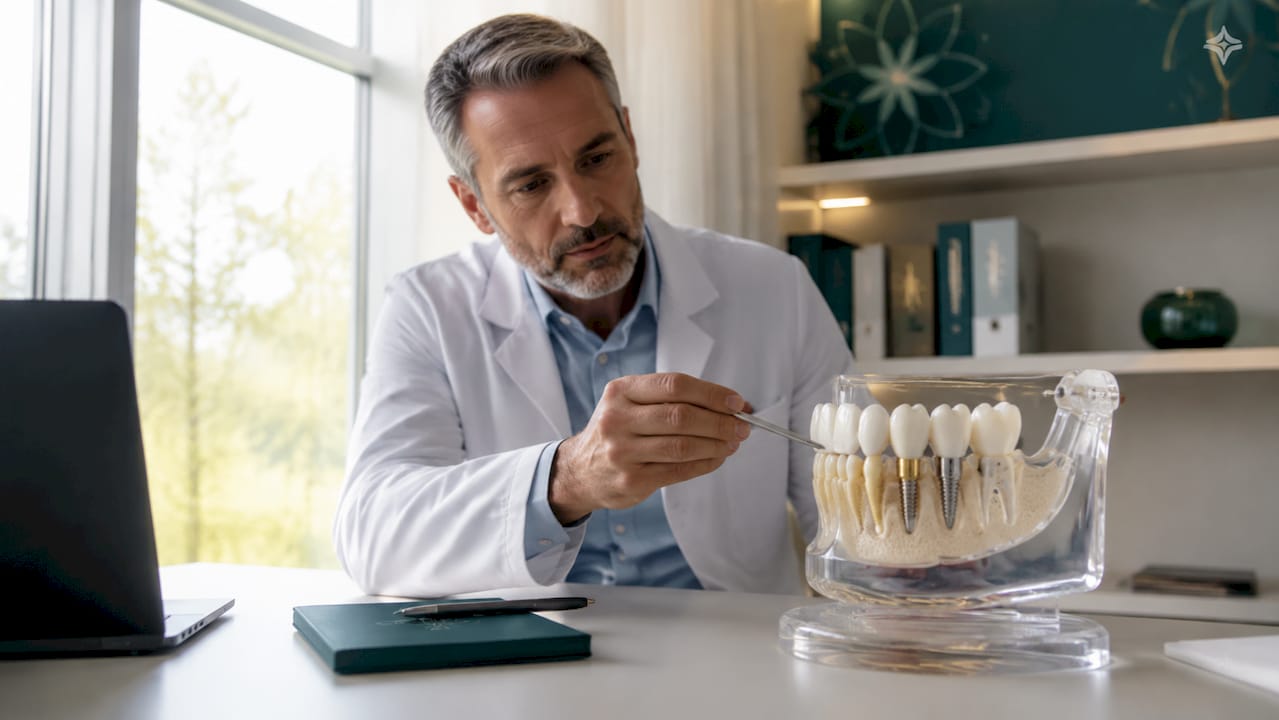
What is a dental implant and how is it structured?
A dental implant is a surgical medical device inserted into the jawbone in place of a missing tooth’s root. The FDA classifies it as a medical device, and its three-component structure is consistent across virtually all modern implant systems:
- Implant body: The post itself, typically made of titanium or zirconia, which is surgically embedded into the jawbone and integrates with the surrounding bone over several months.
- Abutment: A connector piece attached to the implant body, usually secured with an abutment fixation screw, which extends through the gum line into the mouth.
- Restoration: The visible artificial tooth, most commonly a porcelain crown, which is fixed onto the abutment to complete the replacement.
When a tooth is lost through injury or disease, the jawbone beneath it begins to shrink through a process called resorption. An implant halts this by occupying the space the natural root once held, preserving both bone volume and the structural integrity of adjacent teeth. No other tooth replacement option achieves this at the root level.
How does the dental implant procedure work, step by step?
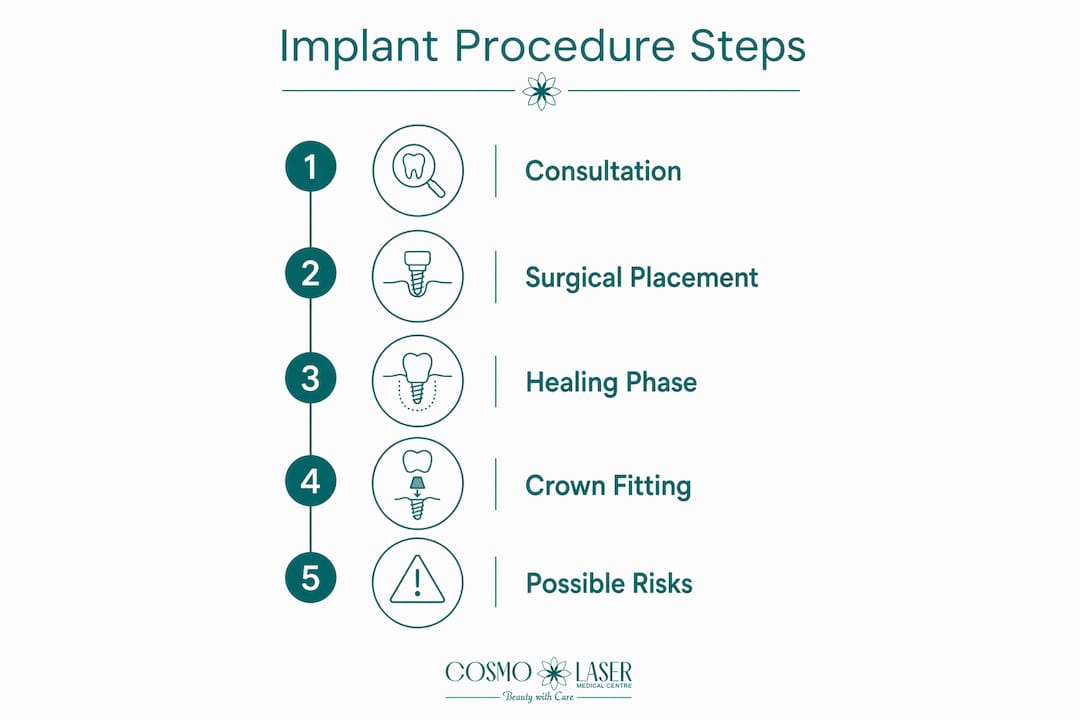
The dental implant process is staged deliberately, and the timeline reflects the biology of bone healing rather than clinical preference. Rushing any phase compromises the outcome.
- Initial consultation and assessment: Your dentist or oral surgeon evaluates your overall health, existing bone density, and gum condition. Three-dimensional imaging, such as CBCT scanning, is standard for precise surgical planning and identifying anatomical structures like the mandibular nerve.
- Bone grafting (where required): Patients with insufficient bone volume may need a sinus lift or ridge augmentation before implant placement. Adequate bone quantity and quality are critical for implant viability; without them, the post has nothing stable to integrate with.
- Surgical implant placement: The implant body is placed into a prepared osteotomy site in the jawbone under local anaesthesia. Surgical protocols require incremental drilling with copious saline irrigation to keep bone temperature below 47°C, preventing thermal necrosis that would cause integration failure.
- Osseointegration: The implant body fuses with the surrounding bone over time. According to Guy’s and St Thomas’ NHS Foundation Trust, mandibular healing typically takes 2–3 months, while maxillary (upper jaw) healing requires 3–6 months. During this period, a temporary abutment is usually placed.
- Abutment placement: Once osseointegration is confirmed, the permanent abutment is attached. In a two-stage procedure, this requires a minor second surgery to expose the implant body; in a one-stage approach, the abutment is placed at the initial surgery.
- Final restoration: The custom crown, bridge, or denture is fitted onto the abutment, completing the tooth replacement. Shade matching and bite alignment are assessed at this stage to achieve a natural result.
The full process, from initial consultation to fitted crown, typically spans 6–12 months when bone grafting is not required, and longer when it is. Patients should plan for multiple appointments spread across this period.
Why dental implants are the preferred tooth replacement option
Dental implants offer a combination of functional and structural benefits that other tooth replacement options cannot fully replicate.
- Restored chewing ability: Implants function like natural teeth, allowing patients to eat without restriction. Removable dentures, by contrast, reduce biting force considerably.
- Natural appearance: The porcelain crown is colour-matched and shaped to blend with surrounding teeth, making the restoration virtually indistinguishable from a natural tooth.
- Jawbone preservation: Because the implant body occupies the root space, it prevents bone shrinkage that would otherwise alter facial structure over time.
- Stability of adjacent teeth: A gap left by a missing tooth allows neighbouring teeth to drift. An implant holds that space, keeping the surrounding dentition aligned.
- Improved speech: Ill-fitting dentures can slip and affect pronunciation. Fixed implant restorations eliminate this problem entirely.
- Ease of care: Implants are cleaned exactly like natural teeth, with brushing and flossing, requiring no adhesives or overnight soaking.
- Longevity: With proper maintenance, implants can last many years, making them a cost-effective solution over a patient’s lifetime compared to restorations that require periodic replacement.
Risks and complications you should know about
Dental implants carry a strong track record, but they are surgical procedures and carry genuine risks that every patient should understand before proceeding.
- Infection at the implant site: Post-surgical infection can compromise healing and, if untreated, lead to implant failure.
- Nerve damage: Incorrect placement near the mandibular canal can cause altered sensation, numbness, or tingling in the lip, chin, or tongue.
- Sinus complications: Upper jaw implants placed too close to the sinus cavity can cause sinusitis or sinus perforation.
- Implant failure: Failure may occur due to poor osseointegration, systemic infection, or delayed healing. Patients with uncontrolled diabetes face a higher failure risk due to impaired healing responses.
- Smoking: Smoking reduces blood supply to healing tissues and significantly increases the likelihood of both early and late implant failure.
- Peri-implantitis: A form of gum disease specific to implants that, if left untreated, destroys the bone supporting the implant.
Complications can appear shortly after placement or months later. Some result in implant looseness or loss, requiring a further surgical procedure to remove and potentially replace the implant system.
Pro Tip: If your implant feels loose, painful, or you notice swelling that persists beyond the normal healing window, contact your dental provider immediately. Early intervention almost always prevents the need for implant removal.
What do dental implants cost in the UK, and does the NHS cover them?
Cost is one of the most common concerns for patients considering implants in the UK, and the picture is more nuanced than a single price figure suggests.
Private costs
Dental implant costs in the UK vary by region, the complexity of the case, and the materials used. A single implant including the post, abutment, and crown typically runs into the thousands of pounds. Full-mouth reconstructions using implant-supported bridges or implant-retained dentures represent a considerably larger investment. Costs in the research pool from the US market indicate single implants generally cost several thousand dollars; UK private pricing varies widely between practices and should be confirmed directly with your chosen specialist.
NHS availability
NHS dental implants are available only in very limited circumstances. The NHS generally funds implants when tooth loss results from a specific medical condition, accident, or congenital absence, and only when a clinical case can be made that no other treatment is appropriate. Routine tooth loss from decay or gum disease does not typically qualify. Patients seeking implants for cosmetic or general restorative reasons will almost always need to pursue private treatment.
Managing the cost
- Many private dental practices offer interest-free or low-interest payment plans, spreading the cost over 12–24 months.
- Some dental insurance policies include partial implant cover; check the policy terms carefully, as waiting periods and annual limits apply.
- Dental schools affiliated with UK universities sometimes offer implant treatment at reduced rates under supervised clinical conditions.
Pro Tip: Always request an itemised treatment plan before committing. A reputable practice will break down the cost of the implant body, abutment, crown, and any additional procedures such as bone grafting or extractions separately.
How to care for your dental implants long term
Implants demand more disciplined hygiene than natural teeth, not less. The reason is structural: implants lack the periodontal ligament that connects natural tooth roots to bone, making the gum-to-implant interface more vulnerable to bacterial infiltration. Plaque that accumulates at this junction promotes peri-implant disease, which is considerably harder to treat than conventional gum disease.
- Brush twice daily using a soft-bristled toothbrush, paying particular attention to the gum line around each implant.
- Floss daily using implant-specific floss or an interdental brush to clean the spaces between the implant crown and adjacent teeth.
- Use a water flosser as an adjunct, particularly for implant-retained bridges where conventional floss cannot reach underneath the pontic.
- Attend professional cleanings every three to six months, depending on your dentist’s recommendation. Hygienists use non-metallic instruments around implants to avoid scratching the titanium surface.
- Avoid habits that stress the implant: Chewing ice, biting nails, or using teeth as tools can fracture the crown or loosen the abutment screw.
- Monitor for warning signs: Looseness, persistent pain, or bleeding around the implant site warrants prompt professional assessment. Catching problems early prevents irreversible implant failure.
Dental implants are not a set-and-forget treatment. The patients who achieve the best long-term outcomes are those who treat their implants with the same rigour they would apply to natural teeth, and who attend follow-up appointments consistently.
Titanium vs zirconia: which implant material is right for you?
The two dominant implant materials in UK clinical practice are titanium and zirconia (zirconium oxide), and each has a distinct profile of properties that suits different patient needs.
| Property | Titanium implants | Zirconia implants |
|---|---|---|
| Osseointegration | Extensively documented; gold standard | Good integration; growing clinical evidence |
| Aesthetics | Grey metal; may show through thin gum tissue | Tooth-coloured; preferred for thin gum biotypes |
| Biocompatibility | Excellent; ISO and ASTM evaluated | Excellent; ceramic, metal-free option |
| Durability | Very high; decades of clinical data | High; more brittle than titanium under lateral force |
| Allergy risk | Rare titanium sensitivity reported | Preferred for patients with metal sensitivities |
| Clinical use in UK | Most widely used | Increasingly available; specialist placement required |
Both materials are evaluated against international consensus standards set by the International Organisation for Standardisation (ISO) and ASTM International, covering biocompatibility, mechanical performance, and safety. Titanium remains the most widely used material in UK implant dentistry, supported by decades of clinical data. Clinical studies confirm that both titanium and zirconia are safe and effective; the choice depends on individual anatomy, gum tissue thickness, aesthetic priorities, and any documented metal sensitivity.
Surgical precision matters as much as material choice. During the osteotomy, bone temperature must remain below 47°C; exceeding this threshold causes bone necrosis and prevents osseointegration regardless of which material is used. Incremental drilling with continuous saline cooling is the accepted protocol for achieving this.
How to choose the right dental implant specialist in the UK
Selecting the right clinician is as consequential as any other part of the treatment decision. Implant dentistry in the UK is not a protected specialty in the same way that orthodontics or oral surgery is, which means the burden of due diligence falls on the patient.
Look for a dentist or oral surgeon who holds a postgraduate qualification in implant dentistry, such as a Diploma or Masters from a UK university or a recognised professional body. Membership of organisations such as the Association of Dental Implantology (ADI) or the British Society of Oral Implantology (BSOI) indicates a commitment to ongoing education and peer-reviewed practice standards.
Ask specifically about the volume of implant cases the clinician places annually, and request to see before-and-after records of cases similar to yours. A practice that uses three-dimensional imaging for surgical planning, rather than conventional two-dimensional X-rays alone, demonstrates a higher standard of pre-surgical assessment. Interprofessional collaboration between the restorative dentist, periodontist, and implant surgeon, where relevant, is a marker of thorough, patient-centred care.
Cosmolaser Medical Centre’s dental team brings specialist expertise to each implant assessment, combining detailed imaging, personalised treatment planning, and a commitment to patient education at every stage of the process.
Key takeaways
Dental implants are the only tooth replacement option that preserves jawbone volume at the root level, making long-term maintenance and specialist selection as important as the surgical procedure itself.
| Point | Details |
|---|---|
| Three-component structure | Every implant system comprises an implant body, abutment, and crown or restoration. |
| Healing timeline | Mandibular osseointegration takes 2–3 months; maxillary healing requires 3–6 months. |
| NHS access is limited | The NHS funds implants only in specific clinical circumstances; most patients require private treatment. |
| Hygiene demands are higher | Implants lack a periodontal ligament, making daily plaque control critical to prevent peri-implant disease. |
| Material choice matters | Titanium is the most widely used material; zirconia suits patients with thin gum tissue or metal sensitivity. |
Why the implant conversation is more nuanced than most guides admit
The standard narrative around dental implants positions them as a straightforward upgrade: pay more, get a permanent tooth, move on. The reality is more layered, and patients who understand this tend to have better outcomes.
The most underestimated variable is bone quality. Adequate bone volume is not simply a prerequisite to tick off before surgery; it is an ongoing biological condition that changes with age, systemic health, and even the time elapsed since tooth loss. A patient who delays treatment by two or three years may face a bone grafting procedure they could have avoided. The window for straightforward implant placement narrows with time, and no amount of surgical skill fully compensates for severely resorbed bone.
The second point that rarely gets the attention it deserves is the distinction between implant placement and implant success. Placement is a single surgical event. Success is a decade-long commitment to hygiene, monitoring, and professional maintenance. Peri-implantitis, the inflammatory condition that destroys bone around a failing implant, is more prevalent than many patients realise, and it is largely preventable with consistent care. The patients who lose implants years after successful placement almost always have a hygiene or monitoring gap in their history.
Choosing a specialist purely on price is the single most common mistake. The difference between a clinician who uses three-dimensional CBCT imaging and one who relies on a standard dental X-ray is not a luxury upgrade; it is the difference between a surgical plan built on accurate anatomy and one built on estimation. In implant dentistry, that distinction has direct consequences for nerve safety, sinus avoidance, and long-term integration.
For patients in the UK, the regulatory framework provides a baseline of safety, but it does not guarantee clinical excellence. Seek out a clinician with documented postgraduate training, a transparent treatment planning process, and a practice that treats aftercare as part of the service, not an afterthought.
FAQ
How painful is getting a dental implant?
Most patients report that the procedure itself, performed under local anaesthesia, is less uncomfortable than they anticipated. Post-surgical soreness typically resolves within a few days and is managed with standard over-the-counter pain relief.
How long does a dental implant last?
With proper oral hygiene and regular professional check-ups, implants can last many years. Clinical benchmarks set a success rate of 85% at five years and 80% at ten years as minimum criteria; well-maintained implants in healthy patients frequently exceed these figures.
What are the main downsides of a dental implant?
The principal downsides are cost (private treatment is required for most UK patients), the length of the treatment process spanning several months, surgical risks including infection and nerve injury, and the ongoing hygiene commitment needed to prevent peri-implant disease.
Can I get a dental implant on the NHS?
NHS dental implants are available only in very limited clinical circumstances, such as tooth loss resulting from a specific medical condition or congenital absence. Routine tooth loss from decay or gum disease does not typically qualify, and most patients will need to fund treatment privately.
What is the difference between titanium and zirconia implants?
Titanium is the most widely used implant material, with decades of clinical evidence supporting its integration and durability. Zirconia is a metal-free, tooth-coloured ceramic alternative preferred for patients with thin gum tissue or documented metal sensitivity, with a growing body of clinical evidence supporting its use.