TL;DR:
- Laser therapy targets specific skin chromophores using precise wavelengths for tissue selectivity and minimal damage. It offers faster recovery and more consistent results compared to traditional methods by sparing healthy tissue and requiring multiple sessions for optimal outcomes. Proper device selection, patient assessment, and protocol adherence are essential for safe and effective laser treatments.
Laser therapy is defined as the medical application of focused light energy to target specific chromophores within skin tissue, including melanin, haemoglobin, and water. Aesthetic clinics use lasers because no other technology matches their ability to treat wrinkles, pigmentation, vascular lesions, and scarring with the same degree of tissue selectivity and minimal disruption to surrounding skin. The principle underpinning all clinical laser work is selective photothermolysis: the delivery of a precise wavelength that a target absorbs more readily than the tissue around it. Understanding this principle explains why laser technology in clinics has become the standard rather than the exception.
Why aesthetic clinics use lasers: the science behind the choice
Lasers work by converting light into thermal energy within a specific target. A clinician selects a wavelength that a chosen chromophore absorbs strongly. The laser pulse heats that target to a damaging temperature while the surrounding tissue remains largely unaffected. This is selective photothermolysis in practice, and it is the reason lasers outperform most conventional treatments for precision.
Pulse duration matters as much as wavelength. A pulse that is too long allows heat to spread beyond the target, causing collateral damage. A pulse that is too short may not deliver sufficient energy. Matching pulse duration to the thermal relaxation time of the target is what separates a safe, effective treatment from a harmful one.
Two broad categories of laser exist in clinical practice: ablative and non-ablative. Ablative lasers remove the outer skin layers entirely. Non-ablative lasers heat the dermis without breaking the surface. Fractional technology sits between these two poles: it creates microscopic columns of thermal injury while preserving the surrounding healthy tissue, which drives rapid healing and collagen remodelling with shorter downtime than fully ablative approaches.
Pro Tip: Ask your clinician whether a fractional or non-ablative approach suits your skin before committing to a session. The right category depends on your skin type, condition severity, and how much recovery time you can accommodate.
Key chromophores targeted in aesthetic laser work include:
- Melanin — absorbs wavelengths in the 532–1064 nm range, making it the primary target for pigmentation and tattoo treatments.
- Haemoglobin — absorbs strongly at 577 nm and 585 nm, making vascular lesions treatable without damaging surrounding skin.
- Water — absorbs infrared wavelengths used in ablative resurfacing to vaporise tissue layer by layer.
What benefits do laser treatments offer compared to traditional methods?
Precision is the defining advantage of laser treatments for aesthetics. A laser targets only the chromophore it is calibrated for. Conventional chemical peels or mechanical dermabrasion remove tissue indiscriminately, which increases the risk of scarring and uneven results. Lasers spare healthy tissue by design.
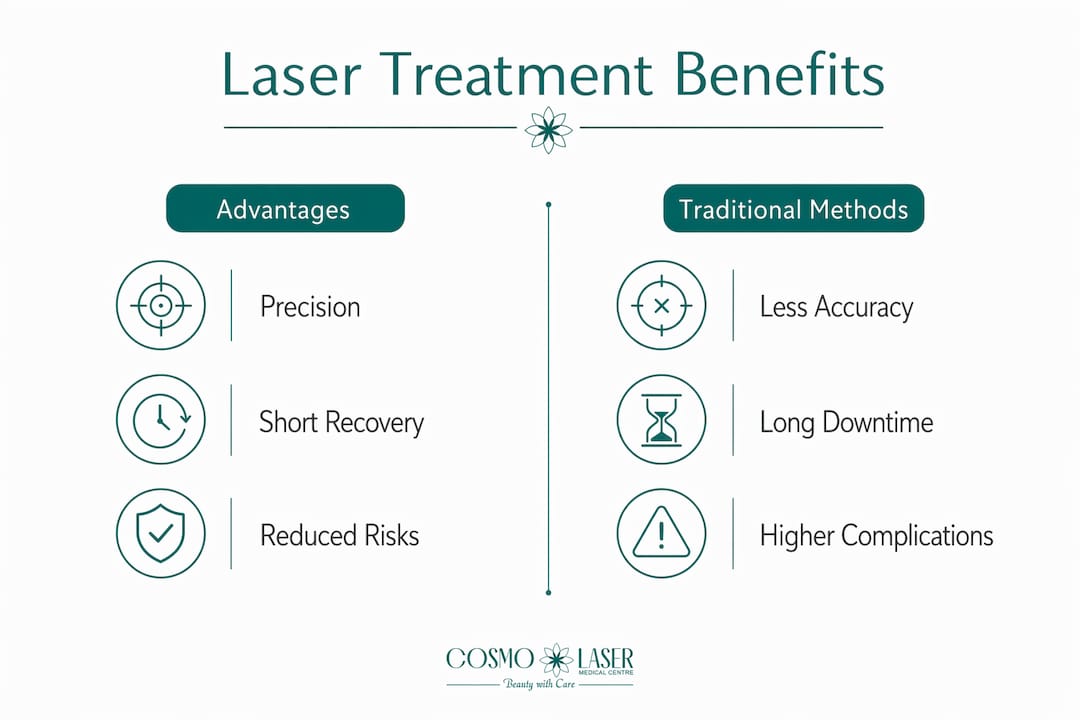
Recovery time is shorter with fractional and non-ablative approaches than with traditional surgical or fully ablative methods. A patient undergoing fractional CO2 resurfacing typically experiences 5–7 days of downtime rather than the weeks associated with older fully ablative procedures. That reduction in recovery time makes laser treatments accessible to patients who cannot take extended time away from work or daily life.
Clinical outcomes are measurable and reproducible. Fractional ablative laser treatments achieve approximately 95% clearance rates for conditions such as Xanthelasma after three sessions spaced two months apart. That figure reflects what a structured, multi-session protocol can achieve when parameters are correctly set.
The versatility of laser technology is another reason clinics invest in it. A single platform can address multiple concerns depending on the wavelength and settings used:
- Fine lines and wrinkles through collagen stimulation
- Acne scarring through fractional resurfacing
- Pigmentation disorders through selective melanin targeting
- Vascular lesions through haemoglobin absorption
- Skin laxity through deep dermal heating
Reduced complications are achievable through parameter optimisation. Phenotype-specific laser selection and conservative parameter use minimise the risk of burns and post-inflammatory hyperpigmentation, particularly in patients with darker skin tones. Clinics that follow this approach consistently report fewer adverse events than those applying generic settings.
Which laser technologies are commonly used in aesthetic clinics?
Different clinical problems require different laser platforms. The choice of device is not arbitrary. It reflects the chromophore being targeted, the depth of treatment required, and the patient’s Fitzpatrick skin type.
Fractional CO2 and erbium ablative lasers
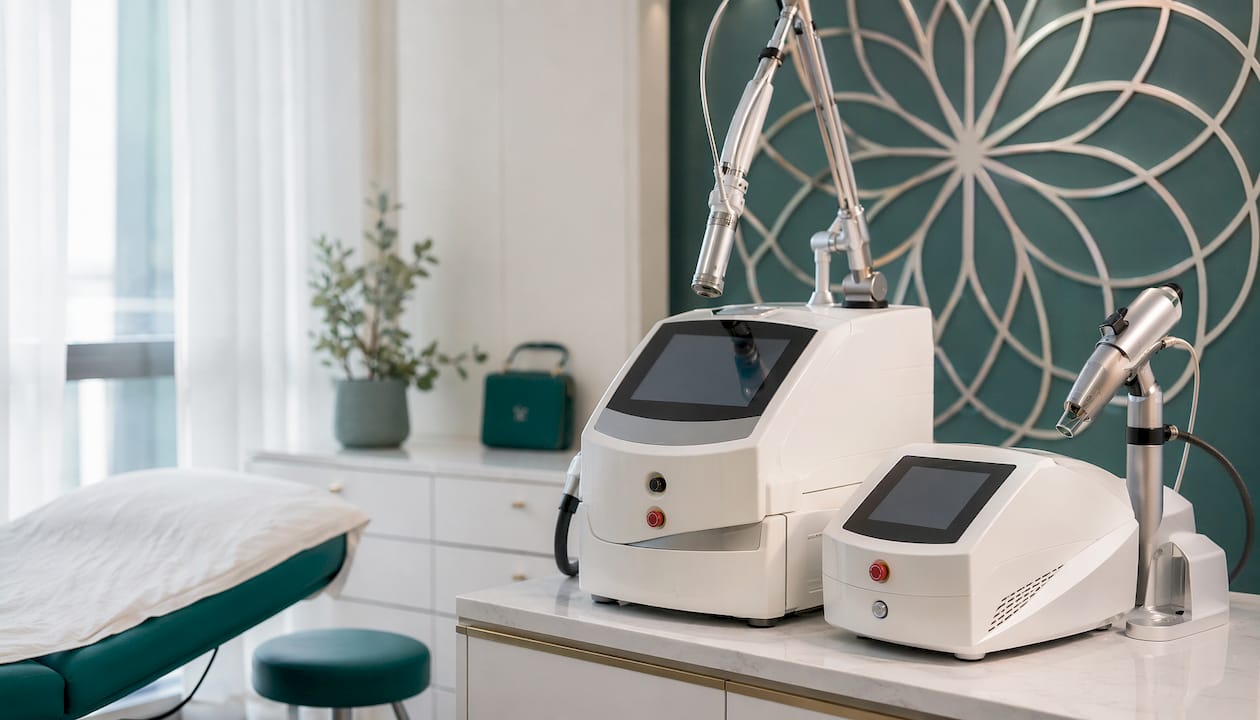
Fractional CO2 lasers operate at 10,600 nm and target water in skin cells. They are the standard choice for skin resurfacing, deep wrinkle reduction, and acne scar treatment. Erbium lasers at 2,940 nm ablate tissue more superficially with less thermal spread, making them preferable for patients who need resurfacing with reduced redness and faster healing. Both platforms stimulate collagen remodelling through controlled thermal injury. Cosmolaser uses CO2 fractional laser technology for skin rejuvenation, applying it with phenotype-specific parameters to suit the diverse skin tones common in the UAE.
Picosecond lasers
Picosecond pulse durations are a thousand times shorter than nanosecond lasers, which means they shatter pigment particles through photoacoustic rather than purely thermal mechanisms. This reduces collateral heat damage significantly. The result is safer treatment for Fitzpatrick skin types III–V, where the risk of post-inflammatory hyperpigmentation is highest. Picosecond platforms are now the preferred choice for pigmentation disorders and tattoo removal in patients with medium to darker skin tones. Cosmolaser offers picosecond laser treatment as part of its pigmentation management programme.
Nd:YAG lasers
The Nd:YAG laser at 1,064 nm penetrates deeply and is absorbed less by melanin than shorter wavelengths. This makes it the safest option for vascular lesions and hair removal in darker skin types. It reaches deeper dermal vessels without triggering melanin absorption at the surface, reducing the risk of epidermal damage.
Yellow diode lasers
The 577-nm yellow diode laser destroys targeted tissue at power settings of 3–5 watts, requiring multiple sessions until full clearance is achieved. Its wavelength matches the absorption peak of haemoglobin closely, making it highly effective for vascular lesions such as spider veins and port-wine stains.
Pro Tip: Fractional technology is considered the gold standard for skin rejuvenation because it balances efficacy with manageable recovery. If a clinic recommends a fully ablative approach for a mild concern, seek a second opinion.
What safety practices ensure successful laser outcomes?
Safe laser treatment begins before the patient enters the treatment room. Laser treatment protocols require skin conditioning and strict photoprotection as preparatory steps. These measures prime the skin to respond well and reduce the likelihood of complications during and after the procedure.
A structured safety approach in a reputable clinic follows this sequence:
- Skin type assessment — Classify the patient using the Fitzpatrick scale to identify risk factors for hyperpigmentation and thermal injury.
- Phenotype-specific parameter selection — Adjust fluence, pulse duration, and spot size to match the patient’s skin tone and condition severity.
- Pretreatment conditioning — Apply topical agents such as retinoids or hydroquinone where clinically indicated to prepare the skin.
- Conservative fluence at first session — Begin at the lower end of the therapeutic range and escalate gradually across subsequent sessions.
- Post-treatment photoprotection — Prescribe broad-spectrum SPF and advise strict sun avoidance to protect the treated area during healing.
- Follow-up and monitoring — Review the patient’s response before each subsequent session and adjust parameters accordingly.
Individualised, indication-driven treatment selection is the clinical standard that separates effective laser programmes from those that produce inconsistent results. Clinics that apply the same settings to every patient regardless of skin type or condition severity produce avoidable adverse events. Expert clinicians treat the patient, not just the condition.
Patients should also understand that effective laser treatments require multiple sessions, with results improving cumulatively. A single session rarely achieves full clearance for conditions like pigmentation or scarring. Setting realistic expectations at the outset is part of responsible clinical practice.
Key takeaways
Aesthetic clinics use lasers because selective photothermolysis delivers tissue-specific results that no conventional method can replicate, provided that device selection, parameter setting, and patient preparation are all matched to the individual.
| Point | Details |
|---|---|
| Selective photothermolysis | Lasers target specific chromophores, sparing surrounding tissue and reducing complication risk. |
| Fractional technology advantage | Fractional lasers create controlled microcolumns of injury, balancing strong results with shorter recovery times. |
| Multi-session protocols | Conditions like pigmentation and scarring require a series of treatments for cumulative, lasting clearance. |
| Phenotype-specific parameters | Adjusting fluence and wavelength to Fitzpatrick skin type is the primary safeguard against post-inflammatory hyperpigmentation. |
| Pre- and post-treatment care | Skin conditioning and photoprotection are clinical requirements, not optional extras, for safe laser outcomes. |
Lasers in practice: what clinical experience actually shows
Patients often arrive expecting a single session to resolve a condition that took years to develop. That expectation is the most common source of disappointment I see in aesthetic practice. Pigmentation, acne scarring, and vascular lesions all respond to laser therapy, but they respond across a series of treatments, not overnight.
What clinical experience has taught me is that the device is rarely the limiting factor. The limiting factor is almost always the protocol surrounding it. A well-calibrated fractional CO2 laser in the hands of a clinician who skips pretreatment conditioning and ignores Fitzpatrick classification will produce worse outcomes than a less powerful device used with rigorous patient assessment and conservative parameter escalation.
The advances in picosecond technology have genuinely changed what is achievable for patients with medium to darker skin tones. Before picosecond platforms became widely available, treating pigmentation in Fitzpatrick type IV or V skin carried a real risk of worsening the very problem the patient came to resolve. That risk has not disappeared, but it is now manageable when the right device and the right protocol are combined.
My honest view is that lasers work best when they are part of a broader skin health plan rather than a standalone intervention. Combining laser and facial treatments with appropriate homecare and sun protection produces results that neither approach achieves alone. Patients who commit to the full protocol consistently see better outcomes than those who treat laser sessions as isolated events.
— Dr Anoop Suresh Babu
Cosmolaser’s laser treatments: what to expect
Cosmolaser, based in Sharjah, offers a range of laser skin treatments delivered by qualified doctors and specialists with extensive experience in aesthetic medicine and dermatology. Every treatment plan begins with a thorough skin assessment to match the right device and parameters to your skin type and concern.
Whether you are addressing pigmentation, acne scarring, vascular lesions, or signs of ageing, Cosmolaser’s clinical team applies phenotype-specific protocols to maximise results and minimise risk. The clinic’s skin rejuvenation programme integrates laser technology with evidence-based aftercare to support lasting improvements. Book a consultation to receive a personalised assessment and a clear treatment plan tailored to your skin.
FAQ
Why do aesthetic clinics prefer lasers over chemical peels?
Lasers target specific chromophores with precision, sparing healthy tissue in a way that chemical peels cannot. This selectivity reduces the risk of uneven results and allows clinicians to treat deeper structures without removing the entire skin surface.
How many laser sessions are typically needed?
Most conditions require multiple sessions, with results building cumulatively across the treatment series. Conditions like Xanthelasma achieve approximately 95% clearance after three sessions spaced two months apart.
Are laser treatments safe for darker skin tones?
Yes, when the correct device and parameters are used. Phenotype-specific laser selection and conservative fluence settings minimise the risk of post-inflammatory hyperpigmentation in Fitzpatrick skin types III–V.
What is the recovery time after a laser treatment?
Recovery depends on the type of laser used. Fractional ablative treatments typically involve 5–7 days of downtime, while non-ablative and picosecond treatments carry minimal recovery time for most patients.
What preparation is required before a laser session?
Clinicians typically prescribe skin conditioning agents and strict photoprotection in the weeks before treatment. These preparatory steps are clinically required to optimise outcomes and reduce complication rates.