Laser wrinkle treatment is defined as a medical procedure that uses concentrated light energy to stimulate collagen production and resurface damaged skin, producing measurable reductions in wrinkle depth and skin laxity. Understanding how laser reduces wrinkles explained in clinical terms means grasping one core fact: the laser does not simply erase wrinkles. It triggers the skin’s own repair system. Controlled thermal injury activates dermal fibroblasts, the cells responsible for building collagen and elastin. The result is firmer, smoother skin that improves progressively over months. Cosmolaser’s clinical team in Sharjah applies this science daily, tailoring wavelength and energy settings to each patient’s skin type and wrinkle severity.
What are ablative and non-ablative lasers, and how do they differ?
Laser treatments fall into two categories: ablative and non-ablative, with fractional technology sitting between them as a clinically significant middle ground.
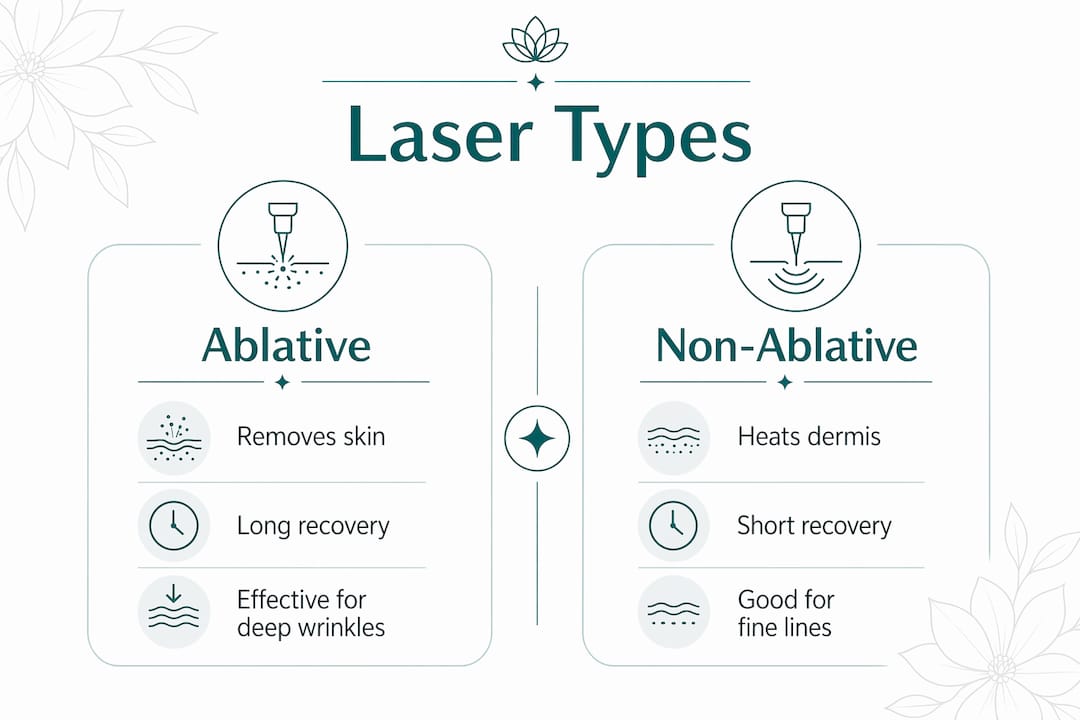
Ablative lasers remove the outer layers of skin entirely. The CO2 laser, operating at a wavelength of 10,600nm, vaporises tissue and creates a controlled wound. That wound triggers an aggressive healing response, producing substantial new collagen. The trade-off is meaningful downtime, typically one to two weeks of visible recovery, and a higher risk of pigment changes if aftercare is not followed strictly.

Non-ablative lasers heat the dermis without removing the surface. The skin stays intact, which means far less recovery time. The 1550-nm non-ablative fractional laser is a well-studied example. Results are real but more gradual than ablative options, and multiple sessions are usually required to achieve comparable improvement.
Fractional lasers treat thousands of microscopic columns of skin while leaving surrounding tissue untouched. Fractional delivery accelerates recovery compared with full-field resurfacing because intact skin bridges heal the treated zones faster. This approach is now the most widely used in clinical practice for wrinkle reduction because it balances efficacy with a manageable recovery period.
| Laser type | Mechanism | Recovery time | Best suited for |
|---|---|---|---|
| Ablative (CO2) | Removes outer skin layers | 1–2 weeks | Deep wrinkles, significant laxity |
| Non-ablative | Heats dermis, surface intact | 1–3 days | Fine lines, minimal downtime needed |
| Fractional | Micro-columns, intact bridges | 3–7 days | Moderate wrinkles, balanced results |
Pro Tip: Ask your practitioner whether fractional or full-field delivery is planned. The distinction affects both your recovery schedule and the depth of wrinkle correction you can realistically expect.
How does laser therapy stimulate collagen and remodel skin?
Laser energy targets chromophores such as water molecules within skin tissue, converting light into heat at a precise depth. That heat creates a controlled thermal injury. The injury is the point, not a side effect.
The body responds to thermal injury by sending fibroblasts to the damaged zone. Fibroblasts are the skin’s construction workers. They synthesise type I and type III collagen, the structural proteins that give skin its firmness, along with elastin, which provides recoil and bounce. CO2 lasers stimulate type I and III collagen through this exact mechanism, producing measurable tissue remodelling.
The timeline of improvement has two distinct phases:
- Surface healing: The outer skin repairs within 10–14 days. Redness fades, new epithelium forms, and the treated area looks presentable.
- Deep collagen maturation: The real structural change happens beneath the surface. Collagen remodelling continues for 6–12 months after the initial session, gradually firming and smoothing the skin.
This phased timeline is the reason patients are advised not to judge final results at the two-week mark. The skin visible at two weeks is healed, but not yet remodelled. The practitioner’s skill in calibrating energy delivery determines how deep the thermal injury reaches and how effectively fibroblast activation occurs. Underpowered settings produce weak collagen stimulus. Overpowered settings risk scarring or pigment loss. The margin between the two is where clinical expertise matters most.
What should patients expect from laser wrinkle reduction?
Laser treatment is not a one-session fix. Most patients require a planned series of sessions, with the number depending on wrinkle depth, skin type, and the laser modality chosen. Setting realistic expectations before the first session prevents disappointment and improves adherence to the full treatment plan.
During the procedure, patients typically feel heat and a sensation similar to a rubber band snapping against the skin. Ablative treatments produce more intense sensations, often described as burning rather than warmth. Comfort protocols, including topical anaesthetic creams and cooling devices, are standard practice and make the experience manageable for most patients.
Aftercare is where many patients underestimate the commitment involved. Ablative CO2 laser requires strict aftercare to avoid pigment changes and prolonged recovery. The following steps are non-negotiable after any ablative or fractional session:
- Avoid direct sun exposure for a minimum of four weeks and apply broad-spectrum SPF daily.
- Keep the skin well moisturised using a fragrance-free, gentle emollient.
- Cleanse with a mild, non-foaming cleanser twice daily to prevent infection.
- Avoid active skincare ingredients such as retinoids and acids until the practitioner confirms the skin has fully healed.
- Attend all scheduled follow-up appointments so the practitioner can monitor healing and adjust the next session’s settings.
Proper post-treatment skincare is not optional. Patients who skip sun protection after ablative treatment risk post-inflammatory hyperpigmentation, a darkening of the treated skin that can take months to resolve.
Pro Tip: Schedule your first laser session in autumn or winter when UV exposure is naturally lower. This makes sun avoidance far easier during the critical healing window.
How effective is laser treatment across different wrinkle types and skin tones?
Clinical evidence for laser skin rejuvenation is strong, particularly for fine lines and moderate wrinkles. A 2026 multicentre clinical review of a 1550-nm non-ablative laser showed wrinkle scores on the Fitzpatrick Wrinkle and Elastosis Scale reducing from 4.48 to 3.36. That reduction is statistically significant at p < .001, meaning the improvement is not attributable to chance. The study population was 84.8% women, reflecting the demographic most likely to seek this treatment.
Fine lines respond faster and more completely than deeply etched wrinkles. A fine line sits in the superficial dermis and responds well to non-ablative or fractional treatment within two to three sessions. A deep furrow, such as a nasolabial fold carved by decades of facial movement, requires ablative energy and realistic expectations: improvement, not erasure.
Skin tone is a critical variable in laser selection. Patients with lighter skin phototypes (Fitzpatrick I–III) tolerate ablative CO2 treatment with lower pigment risk. Darker skin tones carry a higher risk of post-inflammatory hyperpigmentation and hypopigmentation with aggressive ablative settings. Fractional delivery reduces but does not eliminate this risk.
| Skin phototype | Recommended approach | Pigment risk | Expected sessions |
|---|---|---|---|
| Fitzpatrick I–III | Ablative or fractional CO2 | Low to moderate | 1–3 |
| Fitzpatrick IV | Fractional non-ablative | Moderate | 3–5 |
| Fitzpatrick V–VI | Non-ablative, conservative settings | Higher | 4–6+ |
Laser skin tightening also aids firming by heating the dermis, but severe sagging often requires surgical support rather than laser alone. Knowing this boundary helps patients choose the right treatment category from the outset.
Key takeaways
Laser wrinkle reduction works by triggering controlled thermal injury that activates fibroblasts to produce new collagen, with visible surface healing in 10–14 days and deeper structural improvement continuing for 6–12 months.
| Point | Details |
|---|---|
| Two main laser categories | Ablative lasers remove skin layers; non-ablative lasers heat the dermis without surface removal. |
| Fractional technology | Fractional delivery treats micro-columns of skin, balancing efficacy with faster recovery than full-field resurfacing. |
| Collagen timeline | Surface healing takes 10–14 days, but collagen remodelling shapes final results over 6–12 months. |
| Aftercare is non-negotiable | Sun avoidance, moisturisation, and gentle cleansing prevent pigment changes and prolonged recovery. |
| Skin tone affects laser choice | Darker skin phototypes require conservative, non-ablative settings to minimise pigment irregularity risk. |
What I’ve learnt from watching patients navigate laser treatment
The single biggest misconception I encounter is that laser is a one-appointment solution. Patients arrive expecting to look ten years younger within a fortnight. The science simply does not work that way. Collagen remodelling is a biological process measured in months, not days. When patients understand this upfront, they commit to the full treatment plan and their results are consistently better.
The second thing I have observed is that aftercare discipline separates good outcomes from great ones. I have seen patients with textbook laser sessions produce mediocre results because they returned to sun exposure too early or used harsh actives before the skin was ready. Conversely, patients who follow recovery protocols diligently often exceed the average improvement seen in clinical trials.
Practitioner skill is the variable that rarely gets discussed openly. Wavelength selection, pulse duration, and energy density are not one-size-fits-all decisions. A practitioner who treats a Fitzpatrick V skin type with the same settings used for Fitzpatrick II is not practising safely. The clinical knowledge behind those settings is what patients are really paying for, not just the machine.
My honest view is that laser is one of the most effective non-surgical wrinkle reduction techniques available, but only when it is matched correctly to the patient. The technology is a tool. The outcome depends on the person wielding it and the patient maintaining the results.
— Anoop
Cosmolaser’s laser wrinkle treatments in Sharjah
Cosmolaser offers a range of laser wrinkle treatments designed around each patient’s skin type, wrinkle depth, and recovery availability. The clinical team assesses phototype, wrinkle severity, and lifestyle before recommending a protocol, whether that is a fractional non-ablative course or a more intensive ablative session.
The CO2 fractional laser service at Cosmolaser is the clinic’s primary option for moderate to significant wrinkle reduction, combining the collagen-stimulating power of ablative CO2 energy with fractional delivery to reduce downtime. For patients seeking complementary treatments alongside laser, options such as collagen biostimulators and skin tightening are available as part of a personalised plan. Book a consultation at Cosmolaser to receive a clinical assessment and a treatment plan built around your skin.
FAQ
How does laser reduce wrinkles at a cellular level?
Laser energy creates controlled thermal injury in the dermis, activating fibroblasts to produce new type I and III collagen and elastin. This structural rebuilding firms and smooths the skin over 6–12 months.
How many sessions does laser wrinkle treatment require?
Most patients need between one and six sessions depending on wrinkle depth, skin type, and the laser modality used. Non-ablative fractional treatments typically require more sessions than ablative CO2 procedures.
Is laser wrinkle treatment safe for darker skin tones?
Laser treatment is safe for darker skin tones when the correct modality and settings are chosen. Non-ablative fractional lasers with conservative energy settings carry a lower pigment risk for Fitzpatrick IV–VI skin types.
What does laser treatment feel like during the procedure?
Ablative treatments produce a heat or burning sensation, while non-ablative options feel milder. Topical anaesthetic creams and cooling devices are used routinely to keep the procedure comfortable.
How long do laser wrinkle treatment results last?
Results from ablative CO2 laser can last several years, but ongoing sun protection and skin maintenance are required to preserve them. The skin continues to age naturally, so periodic maintenance sessions extend the benefit.
One Response