
TL;DR:
- Proper post-treatment skincare is essential for optimal healing, dramatic results, and complication prevention. Follow clinician-recommended routines tailored to your procedure, skin type, and environment, especially under UAE’s intense sun. Expert guidance ensures faster recovery, better outcomes, and minimizes risks like hyperpigmentation and infections.
You walked out of your aesthetic appointment feeling excited, maybe a little red and swollen, but ready for the transformation to reveal itself. Here is the part nobody tells you clearly enough: the procedure itself is only half the equation. What you do in the 48 to 72 hours after your treatment, and in the weeks that follow, determines how fully you recover, how dramatically your results show, and whether you experience complications. Post-treatment skincare is critical because your skin barrier is at its most vulnerable right after any cosmetic procedure, and the right routine is what bridges the gap between “good” and “remarkable” results.
Table of Contents
- Why post-treatment skincare matters for your skin’s recovery
- What science says: How evidence-based aftercare accelerates healing
- Comparing aftercare: Do’s and don’ts for different procedures
- Tailoring your aftercare: UAE climate and skin type considerations
- What most people get wrong about post-treatment care
- How expert-led aftercare at Cosmolaser empowers your results
- Frequently asked questions
Key Takeaways
| Point | Details |
|---|---|
| Skin needs protection | Your skin’s barrier is especially vulnerable post-procedure and requires gentle, protective care for optimal healing. |
| Aftercare speeds results | Evidence-based skincare after your treatment can cut downtime and visibly enhance your results. |
| Personalization is vital | Always follow your provider’s specific instructions—never rely solely on generalized online routines. |
| Sun safety is essential | In the UAE, robust sun protection is non-negotiable for safe and successful recovery. |
Why post-treatment skincare matters for your skin’s recovery
Now that we’ve set the stage, it’s important to understand exactly how overlooked aftercare can impact your outcomes.
Every aesthetic procedure, whether it’s a laser session, a chemical peel, microneedling, or dermal filler, creates some level of controlled stress on the skin. That stress is intentional. It’s how treatments stimulate collagen, accelerate cell turnover, and resurface damaged tissue. But the flip side is that your skin’s natural defense system, the protective outer layer called the stratum corneum, is temporarily disrupted in the process.
When that barrier is compromised, your skin loses moisture faster, absorbs irritants and bacteria more readily, and becomes hypersensitive to external triggers like sunlight, sweat, and even certain fabrics. Think of your skin post-procedure like a fresh wound, it’s in active repair mode and requires the right environment to heal correctly.
“Post-treatment skincare is critical because immediately after aesthetic procedures the skin barrier is more vulnerable, and the correct routine supports healing while reducing risks that can compromise results.”
The risks of ignoring proper aftercare aren’t minor. They include:
- Infection: Open micro-channels in the skin can allow bacteria to enter, especially if you touch your face with unwashed hands or use non-sterile products.
- Post-inflammatory hyperpigmentation (PIH): Especially common in Fitzpatrick skin types III through V, this occurs when the healing skin is exposed to UV rays or friction too early.
- Prolonged redness and swelling: Using the wrong products or skipping calming, barrier-supporting ingredients can extend recovery time significantly.
- Compromised results: If your skin doesn’t heal optimally, you may see uneven texture, reduced collagen remodeling, or patchiness where results should be uniform.
Simple protective strategies make a real difference. Gentle cleansers, medical-grade moisturizers, and broad-spectrum SPF applied from day one are the non-negotiables every clinician will recommend. Our recovery guide for post-treatment skincare walks through this in full detail, but the foundation always starts with respecting what your skin just went through.
What science says: How evidence-based aftercare accelerates healing
Having seen why the skin needs extra attention after procedures, let’s see how the right routine can truly change your recovery trajectory.
The aesthetics world is full of marketing claims, but what does clinical research actually show? The short answer is that specific post-procedure topicals measurably improve healing, with measurable differences in hydration levels, redness reduction, crusting, scaling, and how fast erythema (visible redness) resolves. These aren’t subjective impressions. They are blinded evaluator studies with standardized skin measurements.
Here’s what the research tells us about key healing parameters and how the right aftercare performs:
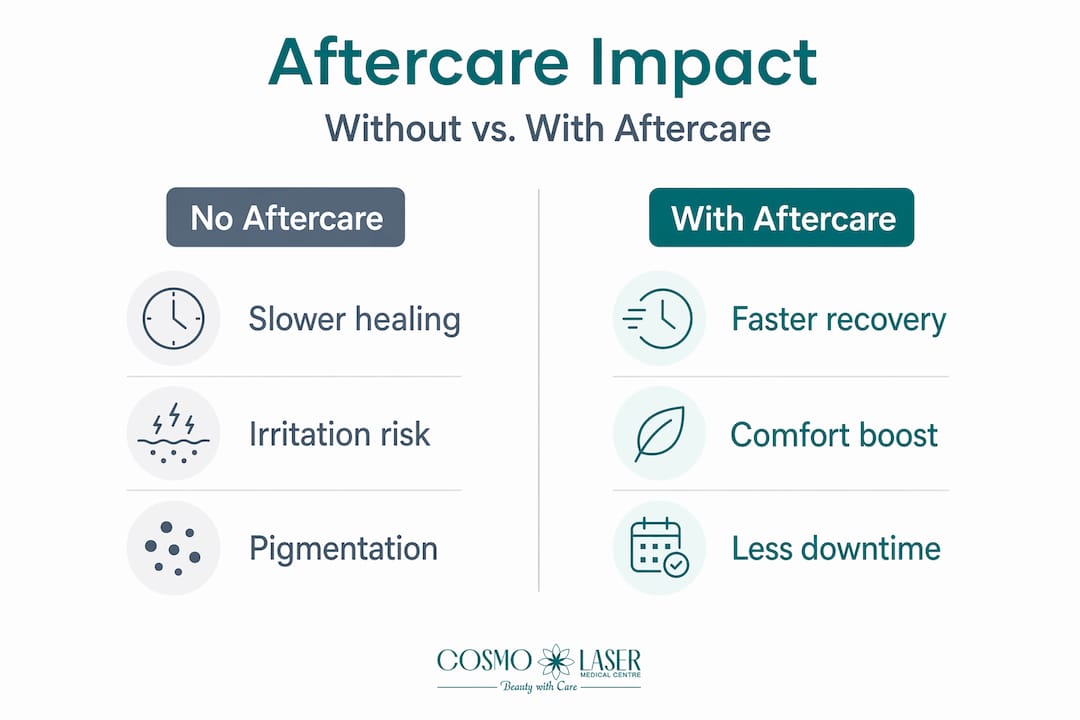
| Healing parameter | Without proper aftercare | With evidence-based aftercare |
|---|---|---|
| Skin hydration | Drops significantly in days 1 to 3 | Maintained with barrier creams |
| Erythema resolution | May persist 7 to 14 days | Reduced to 4 to 7 days in studies |
| Crusting and scaling | Frequent, can lead to scarring | Minimized with correct occlusive agents |
| Hyperpigmentation risk | Elevated, especially in darker skin | Lowered with SPF and calming ingredients |
| Overall texture outcome | Uneven in some patients | More uniform with guided aftercare |
One randomized, evaluator-blinded study showed that adjunct topicals used after laser treatments produced statistically better results in skin appearance compared to minimal aftercare. The takeaway is practical: aftercare is not optional for getting the most from your investment. It’s part of the treatment plan itself.
When we look at skincare after laser treatments, the data consistently points toward the same principles. Use gentle, hydrating products. Protect from UV exposure. Avoid anything that disrupts the skin’s pH or removes the new epidermis before it’s ready. For patients who have had chemical peels, the science behind chemical peel aftercare follows the same logic but with some specific adaptations depending on peel depth.
What this research proves is that faster recovery isn’t just about comfort. It means fewer days of social downtime, a lower likelihood of visible complications, and results that genuinely reflect the quality of the procedure you invested in.
Comparing aftercare: Do’s and don’ts for different procedures
With research-backed proof in mind, let’s get specific. What should you actually do after various cosmetic treatments?
The critical mistake many patients make is treating all procedures the same. A HydraFacial and a fractional CO2 laser session are completely different in terms of skin trauma, and their aftercare requirements reflect that. Provider-specific aftercare instructions are not suggestions. They’re clinical guidance shaped by the specific depth of treatment, your individual skin type, and the products your provider knows are safe at each stage.
Here is a side-by-side breakdown of recommended dos and don’ts:
| Procedure | Do | Don’t |
|---|---|---|
| Chemical peel | Use gentle cleanser, apply barrier cream, wear SPF 50+ | Exfoliate, pick peeling skin, use acids or retinoids |
| Laser resurfacing | Keep skin moist with prescribed ointment, stay out of sun | Use makeup, touch face with hands, exercise intensely |
| Botox/fillers | Stay upright for 4 hours, apply ice if needed, avoid pressure on area | Massage treated area, use saunas, take blood thinners |
| HydraFacial | Apply lightweight SPF, continue gentle hydration | Use heavy occlusive products immediately, book another resurfacing treatment |
| Microneedling | Use peptide-based serums, keep skin cool, apply SPF | Use vitamin C or retinol, swim, sweat excessively |
Follow these numbered steps to set yourself up for a smooth recovery regardless of which procedure you had:
- Ask your provider for a written aftercare plan before you leave the clinic. Don’t rely on memory when your skin is flushed and your mind is on results.
- Stock your bathroom in advance with the products your clinician recommends, so you’re not improvising on day one.
- Schedule a follow-up appointment within the first week if your treatment involves significant downtime, such as deep peels or laser resurfacing.
- Document your skin daily with photos in consistent lighting, so you can spot any unusual reactions early.
- Avoid social events that require heavy makeup for at least 48 to 72 hours post-treatment where possible.
Pro Tip: Never reintroduce active ingredients like retinoids, glycolic acid, or vitamin C serums without explicit clearance from your provider. These powerful ingredients are excellent during regular skincare routines but can strip the new skin or trigger inflammation when used too early in recovery.
For more specific guidance, our chemical peel aftercare tips, HydraFacial aftercare, and laser skin resurfacing guide each address the nuances of individual procedures in depth.
Tailoring your aftercare: UAE climate and skin type considerations
Procedures and routines are important, but so is local context. Here’s how to adapt your recovery for the UAE’s unique environment.
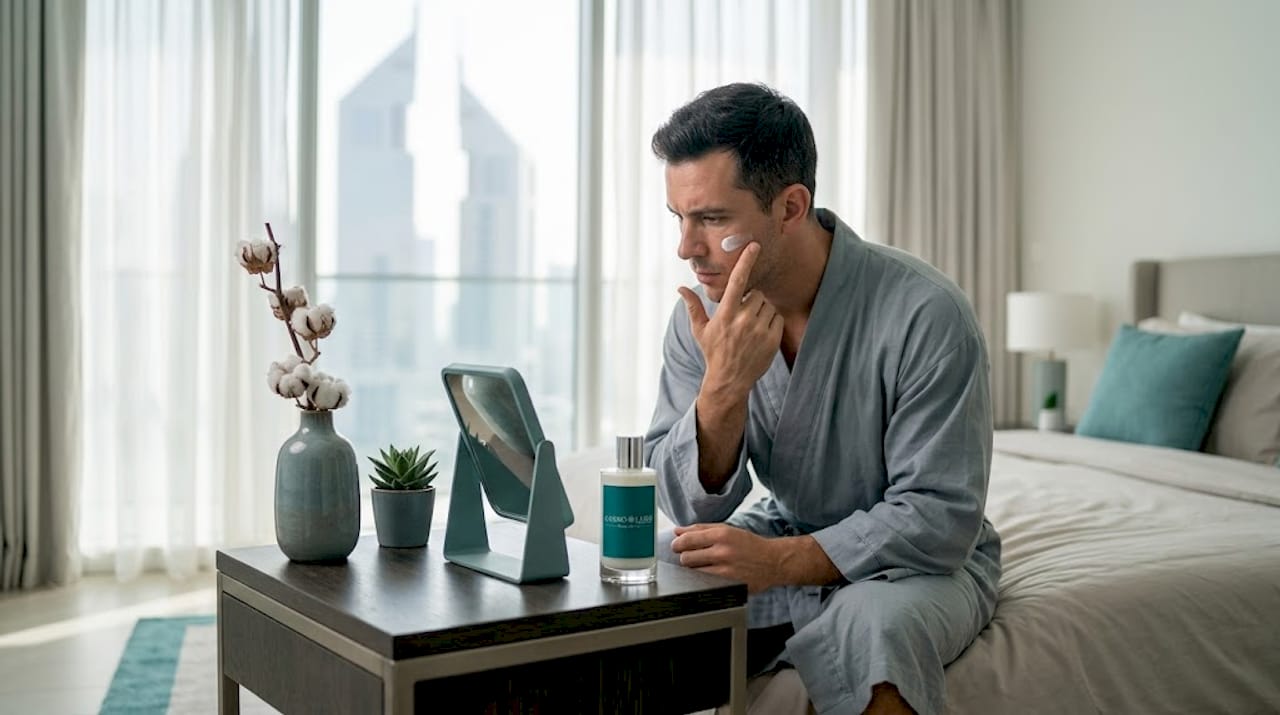
Living in the UAE presents a very specific set of aftercare challenges. The sun intensity here is extreme, with UV index values regularly reaching 10 or above, even in mild months. After any cosmetic procedure, sun exposure risks escalate sharply because the skin’s ability to defend against UV damage is temporarily reduced. Skipping SPF in the UAE after a treatment isn’t just careless, it’s genuinely dangerous for your results.
Here’s what UAE residents specifically need to factor into their aftercare:
- SPF 50+ is the baseline, not the ceiling. Look for broad-spectrum mineral sunscreens with zinc oxide or titanium dioxide, which are gentler on treated skin than chemical filters.
- Reapply sunscreen every two hours if you’re going outdoors, even for short trips in the car. UVA rays penetrate glass, and Sharjah’s roads mean significant windshield exposure.
- Humidity and air conditioning are a double-edged sword. Indoor AC dries the skin aggressively while outdoor heat can trigger sweating that irritates healing skin. Use a lightweight, fragrance-free moisturizer throughout the day.
- Timing your procedure strategically matters. If possible, schedule more intensive treatments during cooler months, between November and February, to reduce environmental stress during healing.
Skin type plays an equally important role. Many patients in the UAE have Fitzpatrick skin types III, IV, and V. These skin types carry a higher risk of post-inflammatory hyperpigmentation (PIH), a darkening of the skin triggered by inflammation during healing. This isn’t a reason to avoid procedures but a reason to be even more disciplined about aftercare, especially sun avoidance and calming ingredients like niacinamide and centella asiatica.
Pro Tip: If you’re prone to hyperpigmentation, talk to your provider about incorporating a low-dose brightening agent like tranexamic acid or azelaic acid into your routine a few weeks before your procedure. This can prime the skin and reduce PIH risk during recovery.
Our detailed resource on preventing post-treatment pigmentation is particularly useful for patients with deeper skin tones navigating their aftercare in the Gulf region.
What most people get wrong about post-treatment care
Here’s the uncomfortable truth that most skincare content won’t tell you: following a generic aftercare checklist from the internet can actually set your recovery back.
We’ve seen it repeatedly in clinical practice. A patient undergoes a well-executed treatment and then spends their recovery period following a popular blog’s “universal post-procedure routine.” They layer on several “natural” or “healing” oils, resume their actives after five days because a video said so, and end up with prolonged redness or a breakout that delays their results by weeks.
The problem isn’t that the information is always wrong. Some of it is genuinely well-intentioned and partly accurate. The problem is that it’s not calibrated to your procedure, your skin type, the depth of treatment you received, or the products your clinician actually knows are compatible with your skin’s current state.
There’s also a dangerous tendency to think that if a product is labeled “gentle” or “natural,” it’s automatically safe post-procedure. Certain essential oils, for example, are potent irritants on compromised skin. Even fragrance-free products can contain ingredients that disrupt healing if they’re not formulated for post-procedural use.
Our complete recovery guide takes a different approach: it emphasizes clinician-led protocols over generalized advice. The real secret isn’t finding the perfect product. It’s having a provider who knows your skin, communicates clearly about what to expect, and adjusts your aftercare plan if something isn’t responding the way it should. Your recovery is an active process that requires real-time guidance, not a static checklist you found at midnight before your appointment.
How expert-led aftercare at Cosmolaser empowers your results
That brings us full circle. All of this information is most powerful when it’s paired with expert guidance from the moment you walk into a clinic to weeks after your treatment ends.
At CosmoLaser Medical Center in Sharjah, aftercare isn’t a pamphlet handed to you at the door. It’s a clinician-led, individualized plan built around the specific treatment you’ve had, your skin type, and the UAE climate you’re returning to. Whether you’re recovering from Botox treatments in Sharjah, professional chemical peels, or advanced skin resurfacing expertise, the team at CosmoLaser walks with you through every stage of recovery.
Our specialists don’t just perform procedures. They’re invested in the outcome. That means proactive communication, tailored product recommendations, and follow-up care that ensures your skin heals the way it should. If you’re ready to experience aesthetic results that are backed by real clinical expertise, including the aftercare that actually makes those results last, contact CosmoLaser Medical Center to schedule your consultation today.
Frequently asked questions
When can I start using my active skincare products after a cosmetic procedure?
You should only resume actives like retinoids or acids when your provider specifically clears you, as using them too soon can cause irritation, delayed healing, or even scarring.
Is post-treatment sun exposure safe if I wear sunscreen?
Wearing sunscreen helps, but your skin’s vulnerability immediately after treatment means even filtered UV exposure can trigger hyperpigmentation, so minimizing direct sun contact in early recovery is the smarter approach.
Do all post-procedure topicals really improve healing?
Not all products are equal. Certain regenerative topicals show measurable improvements in healing parameters in clinical studies, but only your doctor can recommend the products that are right for your specific treatment and skin type.
How do I prevent pigmentation after my procedure in the UAE climate?
Consistent SPF use and a personalized routine built around your skin type are essential, and because the safest implementation is procedural-by-procedural, your provider’s specific aftercare instructions should always be your primary guide.
2 Responses